




On February 4th, the XRP Ledger network resumed operations after an outage lasting over an hour, confirmed Ripple’s CTO David Schwartz.
The network is now recovering. We don’t know exactly what caused the issue yet.
Super-preliminary observation: It looked like consensus was running but validations were not being published, causing the network to drift apart. Validator operators manually intervened to choose a…
— David “JoelKatz” Schwartz (@JoelKatz) February 4, 2025
Activity halted at block 93,927,174. The blockchain restarted after 64 minutes.
“It seemed like consensus was functioning, but validations were not being published. This led to the network drifting apart,” explained Schwartz.
Validator operators had to manually intervene to “choose a sensible starting point” to achieve sufficient consensus and coordinated ledger flow, he added.
“As far as I can tell, very few UNL operators made any changes. The network may have spontaneously recovered. Not sure yet,” noted Schwartz.
According to him, all conclusions are “very preliminary,” and developers continue to investigate.
Ripple emphasized that the incident did not affect the security of users’ funds.
CEO of the XRPL division, Daniel Keller, noted at the beginning of the outage that all “35 nodes continue to propose.” The quorum threshold is 80% — 28 nodes.
They are still on it. The quorum is still 28, all 35 nodes are proposing.
— Daniel “CEO of the XRPL” Keller (@daniel_wwf) February 4, 2025
Users in the comments highlighted a persistent critique of Ripple’s blockchain within the community — centralization. For instance, Ethereum’s operation is supported by over 1 million validators.
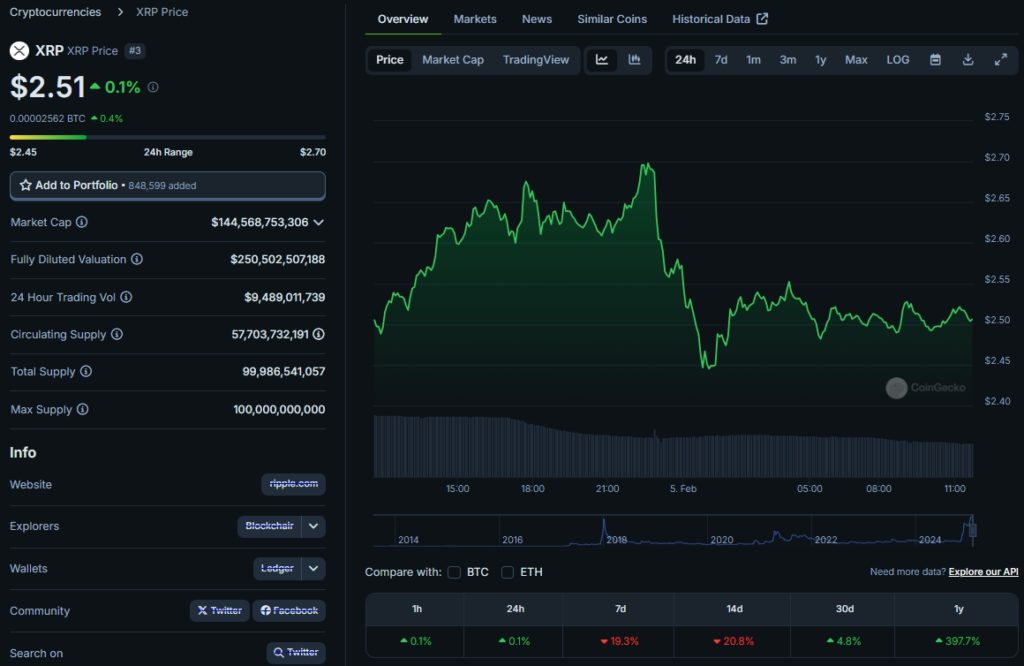
Following the network halt, the price of XRP fell to $2.45. Subsequently, the quotes recovered to around $2.50. As a result, the coin’s rate remained virtually unchanged over the past day.


Back in January, Morgan Creek CEO Mark Yusko noted discussions regarding the potential inclusion of XRP in the U.S. national reserve alongside Bitcoin.
Bloomberg exchange analyst James Seyffart suggested that spot ETFs based on Ripple’s token might appear by the end of 2025.