



Scientists devise tool to expose deepfakes
Researchers at the University of Buffalo have developed an AI-based tool capable of identifying a deepfake photograph by the reflection of light in the cornea. The researchers achieved 94% accuracy, The Next Web writes, citing the results of the study.
They found that in real photographs of people, reflections in the corneas are typically identical. But deepfake images, synthesized using [simple_tooltip content=’Generative Adversarial Network – a machine-learning method consisting of two neural networks: a generator that creates content, and a discriminator that evaluates it. It is often used to create convincing images, videos and audio recordings’]GAN[/simple_tooltip], often fail to convey this similarity.
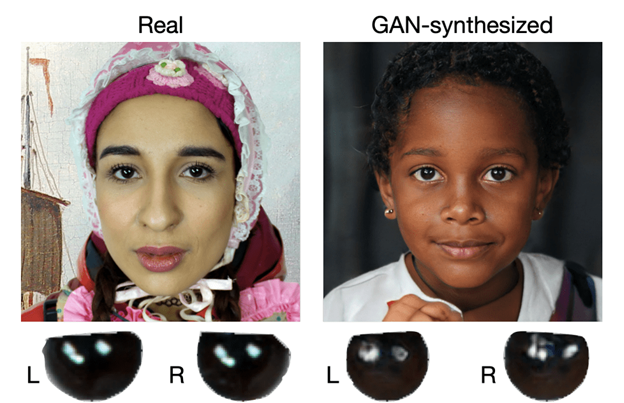
Difference in light reflections in the cornea of a real versus a generated photograph. Data: a study by the University at Buffalo researchers.
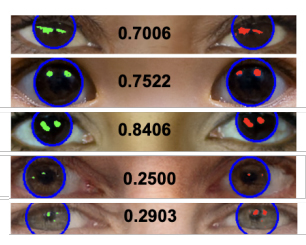
Assessment of the similarity of reflections in each eye. Data: a study by researchers at the University at Buffalo.
The system proved effective at detecting fake photographs drawn from This Person Does Not Exist — a repository of images created using the StyleGAN2 architecture. However, the authors acknowledge that it has several limitations.
The forgery-detection algorithm relies on light reflected by both eyes. This discrepancy can be corrected through manual post-processing of the photograph, and the method will not work if one eye is not visible in the image.
Researchers also noted that their algorithm is effective only for portrait photographs. If the face in the image is not looking at the camera, the system is likely to produce false positives.
The researchers plan to study these issues to improve the method’s effectiveness.
Earlier in the United States, arrested a woman for distributing a deepfake video of teenage girls. In doing so, she sought to undermine her daughter’s cheerleading rivals in the group.
In December last year, the British channel Channel 4 released a deepfake of Queen Elizabeth II as an alternative Christmas greeting.
Subscribe to ForkLog’s Telegram news: ForkLog Feed — the full news feed, ForkLog — the most important news and polls.
Рассылки ForkLog: держите руку на пульсе биткоин-индустрии!