



The U.S. Securities and Exchange Commission (SEC) requested the court to reduce LBRY’s civil penalty from $22 million to $111,614 in the case it had previously won.
accused a decentralized content-publishing platform of selling unregistered securities in the form of the LBRY Credits (LBC) token.
In November 2022, New Hampshire district judge Paul Barbadoro granted the SEC’s suit against the blockchain startup.
In a May 12 filing, the Commission clarified the final demands for legal sanctions. The regulator acknowledged that the project would not be able to pay the initially requested $22 million as a fine due to “a lack of funds” and “a status close to winding down.”
The agency reiterated its request for a court injunction preventing the startup from conducting “future unregistered securities offerings.”
“The Commission takes into account LBRY’s statements about ceasing operations and the lack of funds to pay a larger fine, and also acknowledges that the defendant’s solvency is a factor in imposing sanctions,” said the SEC lawyers.
They noted that the startup, despite promises, took no steps to halt further LBC sales.
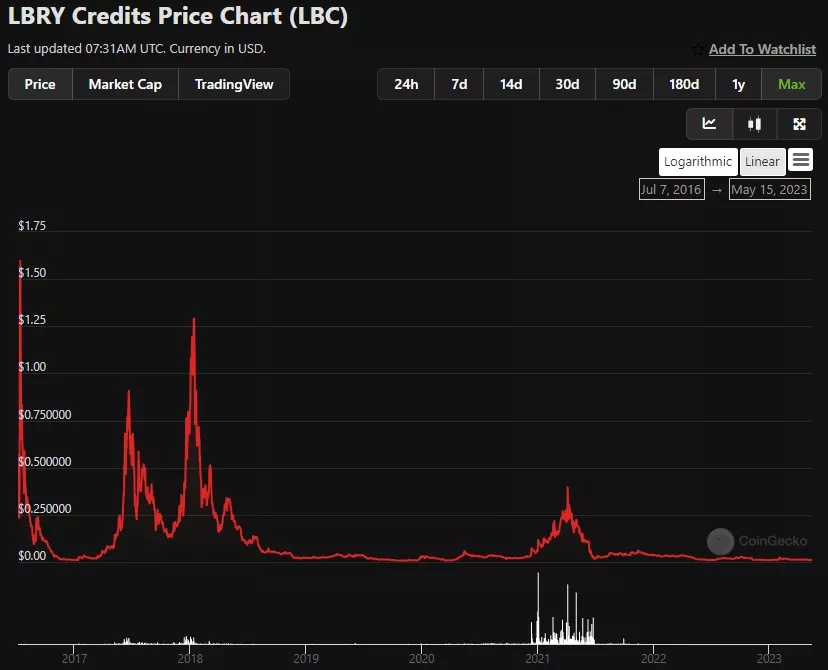
As of writing, the token was trading near $0.01. It is more than 99% below its July 2016 high of $1.60.


Attorney James Filan drew Ripple’s community’s attention to the outcome of the SEC case against LBRY. In December 2020, accused the California fintech startup of selling unregistered securities in the form of XRP tokens. Lawyer Bill Morgan commented on a colleague’s tweet:
“Millions of dollars have been spent to obtain a fine of $111,614 and to financially ruin the company. That helps the world.”
Millions of dollars spent for a fine of $111,614.00 and a company financially ruined. That helps the world. https://t.co/GhvCS0Az7s
— bill morgan (@Belisarius2020) May 12, 2023
Earlier, Ripple CEO Brad Garlinghouse estimated the legal costs of the firm related to the ongoing SEC case at $200 million.