




Key points
- Shorts and longs are short and long positions (sell and buy) in trading. They are used chiefly in margin trading, that is, trading with leverage.
- Most crypto assets are highly volatile. Using shorts and longs lets traders profit from price swings.
- When trading long and short, consider hedging—measures designed to protect against the market moving against your open positions.
Origins of shorts and longs
In medieval Europe, tally sticks made of hazel were used to record debts. The sum put into circulation was marked with notches on one face of the stick. The stick was then split lengthwise along the notches, but not completely, leaving a “handle”. The result was a long part with a handle (stock) and a short part (foil) that completed the stick. The notches appeared on both halves; matching them verified authenticity. The grain of hazel was thought to make forgery impossible. Each party to a transaction held one half. This practice is presumed to have given rise to the terms “stock market”, as well as “long” and “short”.
The expressions “short” and “long” positions spread on American stock and commodity exchanges in the 1850s. Perhaps the earliest mention of short and long positions appears in The Merchant’s Magazine, and Commercial Review, Vol. XXVI, January–June 1852.
Names aside, a short position can last a long time (a week, a month), and a long can be brief. From traditional finance the terms migrated into the bitcoin industry.
Who are the “bulls” and “bears”
Market participants are colloquially called bulls or bears, depending on their stance. Those betting on rising prices (opening longs) are “bulls”; those placing short positions, that is, betting on a decline, are “bears”.



The labels are approximate: there are no pure bulls or bears in crypto. The same trader may run both shorts and longs at once, though position sizes can differ.
What is a long
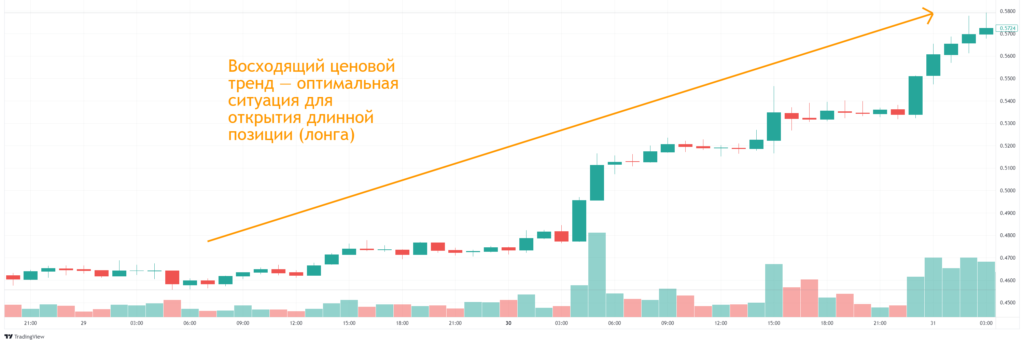
A long (long position) is the purchase of an asset in expectation of a price increase. Profit depends on how much the asset rises. Long positions are the most popular trade among retail investors and are used on the spot market.


What is a short
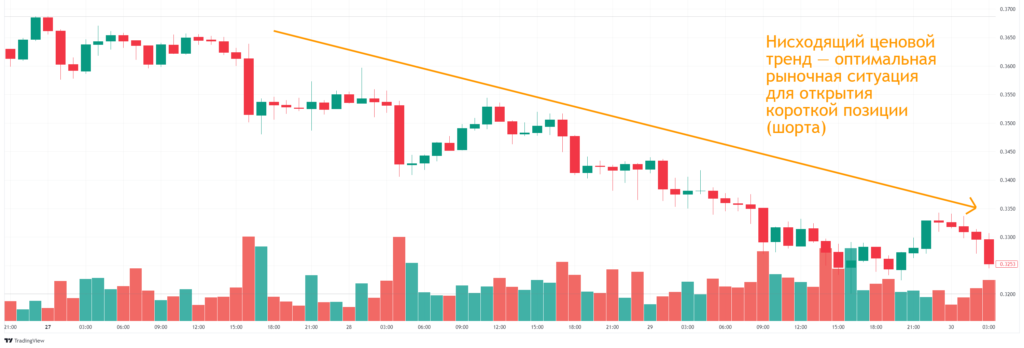
A short, simply put, is the sale of a financial instrument in expectation that it will fall in price.
The mechanics are somewhat more complex than for a long. A trader borrows the asset and sells it on the open market at the current price. After the price drops, the trader buys back the amount borrowed at a lower level and returns it with interest, keeping the price difference as profit. If the price rises instead, the trader takes a loss.


Example
In December 2017 a trader sold short in bitcoins at $19,000 per coin. He sold the coins around that level and then repaid the lender roughly $6,000 per BTC in February 2018, when the price had dropped sharply. Profit per coin amounted to $13,000.
Where margin trading comes in
On the spot market you can, in essence, trade only from the long side (there are techniques that resemble shorting), whereas proper short positions become possible in margin trading.
Margin trading, which enables leveraged trades, requires collateral—a deposit (margin) that guarantees repayment under exchange rules.
Margin is closely tied to leverage—a multiplier that increases the size of a trade by borrowing. In crypto, leverage can range from 2:1 to 100:1 or more. Trading with 50x leverage means that with a $100 cash deposit you can open positions up to $5,000.
If the market moves in the trader’s favour, returns increase in proportion to the chosen leverage. When such a position is closed, the collateral is returned to the lender along with fees, and the remaining profit is credited to the user.
If the price moves the other way, once the value of the trader’s assets (own and borrowed) falls to the size of the loan plus interest (the amount owed), the exchange automatically liquidates all positions and returns the lender’s funds. The margin forms part of what is returned.
In classic leveraged equity trading, liquidation is preceded by a margin call—a demand for additional collateral. Traders often use “margin call” to mean the liquidation itself—in crypto-trader slang, “to catch a walrus”.
A trader can also close a losing position before liquidation, forfeiting only part of the margin. You can do this manually or via a stop-loss order that automatically closes a trade once a set price is reached.
What is hedging?
Crypto markets use hedging—“insurance” in case the price trend runs against a trader’s position. For example, you hold a long while the asset is falling.
Hedging typically involves opening shorts that offset longs, allowing you to break even if the market turns. The investor leaves the original long intact and opens a short, or uses additional instruments.
Hedging suits medium- and long-term strategies. It sits uneasily with intraday trading, where speculation dominates. A popular approach uses futures contracts, both perpetual and fixed-term.
Perpetual contracts work as follows: every eight hours a funding rate is set. Instead of exchanging the contracts or their full values, counterparties pay this rate to each other. Depending on market conditions, either long holders pay shorts, or the other way round.
Fixed-term contracts settle automatically if the investor does not close them before expiry. You can hedge not only with futures but also with options—derivatives for more advanced market participants.
What is averaging?
Under this strategy an investor keeps buying an asset at lower and lower prices, thereby reducing the average purchase cost.
Example
Bitcoin reached $2,900, then began to fall. Spotting a correction, a trader bought coins at successive lower levels: $2,800, $2,600, $2,400, $2,200, $2,000. The average entry price was $2,400. After the correction the price rose and later returned to $2,900.
Pros and cons of longs and shorts
Opening longs is simpler for beginners and boils down to “buy low, sell high”.
Shorting can be effective but is far riskier than long-term investing or averaging. Large short positions should be left to experienced traders able to analyse market dynamics holistically.