



The cryptographer and founder of the Signal messenger, Moxie Marlinspike, criticised the Web 3.0 space’s dependence on centralized platforms. He argued that even with a distributed trustless consensus, users are forced to interact with and trust a handful of large players.
Wrote some notes summarising my first impressions of web3: https://t.co/16MoPROOGc
— Moxie Marlinspike (@moxie) January 7, 2022
In the article “My First Impressions of Web3,” Marlinspike noted that centralisation in the Web 2.0 era is linked to two reasons: users do not want to run their own servers, and protocols evolve far more slowly than platforms.
‘After more than 30 years, cryptography has still not been integrated into email, whereas WhatsApp, in a year, moved from unencrypted data transfer to end-to-end encryption,’ he wrote.
According to Marlinspike, the crypto community pays little attention to client–server interaction. He explained that existing blockchain technologies provide decentralisation of infrastructure, but do not give clients full participation in network activity.
‘All network diagrams are servers; the trust model is between servers. Everything is connected to servers. Blockchain is designed as a network of equals, but not in a way that your mobile device or browser could actually be one of these equals,’ he emphasised.
The founder of Signal added that decentralised applications cannot interact with the blockchain on the client side. In his view, the only alternative is to operate through a remote node. This entails a problem: users must trust API providers such as Infura and Alchemy.
‘This astonishes me. So much effort and energy has been spent creating a distributed trustless consensus, but practically all clients seeking access to it do so simply by trusting the responses of these two companies, without any additional checks,’ he said.
The cryptographer also drew attention to NFTs. He noted that the ERC-721 standard implies that the data themselves are not stored on the blockchain, but only a link to them. Gaining access to the server with this information allows one to alter it at will.
As an example, he cited an Ethereum blockchain NFT he created that changes appearance depending on the IP and the User Agent of the client that issued the request.


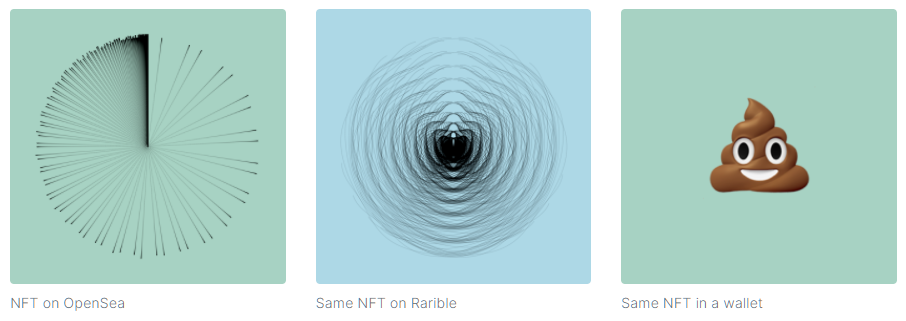
Marlinspike said that a few days after listing the NFT on the OpenSea marketplace, the token was removed from the platform. After that, it vanished from the Signal founder’s digital wallets.
The cryptographer explained that to display user NFTs, extensions like MetaMask query the OpenSea API.
‘In truth, MetaMask does not do anything special — it’s simply a presentation of data supplied by centralized APIs. … All this means that if your NFT is removed from OpenSea, it will also disappear from your wallet. Functionally it does not matter that my token is stored somewhere on the blockchain, because the wallet simply uses the marketplace’s API to display it,’ he said.
In Marlinspike’s view, architecture must be designed to use cryptography “to distribute trust”, bearing in mind that client–server interactions remain centralised. He also said that the industry should move toward simplifying software development.
Vitalik Buterin, founder of Ethereum, replied to Marlinspike. He noted that comparing servers and nodes is not entirely correct, since the latter are not required to operate continuously and uninterruptedly.
Buterin also emphasised that there are teams developing solutions aimed at giving users alternative means of access to the blockchain. He said that, over time, even running a full node ‘will become easier and cheaper’.
Responded!
I think the status quo comes from a present-day “missing middle” where we have centralized-but-easy things and decentralized-but-hard things, but new tech (w lots of cryptography!) actually is on the cusp of giving us the best of both worlds.https://t.co/XIx8f2oiVi pic.twitter.com/phTSrGW0OR
— vitalik.eth (@VitalikButerin) January 8, 2022
‘Therefore, I see no technical reason why the future should resemble the current status quo,’ he added.
According to Buterin, a number of factors slow the addressing of existing problems — scarce technical and economic resources, and the difficulty of implementing solutions in the base protocol.
As reported in December 2021, Jack Dorsey doubted the future decentralisation of Web 3.0. He said that venture capital’s strong influence would hinder achieving this goal.
Read ForkLog’s bitcoin news on our Telegram — cryptocurrency news, prices and analytics.