


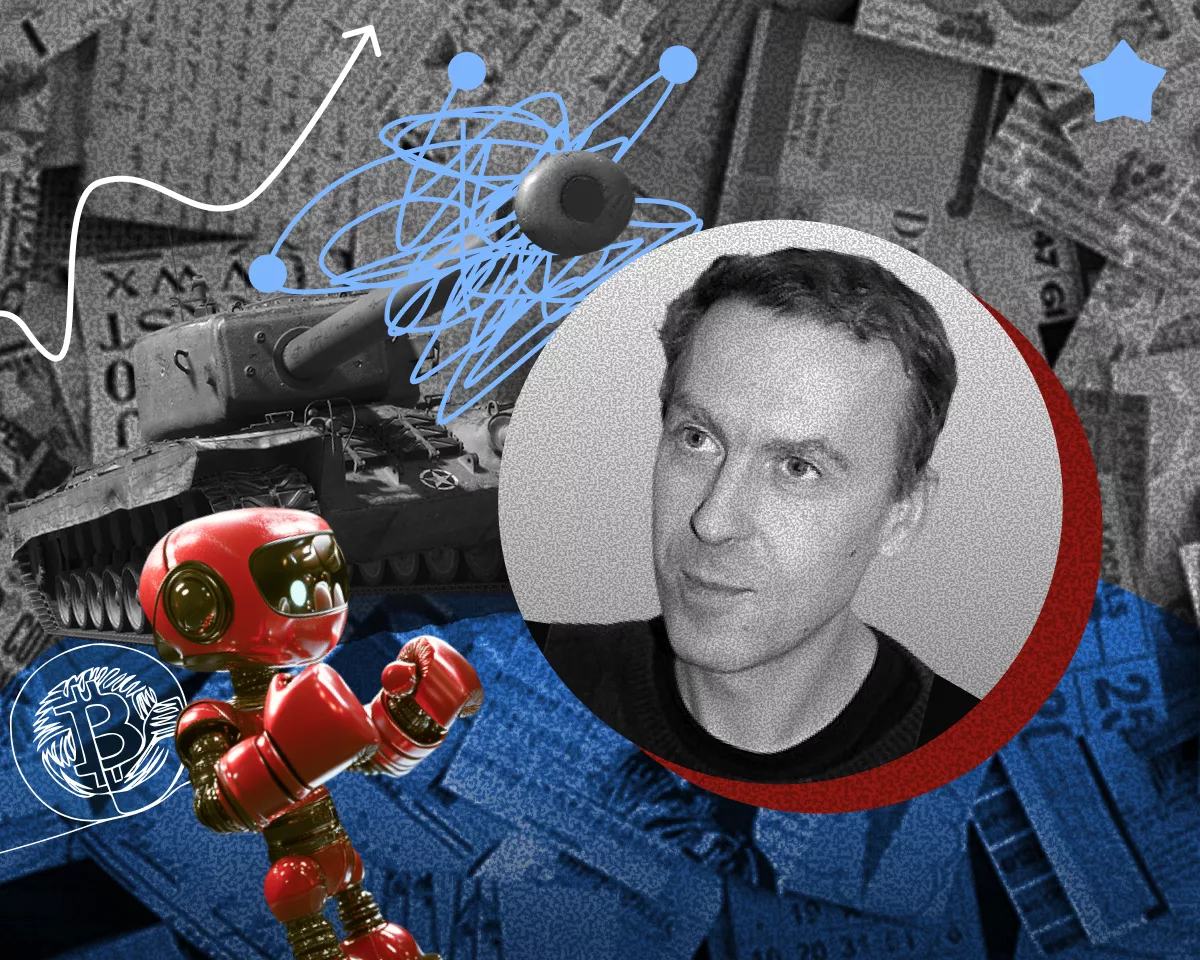
Silicon Tanks: Nick Land, the right face of accelerationism
The British philosopher Nick Land began his career as a careful reader and bold interpreter of 20th-century leftist thinkers, anarchically breaking the usual bounds of academic tradition. He is now a supporter of “neoreaction,” an apologist for technocracy and surveillance capitalism, who regards Peter Thiel as the greatest thinker of the present day.
How that 180-degree turn happened, and why Land found in bitcoin a confirmation of his “outrageous” hypotheses, is the subject of the first piece in the new series “Silicon Tanks,” in which ForkLog profiles the most influential philosophers and visionaries of the digital age.
The CCRU era
“Trump will be magnanimous. He feels the hand of the Lofty Powers on his shoulder. Elon Musk, just admit: ‘My grasp of Solemn Providence was imperfect.’ That’s all that is required of you. The timeline will stay the same, and we could still make it to Mars.”
“When Musk says: ‘I understand democratic politics better than Trump,’ it’s as if Trump were to say: ‘I understand building electric cars better than Musk.’”
“‘Sorry, Donald, it’s all the f—ing ketamine, I won’t do it again’;
‘You are forgiven, my son. Get back to work.’
Then I woke up and screamed.”
Trump will be magnanimous. He feels the hand of The Lofty Powers upon his shoulder. Just admit “My grasp of Solemn Providence was imperfect” @elonmusk , that’s all it takes. The timeline could be saved. Mars could still be within our reach.
— Xenocosmography (@xenocosmography) June 5, 2025
Those lines are not the work of some random armchair pundit on X, nor a bored teenage 4channer, nor a survivalist religious fanatic building a private nuclear bunker in the Ozarks in anticipation of the Second Coming. That is how the 63-year-old Nick Land — among the leading contemporary philosophers studying the intricate relations between humans, technology, the state and capital, in the broadest senses of those words — comments on a recent public spat between Donald Trump and Elon Musk.
In 1987 he defended a dissertation on Martin Heidegger and “On the Way to Language.” That same year Land began teaching at Warwick — a “plate-glass university” that would become one of Britain’s most prestigious intellectual centres.
From the outset Land showed a consistent refusal to obey the rules of the university and the scholarly world. For a long time he had only one major work in a relatively traditional register — Thirst for Annihilation (1992). In it Land turns to the work of Georges Bataille, the French philosopher and writer of transgressive fiction whose central themes were the limits of personal freedom, extreme bodily practices, the crisis of humanism and, as a consequence, mass dehumanisation, reducing people to two functions: “executioner” and “victim.”
“Bataille burns out your soul and it’s not possible to take it. You can either die or go somewhere else. Or both,” Land admits in his 1995 essay “No Future.”
From the 20th-century continental tradition he borrowed a writing method critics dub theory fiction. Following experiments by Friedrich Nietzsche and Søren Kierkegaard, thinkers like Georges Bataille, Maurice Blanchot and Pierre Klossowski preferred to set out their ideas as literature rather than academic articles. Land’s key writings are cast in the same mode, drawing on Lovecraftian and abstract horror, cyberpunk and slipstream, with a palpable dose of William S. Burroughs:
“The metrophage tunes you to the end of the world. Let’s call it Los Angeles. The state is rotten to the core with narco-capital and is now falling apart at random. Its collapse exposes an urban war landscape of communication arteries, fortifications, and free-fire zones, controlled by a combination of high-intensity airmobile LAPD units and quasi-Nazi private security outfits. Along lines of social fracture, media gigacash is sadomasochistically interlaced with zones of dynamic underdevelopment, where viral neo-leprosy spreads against a backdrop of tectonically tense static.” (“Meltdown,” 1997).
Following Bataille, Land demands that one “extinguish one’s personality” — a similar aim to that declared by the members of the secret society “Acéphale,” who practised “magical” rites and symbolic “sacrifices.” For them the rejection of the self was an experience of individual death through which a new collective organism was born.
Such ideas underpinned the Cybernetic Culture Research Unit (CCRU), founded by Land in 1995 with his Warwick colleague Sadie Plant. The CCRU jettisoned traditional philosophical strategies. Instead of lectures and seminars they staged performances with electronic music, during which Dr Land, to awkward laughter from the audience, demonstrated a transformation into an “other”: a snake, a werewolf, a lemur. As explained by Diana Khamis, a translator of Land’s writings into Russian, CCRU members “used self-humiliation and dehumanisation as a means to overcome the ‘I’.”
CCRU’s strategies were shaped by the social, cultural and political backdrop of the time. In the autumn of 1994 British society was convulsed by the parliamentary passage of the “Criminal Justice and Public Order Act.” Ostensibly aimed at defending “public morals” and cracking down on illegal raves, the law in effect curtailed freedom of assembly and encouraged police violence and other abuses of power. Among other things it contained a clause that silence in response to “lawful questions” by constables would be treated as an admission of guilt.
The Act also offered an absurd definition of the genres it sought to ban. Techno and house were described as “music” (the quotation marks are in the text), “wholly or predominantly characterised by the emission of a succession of repetitive beats.” Both civil society and musicians opposed the law, which remained in force for four years. “Fuck ’em and their law”, declared The Prodigy. “We have explosive”, threatened The Future Sound of London.
There were subtler acts of cultural resistance. On the eve of the law’s entry into force, Autechre issued the Anti EP, a three-track release constructed from as many non-repeating beats as its authors could muster.
The original pressing was sealed with a sardonic warning that it should be played in the presence of a lawyer and a qualified musicologist capable of explaining to the police the unrhythmic nature of the compositions. Through such practices mass art began to explore the peculiar beauty of error — the glitch in the algorithm — and the liberating potential of bugs and glitches.
CCRU pulled in the same direction. It abandoned logical and lucid philosophical language in favour of verbal chaos that mimics the thinking of a schizophrenic, an occultist, someone intoxicated by drugs — or a broken machine. The mode lets Land conduct a furious audit of the intellectual values produced by bourgeois capitalist society:
“When one turns to the Western tradition — to the authoritative discourses of truth, to the councils at which theological dogma was elaborated and which today underwrite our ‘common sense’ — one should not be investigating ‘errors,’ ‘weaknesses of argument’ or ‘mistaken judgments.’ No, what is at issue can only be a deeply rooted and fanatical discipline of lying. And hence one aspect of the radicalism of atheistic thought, from Schopenhauer, Nietzsche and Bataille, lies in overthrowing the high-bourgeois apologetic-epistemological problematic of modern philosophy with a question posed for the first time with full clarity: where does the lie stop?” (“Nietzsche the Shaman,” 1995).
CCRU delighted in mystifications: it devised its own conspiracies and conducted interviews with fictitious scholars. Its key influences were Gilles Deleuze and Félix Guattari, authors of the monumental Anti-Oedipus and A Thousand Plateaus. Following the classics of post-structuralism, the unit offered a psychoanalytic reading of capitalism as a system that produces not values but desires, reflecting Freudian complexes, a death drive and self-destruction. The alternative is the “schizophrenic” thinking of the rhizome, the mycelium, which lets one slip the grasp of the state with its repressions, neuroses, sadism and masochism.
No less important was the Situationist International of Guy Debord, with its critique of consumer society and its anarchic insistence on revolution for revolution’s sake. These ideas and practices would feed accelerationism — the ideology that calls for total speed-up of progress and a rethinking of technology in order to aggravate capitalism’s internal contradictions and hasten its collapse. The unit also took serious cues from cryptographers and the early cypherpunks.
In 1995 CCRU co-founder Sadie Plant wrote “Zeros + Ones: Digital Women + The New Technoculture,” a foundational text of early cyberfeminism. It contains several tenets often cited as part of the theoretical base of the left wing of accelerationism. Plant argues for rethinking the gendered dimension of technology. In patriarchal capitalist society, machines are coded as masculine: they are expected to help subjugate the world and satisfy needs and desires.
She points out that digital technologies are, by contrast, feminine by nature: algorithms trace back to practices traditionally coded as women’s work — weaving, for instance. It is no accident that the first machine to use binary zeros and ones was the Jacquard loom.
In 1997 Plant left Warwick to focus on independent research. A year later the university dispensed with Dr Land as well — the administration’s patience had run out; he was asked to vacate the lecture hall and “corrupt” the young elsewhere.
Despite its brief existence, CCRU attracted the attention of many intellectuals who shaped the culture around the millennium. Among those involved were the incisive critical theorist Mark Fisher, Reza Negarestani, later author of the cult “Cyclonopedia,” Ray Brassier, a co-founder of speculative realism, the Afrofuturist Kodwo Eshun and others. Music at the seminars came from Hyperdub founder Steve Goodman, while reports were filed by Simon Reynolds, a critic held in high esteem in Britain and America.
Most of them disavowed their teacher when, after years of seclusion, Land returned to public life with new ideas that had little in common with CCRU’s left radicalism.
A rightward turn and the “philosophy of bitcoin”
After leaving the university Land went through a severe personal and intellectual crisis, worsened by abuse of psychoactive substances — chiefly amphetamine and its derivatives.
“The cybertheoretical hurricane named Nick Land died at the very end of the 1990s, eaten alive by lemurian demons, leaving behind a smirking, middle-aged man of extreme right-wing convictions, still dabbling in the Kabbalah and still capable of writing damn good texts. When I asked this man what I should do with his early works, how I should deal with his untimely death, and how to understand what had died and what remained, his answer was unequivocal: do whatever you want with them and take my death however you want, I really am dead, and in any case we all die regularly, chopped up by time like birds hitting a jet engine,” writes Diana Khamis.
Land’s 21st-century programme is negative: less a set of prescriptions than a barrage against his ideological opponents. His main adversary is Nick Srnicek, the Canadian philosopher behind the “Accelerationist Manifesto,” which, in Land’s view, fundamentally misunderstands and appropriates accelerationism, recasting it as “an implicit call for a new Leninism without the NEP (but with utopian techno-managerial experiments from Chilean communism).”
In Land’s account, left and right have swapped roles in history. Democratic socialists, he argues, have become conservatives defending the global status quo, grounded in “outdated” ideas of humanism, justice, equality and the maximisation of welfare for the greatest number. The far right, by contrast, has assumed the revolutionary task of wrecking the existing world order and its institutions.

Land’s thinking in its new guise blends social Darwinism, “scientific racism,” and intolerance toward feminist and broadly libertarian political projects. The leading philosopher of our time, Land proclaims, is Peter Thiel; venture capitalism is a new form of natural selection in which the right to survive is earned by successful investment. He lays out his platform in the essay “The Dark Enlightenment,” enthusing over Mencius Moldbug, a living icon of the “alternative right.”
Land prefers to style himself and his allies as the “new reaction” (NRx), distancing themselves from the most fanatical (and often armed) alt-right groupings — though even here he expresses a degree of sympathy, if evasively and in his own way.
“If identity politics in the blood-and-soil vein can, in various ways, cling to power, worse times will be upon them, because they will be forced to produce or create something, and they cannot do that. They will lose any potential for mass globalisation, and their name will be associated with defeat. I would like to see such experiments on a small scale so that they end in instructive failure rather than a global catastrophe […] Local failures are wonderful. Global ones, of course, are not nearly so fine,” Land said in an interview with Logos.
The mind-set of NRx is neatly captured in an apocryphal tale about a supposed forebear — the Italian traditionalist Julius Evola, author of the ultra-right treatise Revolt Against the Modern World (1934). In 1941 Benito Mussolini offered him the editorship of a regime journal. “Duce, but I am not a fascist,” baron Evola replied.
“By which he meant that fascism was, to him, too much a movement of workers and peasants,” explained the philosopher and Islamic political thinker Heydar Jemal.
Neoreactionaries hold as fundamentally false the assumptions of liberal and neoliberal economics that people’s well-being depends directly on the democratic nature of society and the openness of state institutions. They point to Chinese megacities and the monarchies of the Persian Gulf — places with very low civil liberties but very high living standards.
Their ideal ruler of the future is Lee Kuan Yew, the dictator who turned the city-state of Singapore into a high-tech “Disneyland with the Death Penalty,” as William Gibson — a formative writer for the young Land — described it with disgust. In the “new feudalism” of surveillance capitalism, where the technocrat-lord bestows prosperity on the loyal and punishes “backward” dissidents, NRx adherents see neither a utopia nor a dystopia, but the inevitable end of civilisation’s trajectory.
There is no place in this global project for the “obsolete” morality of social justice. Only accelerationists — who do not think but act, conscious of the approaching “absolute horizon” of singularity — will fully function within it. In characteristically provocative fashion Land even names Karl Marx as the first accelerationist thinker, citing the conclusion of his “Speech on the Question of Free Trade” (1848):
“In general, the protective system of our day is conservative, while the system of free trade is destructive. It breaks up old nationalities and pushes the antagonism of the proletariat and the bourgeoisie to the extreme point. In a word, the free trade system hastens the social revolution. In this revolutionary sense alone, gentlemen, I vote in favor of free trade.”
Anything that can catalyse capitalism’s self-destruction in order to build a new techno-aristocracy on its ruins merits the support of right accelerationists. One variation — e/acc — has won especially broad backing in Silicon Valley. The “effective accelerationism” banner has been waved by the aforementioned Thiel, a16z co-founder Marc Andreessen, former Coinbase CTO Balaji Srinivasan and Ethereum co-founder Vitalik Buterin.
But right accelerationism also has a less respectable face, despite public NRx attempts to distance themselves. Its cultural-ideological base has been successfully integrated into various neo-Nazi movements. The small, marginal yet media-magnetic Atomwaffen Division has been most active here. Its members have been charged by US authorities with a series of hate-motivated murders. In its agitprop it embraces a distinctly Landian synthesis of occultism, counterculture, racism and xenophobia, hostility to left-liberal ideologies, the aggressive use of internet memes and the promotion of psychoactive drug use. Despite anti-Islamic rhetoric, Atomwaffen leaders praised acts of religiously motivated terror and urged followers to launch armed attacks on US nuclear facilities. In the destruction of the American state they see, in true accelerationist fashion, a chance to rebuild the world order around white nationalism.
Strikingly, Land’s creative strategies echo the philosophical evolution of Alexander Dugin, leader of the “Eurasian Youth Union.” Earlier, like Land, he turned to musical-visual performance, Crowleyan occultism and postmodernist deconstruction of pop culture. In the new millennium he, like the British neoreactionary whom he often cites, subjected the Deleuze/Guattari legacy to a “right” revision and (coincidentally?) declared:
“Chaos is neither dark nor light. It is dark-light.”
Unlike most of his peers in the philosophy of technology, Land eagerly turns to blockchain and cryptocurrencies. Between 2018 and 2019 his accelerationist blog Urban Future serialised a long essay with the hard-to-translate title Crypto-Current: Bitcoin and Philosophy.
The work is strikingly structured, recalling Wittgenstein’s Tractatus. Land sets out the technical and ideological bases of blockchains and cryptocurrencies, smart contracts and altcoins, including Ethereum and Bitcoin Cash.
Flatly rejecting the moderate libertarian insistence on bitcoin’s political neutrality, Land sees in the first cryptocurrency not a critique but a crushing blow to the “leftist” worldview. Cryptocurrencies, he argues, abolish classic conceptions of value and production shared by both Marxist and capitalist theory and practice.
“What is the value of a stock of 21,000,000 bitcoins? Why, 21,000,000 BTC, of course. Naturally, such a crude tautology might at first seem nonsensical — or at best a semantic evasion. But there is nothing trivial about the disturbance it provokes,” he writes, thinking like a seasoned bitcoin maximalist.
For him, digital gold is a vivid demonstration of the power of “hyperstition” — a key Landian term describing the ability of immaterial and “fantastic” technological phenomena to incarnate themselves and influence objective reality, steering the evolution of society, culture and scientific progress.
“Hype actually makes things real, and utilises belief as a positive force. The fact that they aren’t ‘real’ now doesn’t mean they can’t become real at some point in the future. And once they’ve become real, they were in a certain sense always real. Hyperstitions, in their very existence as ideas, function causally to secure their own reality. […] A hyperstitional object is not merely imaginary or a ‘social construct,’ but is quite literally ‘called’ into existence by the actions undertaken with respect to it,” the philosopher contends.
In Land’s present view, “hyperstition” in Pepe or in Kek is a tool for splitting the “Anglosphere” above all. It is also a shield against Lovecraftian horror — an accelerationist redirection of it into a truly religious revolt against the modern world.
Small wonder that, in the Musk–Trump set-to, the philosopher took the side not of the “techie” and visionary but of a pointedly anti-intellectual priest of what is, in essence, the hyperstitional MAGA cult. More than any other powerful politician, Trump has shown that deeds are secondary: on the road to singularity, the key is to produce and disseminate subversive information.
However one feels about Land’s evolution from an original intellectual into a “smirking, middle-aged man of extreme right-wing convictions,” there is no denying that the boldness of his ideas and syntheses, however anti-humanist, has earned them a place in the global reckoning with today’s technologies and humanity’s place within them. Perhaps the attraction of Land’s method is best summed up by Diana Khamis:
“Land’s texts possess a nervous and slightly dangerous allure, almost like outer space, a dark forest, the deep sea, corpses, gigantic Australian spiders, and other things that are strange, indeterminate, or many-legged.”
Text: Comrade 93
Рассылки ForkLog: держите руку на пульсе биткоин-индустрии!