




- Experts predict the market capitalization of stablecoins will reach $750 billion by the end of 2026.
- Key cryptocurrency bills are under consideration in the United States.
- JPMorgan is exploring stablecoins under pressure from fintech competitors.
Clients of the American branch of Standard Chartered are showing greater interest in stablecoins than in Bitcoin. This was stated by the head of the bank’s digital asset research department, Geoffrey Kendrick, as reported by The Block.
According to the bank, 90% of discussions last week were focused on stablecoins. Meetings were held in Washington, New York, and Boston with clients and officials.
Participants discussed the impact of such assets on the economy following the stablecoin market’s growth to $750 billion. At the time of writing, the segment’s capitalization is approximately $263 billion, according to CoinGecko.


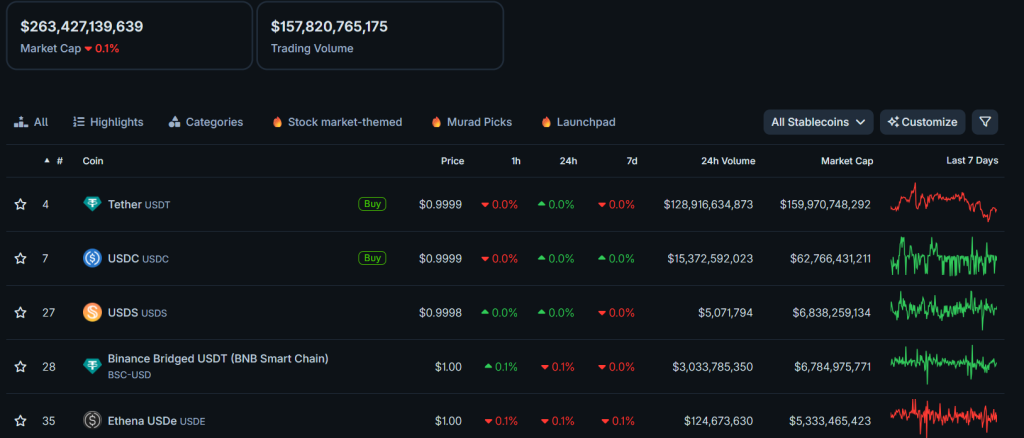
Kendrick believes the projected figure will be reached by the end of 2026. At that point, stablecoins will begin to influence traditional financial assets and policy. Specifically, more treasury bills will be needed in the US to back stablecoins. This could alter the structure of national debt and demand for dollars, the expert emphasized.
Regulation
The discussions coincided with the consideration of bills regulating the industry, particularly stablecoins (GENIUS Act).
On July 15, the US House of Representatives rejected three documents related to cryptocurrencies. However, following a publication by President Donald Trump about a meeting in the Oval Office with congressmen, a new schedule of sessions was proposed. The consideration of the projects will begin on July 16.
According to Kendrick, after the adoption of the GENIUS Act in developed countries, stablecoins are likely to be used for payments. Corporations will benefit from faster and cheaper transfers. Banks and municipalities will be able to issue their own assets.
The expert noted that in developing countries, people buy stablecoins to save in dollars. This helps protect assets from the devaluation of local currencies.
A large outflow of funds through stablecoins could create problems for some countries, Kendrick believes. It will become more difficult for them to control exchange rates and maintain banking systems.
The specialist also mentioned the CLARITY Act. In his view, the law could become a regulatory framework for digital assets and commodities, which would have a “special” impact on the RWA market. The project will create a framework for the tokenization of assets—from real estate to stocks. This will expand the scope of DeFi protocols like Aave, Kendrick concluded.
Fintech and the Stablecoin Market
The largest US bank, JPMorgan, is already studying public stablecoins pegged to the dollar, writes CNBC. Meanwhile, the head of the conglomerate, James Dimon, questioned their necessity but acknowledged:
“I don’t understand why they are needed instead of regular payments. But we are obliged to investigate this.”
According to him, the reason is pressure from fintech competitors.
“They are smart, they want to create bank accounts and payment systems. We cannot miss this,” explained the CEO of JPMorgan.
The bank is already testing JPMD on the Base blockchain, supported by the American cryptocurrency exchange Coinbase. The coin is intended to simplify settlements between JPMorgan’s institutional clients.
Experts warned of a bubble in the stablecoin market. They believe that a successful Circle listing will trigger a wave of IPO from copycat companies.
Later, the BIS stated that stablecoins do not pass the test on three key criteria: “unity,” “elasticity,” and “integrity.”