




Deposits flowing from American banks into stablecoins could reach $500 billion by the end of 2028, reports The Block, citing a report from Standard Chartered.
Analysts at the financial institution view the widespread adoption of stablecoins as an increasing structural risk for TradFi.
The projected amount represents about a third of the expected $2 trillion capitalization of the segment. This estimate aligns with a previous forecast by the bank regarding the potential transfer of $1 trillion in deposits from emerging markets to digital dollar equivalents.
Jeffrey Kendrick, head of digital asset research, noted that risks are heightened as payments transition to blockchain. Additional uncertainty stems from delays in passing the Clarity Act, necessary for regulating the industry in the US.
“This issue has pitted major banks against Coinbase,” the expert noted.
The exchange did not support the latest version of the document, as its new edition undermines the issuance and holding of stablecoins. The head of Bank of America, on the other hand, warned of risks to the traditional sector: if interest is allowed on such assets, banks could lose up to $6 trillion.
Standard Chartered believes that discussions in Washington only confirm the thesis that transparent regulation accelerates the mass adoption of new financial instruments.
Vulnerability of Regional Banks
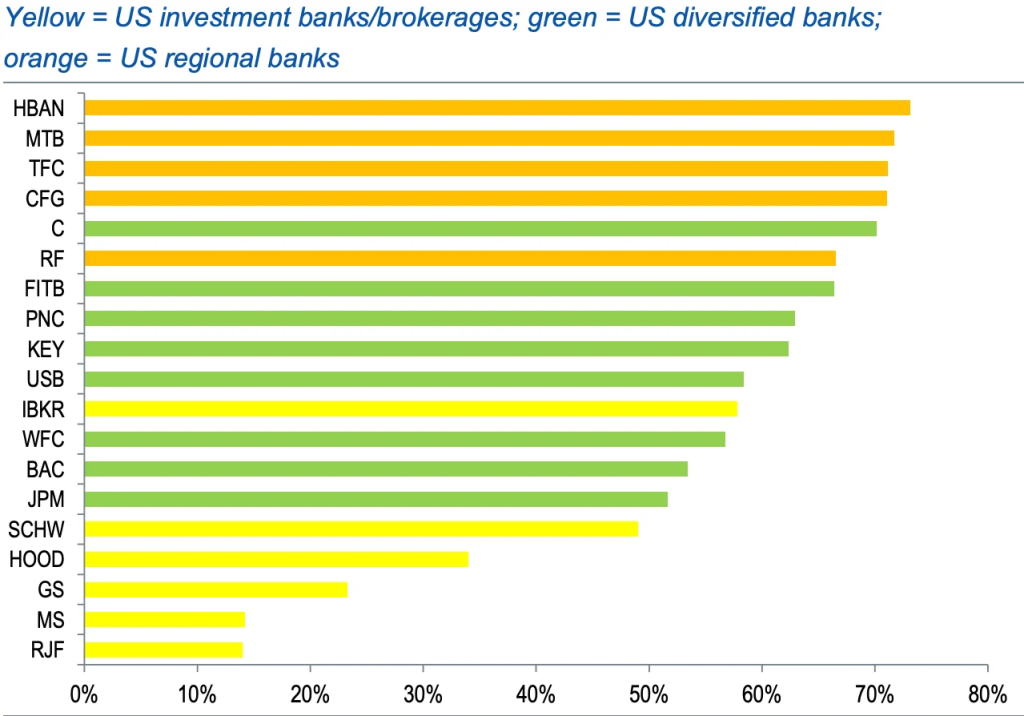
To assess risks, analysts used the ratio of net interest income to total revenue. According to experts, this indicator best reflects the consequences of capital outflow.
Kendrick explained that deposits form the basis of interest margins. Their flow into stablecoins will exert direct pressure on the income of financial organizations.
Research findings:
- US regional banks are most vulnerable due to high reliance on deposit funding;
- diversified banks face moderate risk;
- investment banks and brokers are least affected by the trend, as their income is weakly linked to deposits.


Structural Threats
The report highlights factors that amplify the risk of liquidity outflow. Major issuers — Tether and Circle — hold only a small portion of reserves in bank accounts. This limits the return of capital to the traditional financial system.
According to Standard Chartered, two-thirds of the demand for stablecoins comes from emerging markets, while developed markets account for only a third. This disparity underpins the forecast of $500 billion in losses for US banks and other leading economies.
Kendrick warned of the uneven nature of the consequences. The resilience of specific banks will depend on their ability to restructure financing models and integrate with tokenized infrastructure.
In addition to the reduction in the deposit base, analysts point to threats to non-interest income associated with the growth of the real-world tokenized assets sector (RWA).
The current supply of dollar stablecoins exceeds $300 billion. If Standard Chartered’s scenario unfolds, this figure will triple — by 2028, the market will approach $2 trillion.
Back in August, Tether launched USAT, a federally regulated “stablecoin” for the US market.