




The pandemic has accelerated the deployment of artificial intelligence (AI) systems across various sectors, according to a study by audit firm KPMG.
News: The #COVID19 pandemic has accelerated the pace of #AI adoption, but many say it’s moving too fast, according to a new @KPMG_US survey. Read more insights here: https://t.co/sPqO3YmV6n pic.twitter.com/Yac6O0mZBM
— KPMG U.S. News (@KPMGUS_News) March 9, 2021
The survey involved 950 senior executives from companies with revenues exceeding $1 billion. The study found AI algorithms are used across manufacturing, financial services, technology, retail, life sciences, healthcare and the public sector.


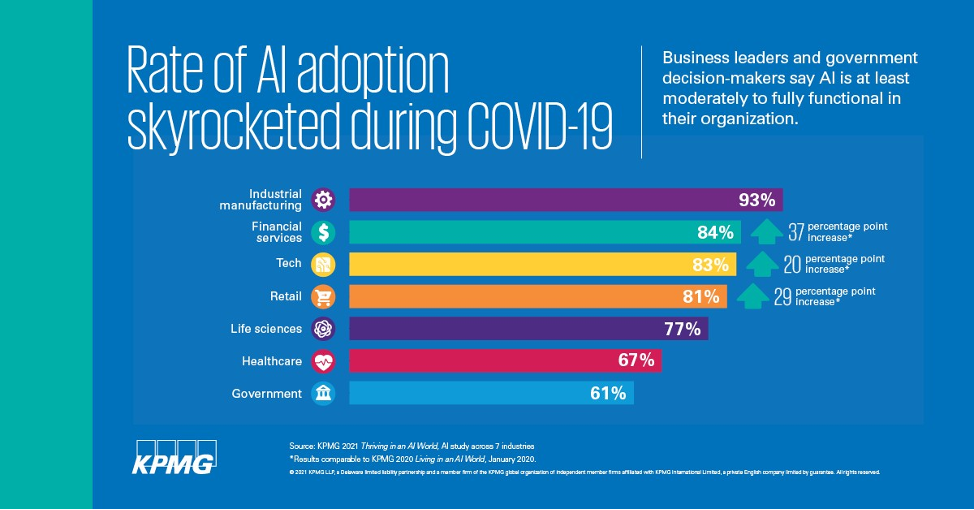
Speed of AI adoption. Data: KPMG.
All respondents cited the pandemic as a factor that contributed to broader AI adoption last year, though the extent varied by industry. They also expect more active steps from the Biden administration to spur deployment of algorithms.
Many noted that AI is advancing too quickly. An overwhelming majority of respondents agreed that governments should regulate the use of the technology.
According to KPMG’s AI director, Tracy Gusher, organisations are becoming increasingly adept at deploying AI successfully. She believes that in the near term many existing systems will begin to yield suboptimal outputs due to the lack of governance mechanisms and the ability to detect potential biases in models, which could materially affect outcomes.
As Gartner experts say, by 2025, 75% of early-stage venture investment decisions will be made based on AI forecasts. In other words, algorithms will themselves determine whether a company is even suitable for human assessment, reducing the importance of presentations and financial metrics.
According to Gartner’s senior director of research Patrick Stakenas, the capabilities of advanced analytics shift early-stage venture investment strategy from “intuition” and qualitative decision-making to a quantitative process.
San Francisco-based venture firm Signalfire already uses its proprietary Beacon platform to track the performance of more than 6 million companies. It draws on 10 million data sources, including scientific publications, patent registries, open-source code, sales data and social networks.
Companies showing stronger performance are flagged on the dashboard, presumably allowing Signalfire to identify the most promising opportunities earlier than traditional venture firms.
In March 2020, the company Cindicator launched the AI-based CND app on the Bloomberg Terminal. It forecasts sentiment for blue-chip stocks on the US stock market.
Follow ForkLog news on Telegram: ForkLog FEED — the full feed of news, ForkLog — the most important news and polls.