



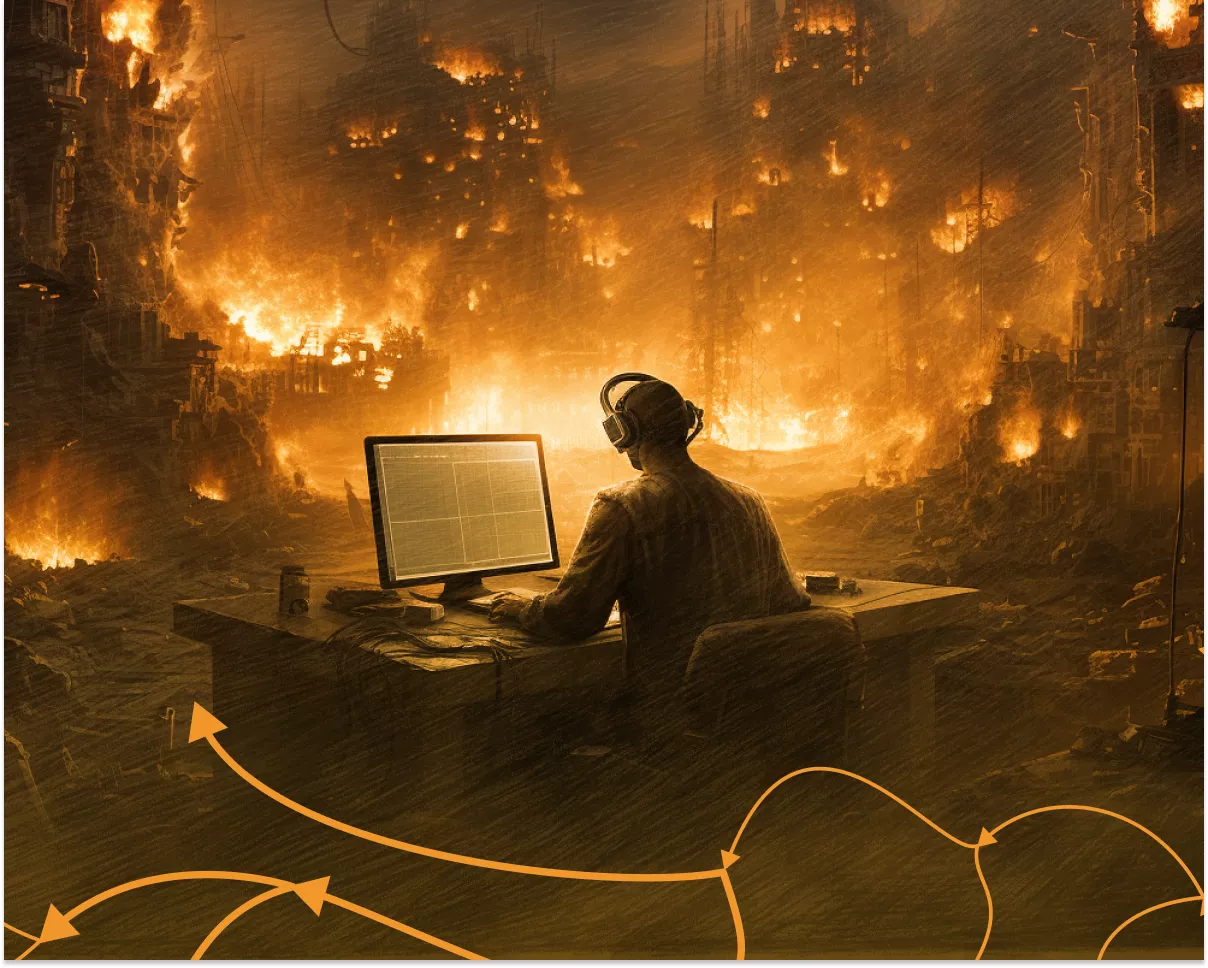
Today, cryptocurrencies cannot be thought of as a separate industry, confined to its own sandbox, as it was for many years. The starting point for crypto’s emergence into the wider world is 2020 — the year of the coronavirus pandemic and the ensuing total reconfiguration of the familiar order of things.
Technological awareness is, above all, an understanding of what technologies are, what impact they can have on our ecosystem and consciousness, and on humans as a species.
For example, many readers of this text are familiar with the mantras of startup founders around the world about how blockchain will free everyone, remove intermediaries and teleport humanity to a better version of the future. Yet this technology, like any other, has multiple purposes. And it can be used in different ways.
It is no secret that blockchain can become one of the technological underpinnings of the digital gulag. And if you consider it in conjunction with artificial intelligence and quantum teleportation of data (which will inevitably change the speed and principles by which the global network operates), it is the perfect recipe for a fully controlled, transparent socio-economic environment in which corruption is eliminated along with humanity and all decisions are made automatically. You do not even need a fully fledged AI for this. A set of neural networks and algorithms is enough to create an impeccably controlled environment. And there are already examples in the modern world of how blockchain and AI are used to create social-rating systems, in which there is no one to pay bribes for access to social benefits.
Human nature is such that much of the documented history is spent on inventing and embedding into life technologies that are incompatible with our ecosystem. These technologies are inherently toxic and harmful to the environment and Homo sapiens as a species. Not only internal combustion engines, but modern electric cars are not as harmless as they seemed at first glance. The big question is the future disposal of lithium-ion batteries and its consequences for the ecosystem. The same applies to digital technologies.
Metaverses, avatars in virtual worlds — this is what humanity has dreamed of and talked about for thousands of years. Once, their place in people’s minds was occupied by pantheons of gods and mythical beings. Already in the twentieth century humanity began dreaming of having an avatar in virtual reality and being anyone in a multitude of imagined worlds. And, in principle, we have already reached a point at which virtual reality replaces the physical. How many hours a day do you spend in digital worlds? Probably more than 10 hours out of 24. This concerns any of your interactions with devices, social networks, etc. But there is an important detail that can be observed in any major metropolis. And not paying at all attention to it.
It consists in the fact that many people already exist in the material reality far less than in the virtual. Some are avatars for not-yet-described and not unambiguously defined life forms — digital entities. They were created by people themselves in the form of social media accounts, etc. And modern people devote quite a lot of effort to servicing the needs of their digital being. How many hours a week do you devote to your Instagram account? This illustrates what information technologies become in the hands of people living beyond technological awareness. They become tools of consumption and often destructive transformation of the person.
Therefore, in a society that is not technologically aware, metaverses do not imply teleporting people into digits. On the contrary, we are headed toward embedding the digit in our bodies with the replacement of the outdated biological form by new life forms. Will the human be the creator of these new life forms or will they gradually become the creation of machines?
Gamified Post-Capitalism
Post-capitalism, in this sense, refers to any socio-economic system that follows capitalism. And gamification is not about everyone having fun and living playfully; it is about another virtualization of reality.
The virtualization of thinking and awareness has already occurred during the progress of technology over the last 30 years, which was accompanied primarily by the spread of the Internet. The virtualization of assets and property rights has been underway since the appearance of the Bitcoin network. Through this, socio-economic virtualization also takes place. How finished and working systems will look depends on the features of a given region on the planet.
Somewhere this new socio-economic system will unfold within the framework of states with full centralisation. Governments there will own and manage all virtual assets that citizens formally own.
Somewhere it will resemble the corporate states of the future with their currencies (or their numerous ones) and competition among economic agents for the title of best worker of the month/year with the introduction of corresponding incentives. Somewhere offshore zones will arise where both state and corporate virtual assets, as well as digital assets free from control, circulate.
All these systems share one thing — money in its familiar form and understanding will no longer exist. Instead there will be a multitude of different financial instruments created for specific tasks.
Ultimately, for a resident of a gamified post-reality there is no difference in what they pay bills with: a digital dollar, Bitcoin, Worldcoin, or tokens tied to real estate/gold/oil/food. What will be more important for a resident of the gamified reality will be the practice of technological awareness and self-identification (who am I?). Because without the first, a person ceases to be themselves and becomes an algorithm. Without the second — it is impossible to integrate and build relationships with other participants of the new socio-economic system.
Robots, Algorithms, AI: The rights of machines and other digital life forms
Special attention in the construction of a gamified post-capitalist reality should be given to robots, algorithms, AI, neural networks, etc. It would appear the spiral of progress will inevitably lead us to the creation of artificial quantum consciousness, which will likely become the real AI.
Even considering already available technologies, many algorithms and neural networks can pose serious competition to humans not only in work but also in understanding reality, and perhaps in self-awareness. Understanding that humans will live with machines, work with them, build families and even raise children, it is important to define these relations from a legal perspective. And already now one of the most important debates in tech is the rights of machines, algorithms, and robots. Some may point to the absence of subjectivity, but in my view that is a convention. For most modern people do not possess subjectivity either. Yet each of them has rights.
We cannot repeat with machines what humans did to their own kind in the era of colonization, turning entire continents into slave labour, on which the largest capitals were formed. What is the secret of corporations? Almost always it is not in high-tech production, but in the use of labor that costs a dollar a day or less. And the results of labor are valued in institutional and legal markets in hundreds, or thousands, of dollars. This laid the groundwork for a huge number of socio-political problems faced and will face even more those who at some point decided that residents of colonized countries have no subjectivity.
In the case of machines, a technologically mindful approach would entail recognizing the rights and freedoms of all algorithms, AI, robots involved in economic and social spheres. However this will not happen in the near future.
One could even fantasize about a scenario in which part of humanity enters into symbiotic and equal relations with machines and carries out the decolonization of the world. What is needed to grant machines rights and freedoms? A fundamental ethics or even a new religious-philosophical system — for machines, humans and future life forms.
A Final Note
All of the above could be viewed as a form of futurology, a vision of the future. Although much of it is already reality for most readers, even if this claim does not seem obvious. What name the gamified post-capitalism we are already in will take is a matter of time.
Whether technological awareness becomes the principal approach to interacting with technologies and integrating them into life also depends on many factors. One thing is clear: the development and integration of the technological stack of the new reality is complete and, contrary to the expectations of many, cryptocurrencies are a tool of total control (in the name of universal security) that will become most effective after the mass introduction of digital IDs.