



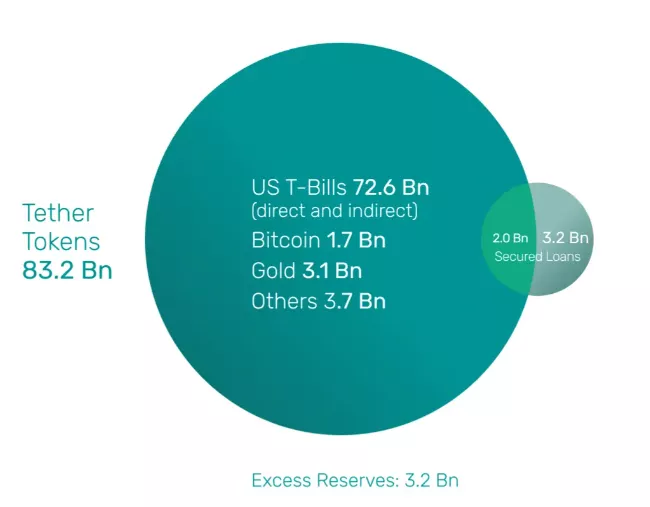
The issuer of stablecoin USDT, Tether, as of September 30 held U.S. Treasury bills worth $72.6 billion. The securities accounted for 84% of assets ($86.38 billion), according to the company’s attestation report.
Together with cash, their share stood at 85.7%.
Liabilities total $83.18 billion (including USDT $83.15 billion), implying excess reserves of $3.2 billion.
“We have reached an all-time high share of cash and cash equivalents within reserves. This demonstrates our commitment to maintaining liquidity and stability in the ecosystem,” — said Paolo Ardoino, CEO of Tether.
The company holds Bitcoin valued at $1.66 billion, gold ($3.15 billion) and other assets ($3.7 billion).
The report notes a $330 million reduction in extended secured loans.
In September, The Wall Street Journal reported that the company restarted lending in its own stablecoin, a year after assurances of discontinuation of such practice.


Tether also disclosed investments in industry-related research totaling more than $809.5 million year-to-date (~$668.9 million in Q3). They are not part of USDT reserves. The category includes investments in sustainable energy, Bitcoin mining, P2P technologies and data storage.
According to CoinGecko, Tether’s market capitalization is $84.8 billion. The company accounts for 68.5% of the stablecoin market.
In May, Ardoino said that high profitability for the issuer would enable it to explore new business lines.
Subsequently, it emerged that Tether invested $1 billion in a Bitcoin mining project in El Salvador. Later, the issuer allocated $420 million to buy Nvidia chips in exchange for a 20% stake in the mining company Northern Data.