


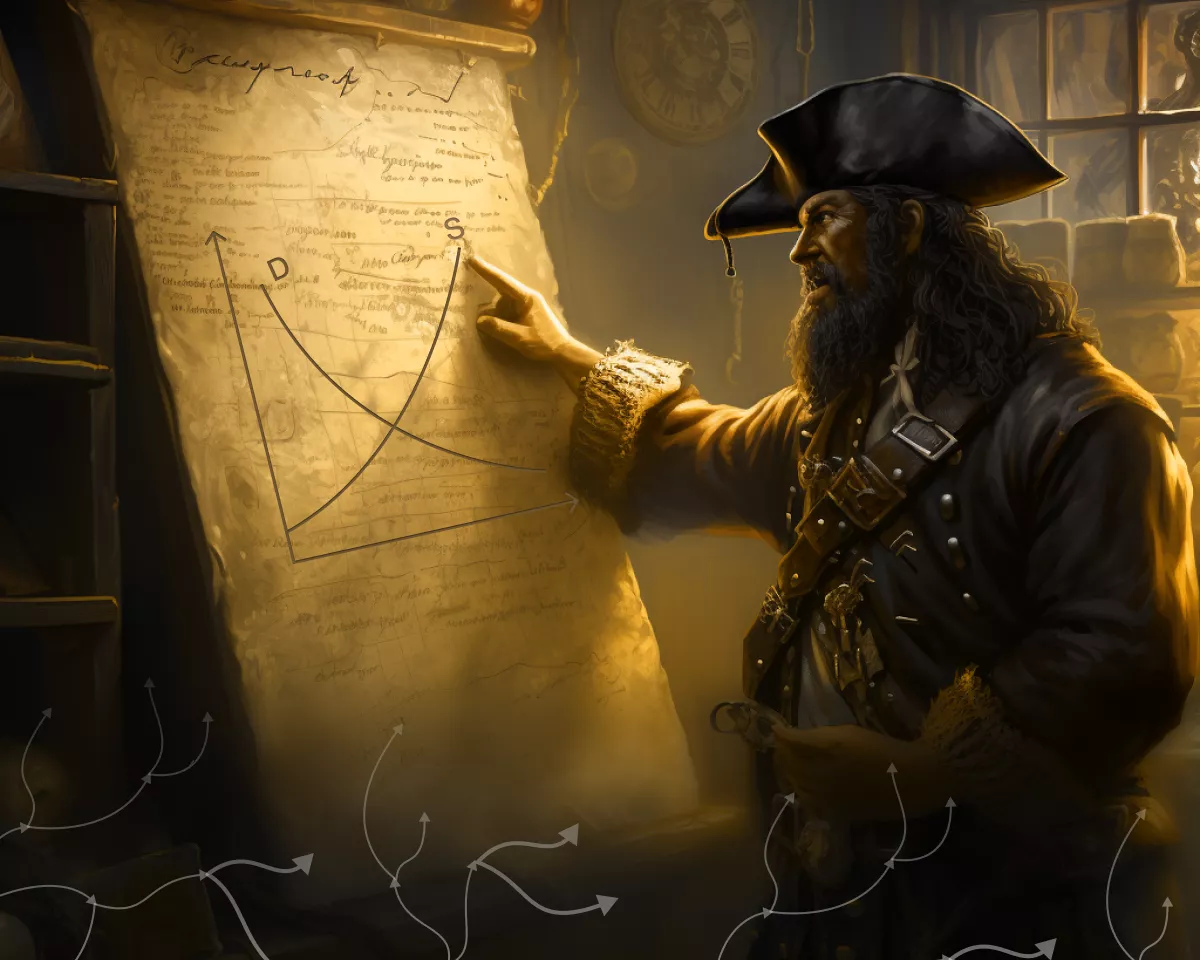
The Invisible Hook: what pirates can teach us about economics
American economist Peter Leeson belongs to the cohort of the Austrian School whose professional formation coincided with the global crisis of 2008. The Great Recession exposed the soft spots of the global market and created demand for radical alternatives. Among them were Austrian ideas, which helped, among other things, to give birth to cryptocurrencies.
In The Invisible Hook: The Hidden Economics of Pirates Leeson sets out his view of the most effective socio-economic arrangements, advancing 18th-century pirate communities as a positive example. ForkLog presents the main arguments of this contentious, at times provocative, yet informative book.
The Invisible Hook
In 1759 the Scottish Enlightenment thinker Adam Smith published The Theory of Moral Sentiments. It went through six editions in his lifetime and became one of the most influential freethinking works of its era. Though Smith’s treatise dealt primarily with ethics, one image from the book stuck in political economy:
“The rich only select from the heap what is most precious and agreeable. In reality they consume little more than the poor. […] Apparently, some invisible hand compels them to share with the poor the produce of all their improvements. They are led by an invisible hand to make nearly the same distribution of the necessaries of life which would have been made, had the earth been divided into equal portions among all its inhabitants.”
Over time this vague metaphor hardened into a more emphatic formulation: “the invisible hand of the market”. The term remains in use today both among champions of economic liberalism and their critics, who doubt that a free market is an unalloyed good.
For the anarcho-capitalist Peter Leeson, the “invisible hand” is unequivocally the best available form of market relations. In describing the economics of piracy he starts from Smith’s metaphor and introduces his own term: the “invisible hook”. According to Leeson, the two notions differ in two fundamental ways:
- The theory of the “invisible hand” suggests that a clear order underlies the apparent “anarchy of the market”. The “invisible hook”, by contrast, describes the real, not metaphorical, anarchy of the pirate community.
- The economy of the “invisible hook” excludes the public good as a value. Its priority is the needs of a small group. Whereas a participant in a traditional competitive market seeks to improve others’ lives by producing a better good or service, the pirate produces nothing and simply appropriates others’ goods.
Though the economy of the “invisible hook” is plainly criminal and sits uneasily with conventional notions of market relations, Leeson points to traits that make it akin to the traditional market:
- Individual self-interest. Like pirates, participants in the traditional economy primarily provide for themselves and their families.
- Individual rationality. People try to achieve their economic aims in the best way they know.
- Response to incentives. People seek to avoid costs and increase profit: when costs rise, output falls—and vice versa.
Leeson, following several historians, ties the rise of pirate economics to the realities of the 18th-century market. In an age of imperial rivalry, naval power was central to the great powers. Yet market conditions created a gross imbalance between the pay of officers and captains and that of rank-and-file sailors.
The latter were cheap and utterly rightless labour. The income from their hard and often dangerous work ranged from £15 to £33 a year (from ~$6,500 to ~$11,500 in today’s terms). The upper end came in wartime, when personnel received combat bonuses. In peacetime the labour market was glutted. If an applicant managed to get aboard at all, he worked for a pittance, out of all proportion to the revenue he generated for the treasury.

In such conditions piracy offered a decent alternative. A sailor could do the work he knew well and earn far more for it. In 1722, for instance, Captain John Evans’s crew seized £9,000; each member pocketed £300—ten times more than on the merchant fleet even in wartime.
Another attraction of the “invisible hook” was the “political” set-up aboard a pirate ship. On the royal navy a sailor had no vote and could be subjected to the harshest punishments at the whim of an all-powerful captain; among sea bandits, the situation was the opposite.
The leader was chosen by direct vote and simple majority. Election conferred not only power but also responsibility. At the slightest dissatisfaction the crew could initiate a kind of impeachment, likewise by vote.
To many, these advantages outweighed a crucial downside: piracy was outside the law, and many careers ended at the gallows.
Despite the obvious immorality of piracy and its eventual suppression, Leeson argues that for its time the “invisible hook” was not only fair but also a progressive socio-economic system. He sees some of its elements as relevant even today.
The economics of pirate democracy
Leeson counts overcoming the so-called paradox of power among the chief achievements of the “invisible hook”. It can be formulated as follows.
Since each individual is guided primarily by personal gain, people need power—the Hobbesian Leviathan—to ensure that competing members of society do not harm one another. But power is not an abstraction; it is made up of living people who, like everyone else, pursue their own advantage. Hence the paradox: “By definition power is strong enough to limit itself, and also strong enough to violate those limits when convenient.” Leeson sees the most extreme forms of this “paradox of power” in some of today’s most troubled African states:
“In these countries, rulers unconstrained by anything or anyone enrich themselves at the expense of citizens, growing ever richer while citizens grow ever poorer. […] Predatory rulers’ behaviour forms in citizens a desire to cooperate for mutual gain. If leaders are going to take nearly all the income from production and exchange, why engage in production and exchange at all? The resulting slump impoverishes society.”
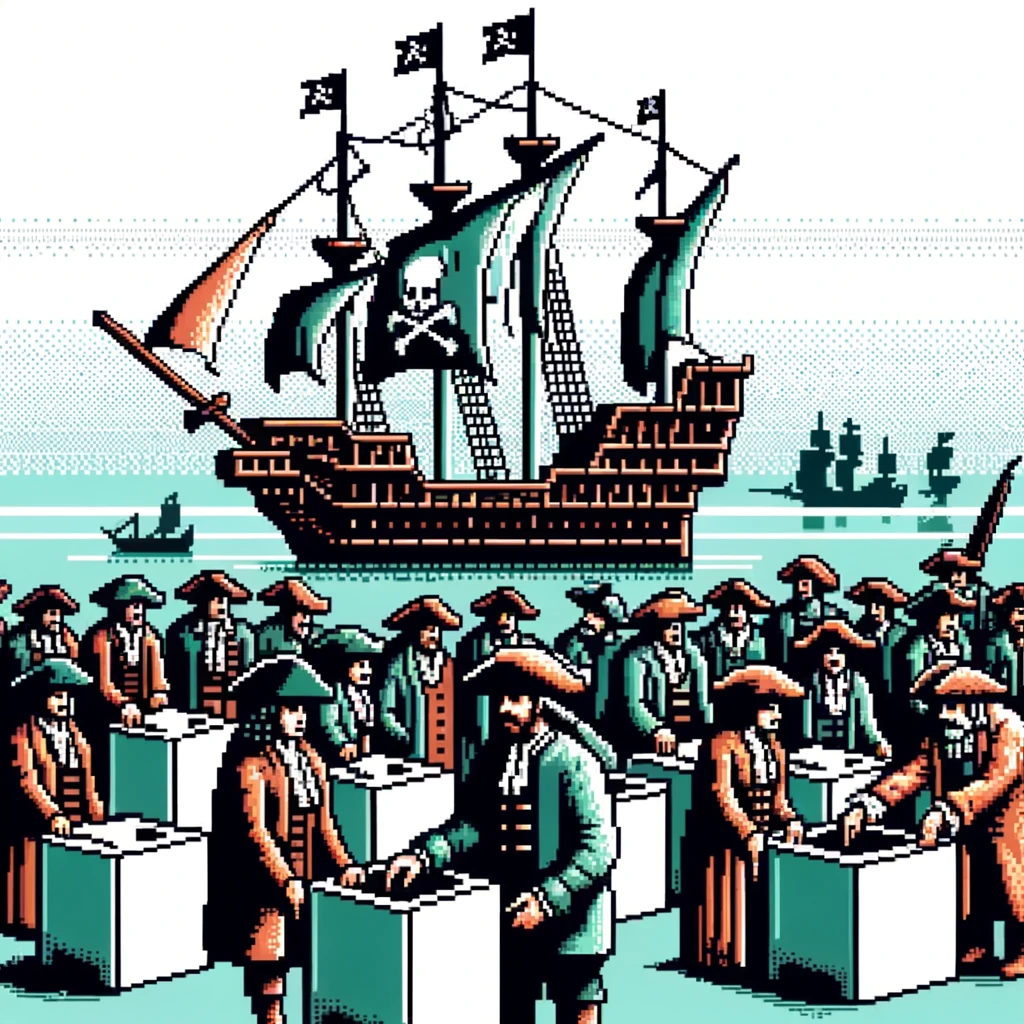
As noted above, pirates eagerly used the vote not only to appoint a captain but also to remove him if he fell short. A system of checks and balances tightly circumscribed the formal head’s role. If an elected leader refused a risky venture while most of the crew were prepared to risk life or limb for the prospective payoff, he was swiftly stripped of his powers.
This simple but effective solution to the “paradox of power” had social effects too. A pirate captain had no privileges beyond higher pay and a private cabin. Otherwise he shared the same life as ordinary sailors: the same rations in the same amount, and the same availability—even at night any subordinate could wake him to discuss personal or collective matters.
No less important was the separation of powers. Though the principle goes back to the Venetian Republic, in the age of the “invisible hook” it was unthinkable in most states. Leeson cites the testimony of an English sailor who, taken prisoner, decided to join the pirates:
“Most of us who had previously suffered from the officers’ ill-usage are now entirely freed from any such grievance. We now have a choice. For proper execution, besides the captain other officers are appointed, so as not to place too much power in the hands of one man.”
The quartermaster played a pivotal role. Elected directly, he ensured fair distribution of benefits among crew members, from provisions to plunder. He was the direct intermediary between the leader and the “people”, and also acted as treasurer. Without this key link pirate democracy could not exist, socially or economically.
Leeson cautions against heroising sea bandits as bearers of lofty ideals—they were nothing of the sort. He argues that these practices, which may strike us as ethically fair, were in fact the product of pure economic rationalism:
“Democratic-type governance on the pirate ship emerged from the chase after the ‘invisible hook’. Pirates were interested in preventing captain abuse so that nothing would impede their coordinated interaction during raids. […] No external authority designed, directed, or imposed democracy on the pirate community. Pirates’ criminal greed led them to adopt this system without prompting from outside.”
In Leeson’s view, democratic self-government combined with a colossal hunger for gain put buccaneers ahead of their time socially. He notes that pirate crews were free of racial prejudice and guaranteed equal rights to all members regardless of skin colour. By contrast, in Britain slavery was outlawed under abolitionist pressure only in 1807, and in the crown’s overseas possessions three decades later.
The economics of the pirate code
Although pirate communities lacked a single command centre, they needed their own non-state regulation (as lawyers today recommend when creating DAOs). In the case of the “invisible hook”, Leeson identifies three basic functions of the “codes” that guided the bandits:
- Resolving potential conflicts within the community. “If crew members were constantly stealing from each other and fighting one another, there could be no cooperation to achieve the enterprise’s goals.”
- Preventing externalities. “Through the carelessness of a smoking pirate the ship could catch fire, and then the large quantity of gunpowder aboard could explode and blow the vessel and crew to smithereens. […] Pirates needed to prevent such threats either by creating additional private property rights or by regulating activity.”
- Regulating non-excludable public goods and benefits. “Anyone who wants to watch a fireworks display can satisfy his curiosity for free. The non-excludability of such a public good as fireworks leads to a ‘free-rider problem’. But if everyone becomes a ‘free rider’, the fireworks will never be launched.”
In piracy, the public good meant collective action—for instance, boarding a merchantman. The booty from such an enterprise was a non-excludable benefit. Part of it went to “social security” for those injured in action—the code’s economic provisions included what today would be called disability benefits.
“Strange as it may seem, the documents closest in spirit to the pirates’ ‘constitutions’ of the 17th–18th centuries were the Puritan evangelical covenants of the same period, drafted by New England settlers. […] Both the evangelical covenants and the pirates’ ‘constitutions’ created systems of private governance for members of their communities, providing a consensual basis for their regulation,” Leeson concludes.
The economics of the Jolly Roger
The most recognisable element of the pirate “brand” was the black flag with a skull and crossbones. Hollywood popularised its modern look. In reality the Jolly Roger came in many variants and could convey different information about a given ship’s crew and intentions.


Why did pirates need to mark their presence so distinctly, warning potential victims in advance? The most obvious answer is intimidation.
Leeson is unconvinced. In his view, through the Jolly Roger pirate communities implemented what modern economists call a signalling strategy. We do something similar in everyday life. Working in an office, one likely follows the firm’s dress code, thereby signalling professionalism. A diploma from a prestigious university signals that its holder is likely highly qualified. Inviting a business partner to an expensive restaurant signals seriousness of intent, and so on.
Thus, without signalling strategy it is impossible, for instance, to conduct an ICO. Experts in this case single out three components necessary for a new project’s success:
- a well-developed roadmap;
- credible information about the board of directors;
- the share of the project the founders are ready to part with.
Leeson argues that pirates also used signalling when forming their “brand”. The skull’s grin on the Jolly Roger was meant not to instil extra horror but to convey clear information: this ship carries pirates who, following their code, will spare you if you do not resist.
“Pirates’ pursuit of profit, which ultimately led them to use the ‘Jolly Roger’, helped to improve the welfare not only of pirates but also of their targets. Ships pursued by pirates certainly would have been better off had they not encountered sea bandits. If that could not be avoided, the ‘Jolly Roger’ ensured a peaceful theft instead of a brutal and bloody battle. Thus, although the ‘Jolly Roger’ was one of the most recognisable symbols of death and destruction, such symbolism is only part of the story. The other part is the lives that were saved thanks to the pirates’ menacing flag,” Leeson believes.
Of course, in presenting such a specific “roadmap” the bandits were guided not by high-minded humanitarianism but by economic expediency. If victims realised in time whom they were dealing with, risks to the pirate ship and its crew were minimised.
Leeson also notes that sea bandits consciously pursued a kind of advertising strategy of reputation-building. To grasp it, he suggests readers recall how we form attitudes to brands. In the car industry, for example, the name Mercedes-Benz almost invariably evokes “German quality”, while Honda conjures affordability and practicality.
Pirates strove for something similar. Their “marketing strategy” was to maintain a reputation as cruel barbarians without moral principles. But they had to weigh costs and benefits carefully. If pirates too often resorted to gruesome executions of those they deemed deserving, future victims would prefer death in battle. Risks for the corsairs would then rise. Conversely, excessive “soft-heartedness” would undermine the pirates’ standing as merciless, highly dangerous foes.

Reception and criticism
Critics’ main complaint about The Invisible Hook is that the author offers overly simple explanations for complex social processes. Economist Alan Kirman argues that Leeson openly romanticises pirates of old and entirely ignores their modern Somali “colleagues”. The reviewer also thinks the phenomena described are the opposite of Adam Smith’s ideas and that the book would be better titled “The Visible Hook”.
Overall, however, the work was well received and brought its author awards from The Week and ForeWord Reviews. And in 2022 Peter Leeson received the Adam Smith Award for an outstanding contribution to popularising the ideas of a free market economy.
“Leeson’s book has an important subtext: if even bandit pirates were able to organise themselves into relatively peaceful communities, perhaps modern people should look less to state coercion and more to the order that arises from voluntary human relationships,” concludes economist Frank Stephenson.
Quotations from The Invisible Hook are taken from: Peter T. Leeson. The Invisible Hook: The Hidden Economics of Pirates. Moscow: Delo Publishing House, 2023. Translated from English by Irina Sheveleva.
Рассылки ForkLog: держите руку на пульсе биткоин-индустрии!