



Only a few months remain until the long-awaited The Merge upgrade, a milestone in Ethereum’s development. Not only will the consensus mechanism change — Ether will become more environmentally friendly and deflationary, potentially supporting its price in the medium to long term.
ForkLog has examined the features of the upcoming upgrade and its potential impact on the investment appeal of the second-largest cryptocurrency by market capitalization.
- Final preparations are underway for Ethereum’s transition to the Proof-of-Stake consensus algorithm as The Merge activates.
- The upgrade will significantly affect the cryptocurrency’s fundamentals, making it deflationary and far more environmentally friendly.
- The pace of Ether issuance will depend on the number of validators and on-chain activity.
A Seven-Year Journey
The transition from Proof-of-Work (PoW) to Proof-of-Stake (PoS) is the most important and complex upgrade in Ethereum’s history. The seven-year-long process has now reached the final stretch.
In the past upgrades were named Serenity, Casper, Shasper, Ethereum 2.0 and, finally, “The Merge.”
The upgrade will change the consensus mechanism that governs how transactions are validated and blocks are produced.


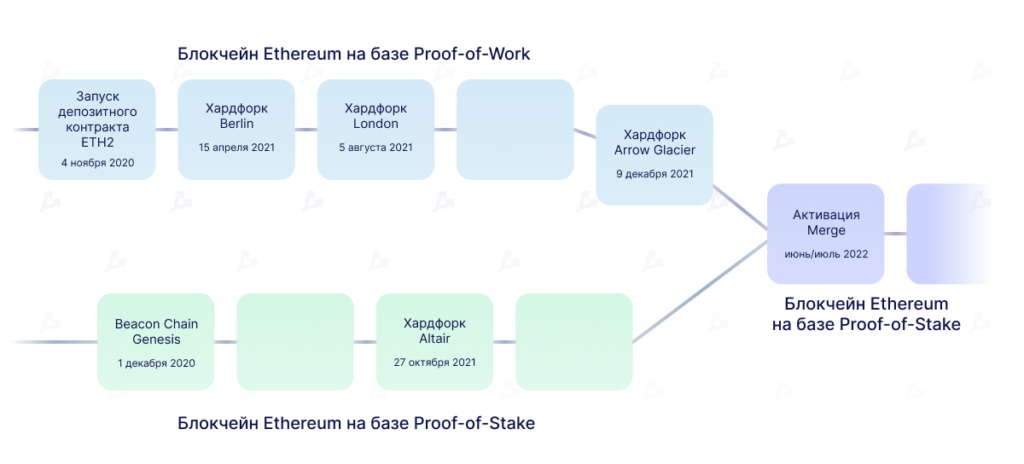
Since 2014, developers have explored the possibilities of PoS as an alternative to PoW systems. Because of its novelty and the limited study of the new algorithm at the time, Ether was launched in 2015 on the basis of the Ethash technology, which relied on Proof-of-Work.
In the same year, developers presented an ambitious roadmap, in which the final development phase was named Serenity. It envisaged a full transition from Ethash to a stable PoS algorithm.
One of the main motives is to raise energy efficiency. Developers expect that, thanks to The Merge, electricity consumption will fall by more than 99.9%. Instead of miners, validators will play the central role in the network, for which 32 ETH are required as collateral.
According to Galaxy Digital Research, the upcoming upgrade will not alter the protocols for user interaction with dapps. No moves of coins will be required from exchange clients, custodial services, or ordinary ETH holders.
From Inflation to Deflation
Currently, most of Ethereum’s new issuance occurs in the traditional PoW blockchain — execution layer. Miners receive 2 ETH per mined block — a total of more than 12,000 ETH per day.


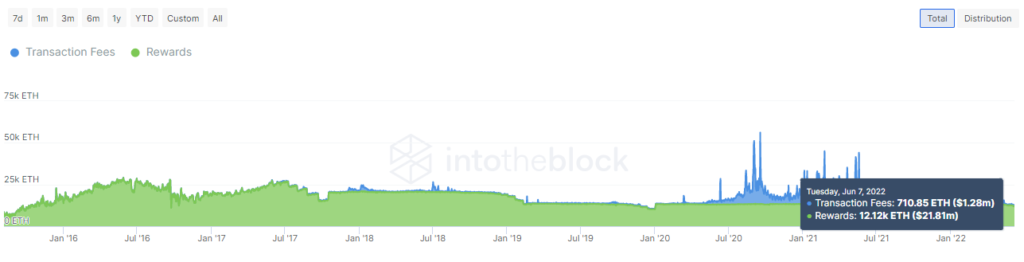
A small portion of ETH is issued on the Beacon Chain. This PoS-based network is referred to as the consensus layer.
The Beacon Chain launch (the zero phase of Ethereum 2) took place on December 1, 2020.
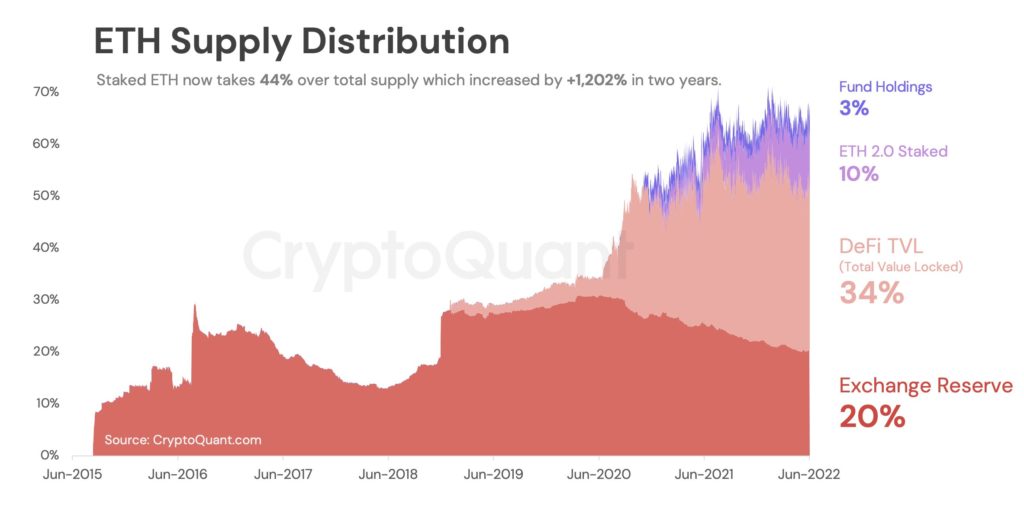
The amount of ETH issued on the consensus layer varies with the number of validators and the amount of ETH staked. Another factor influencing issuance is the burning of a portion of transaction fees depending on network load. This mechanism (EIP-1559) was activated in the London hard fork, since which more than 2.4 million ETH has been burned.


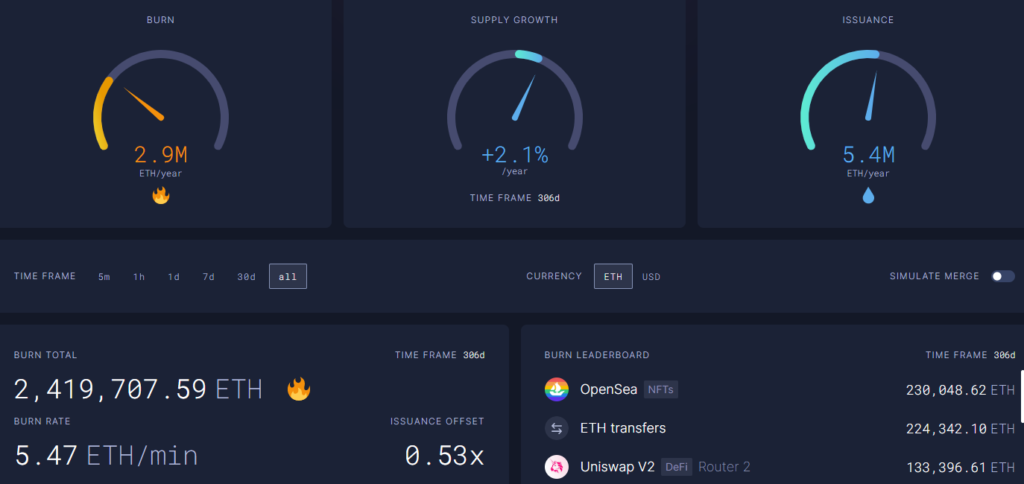
With about 12.7 million ETH staked (roughly 10% of Ether’s circulating supply) and a daily burn rate of 7,900 ETH, inflation would be 2.1%. In other words, the annual new issuance would be around 5.4 million ETH.


The next screenshot is a heat map. It shows how changes in burn rates and the amount of staked ETH at the consensus layer influence Ethereum’s daily issuance.


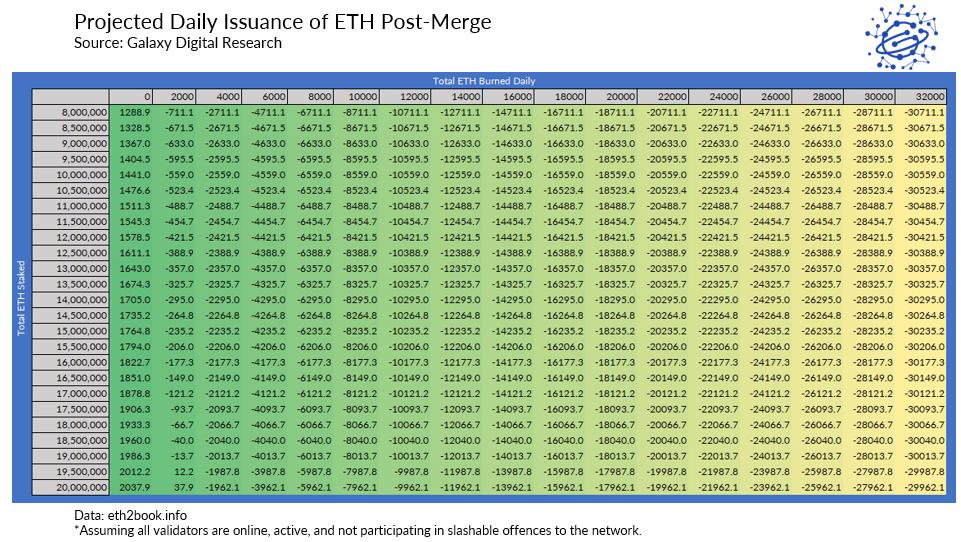
After activation, the emission mechanism no longer contemplates a fixed reward to miners per block. The amount of ETH paid to validators will be dynamic, with each epoch lasting 6.4 minutes.
Assuming 11 million ETH are active on the consensus layer, the heat map above shows that, under this parameter, 1,511 ETH would be issued per day.
If we account for coin burns — for example, 4,000 ETH per day — Ethereum would become deflationary. The supply would shrink by 2,489 ETH per day or about 0.77% per year.
The amount burned directly depends on on-chain activity, which after the DeFi and NFT hype peaked has slowed. The chart below shows that compared with May 2021 peaks, the number of transactions on the Ethereum network has fallen significantly. The daily figure is below 1 million, matching early-2018 levels.


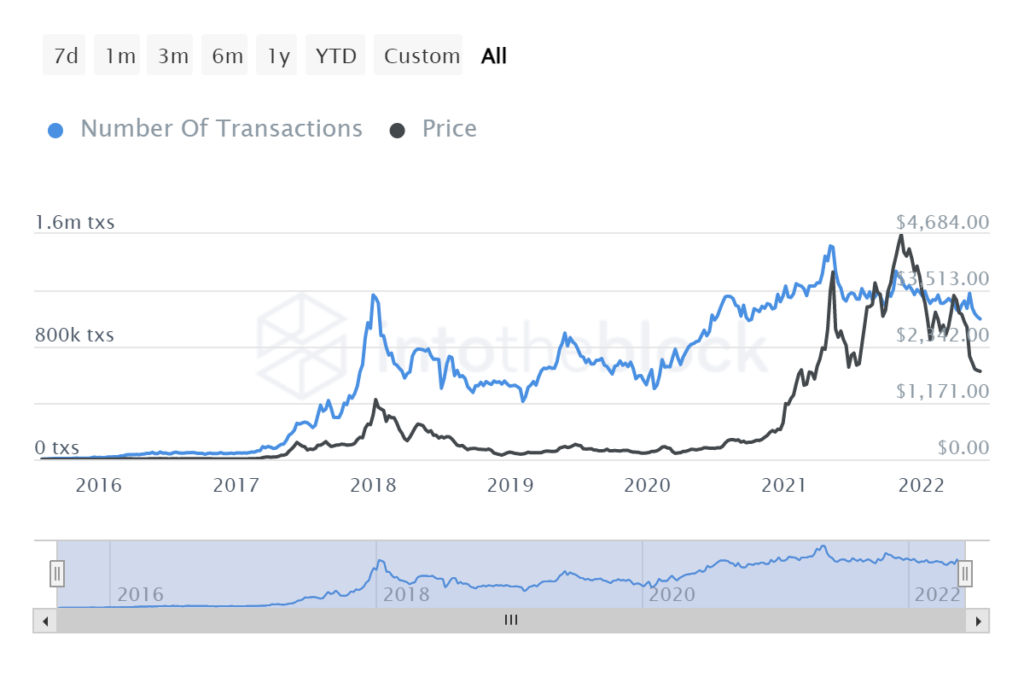
«If adoption by users of Ethereum grows in the coming months and years after the Merge upgrade, Ether’s supply will shrink even faster», said Galaxy Digital Research.
Then, they say, the value proposition of the second-largest cryptocurrency will strengthen, especially in the context of a store of value.
As noted earlier, the security of the PoS network is provided not by energy-intensive miners but by validators who lock in ETH as collateral. The more ETH staked, the harder it is for a potential attacker to seize control of the system and alter transaction history.
The Ethereum consensus layer is designed so that validator rewards automatically adjust based on the amount of ETH staked.


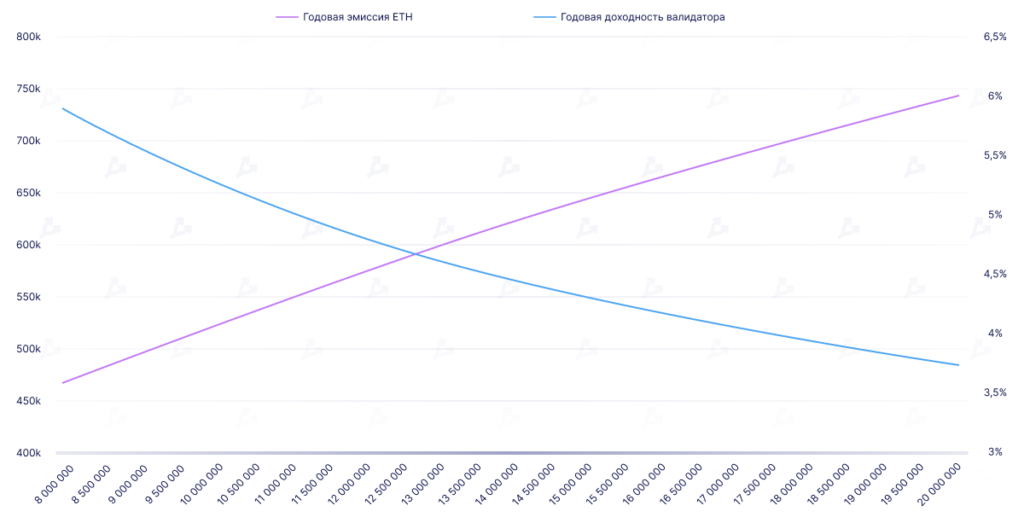
When the amount of ETH staked grows and many validators operate, yields fall. Conversely, when there are few validators and little ETH staked, yields rise to incentivise greater participation in the network.
As of 8.06.2022 there were 399,554 validators.


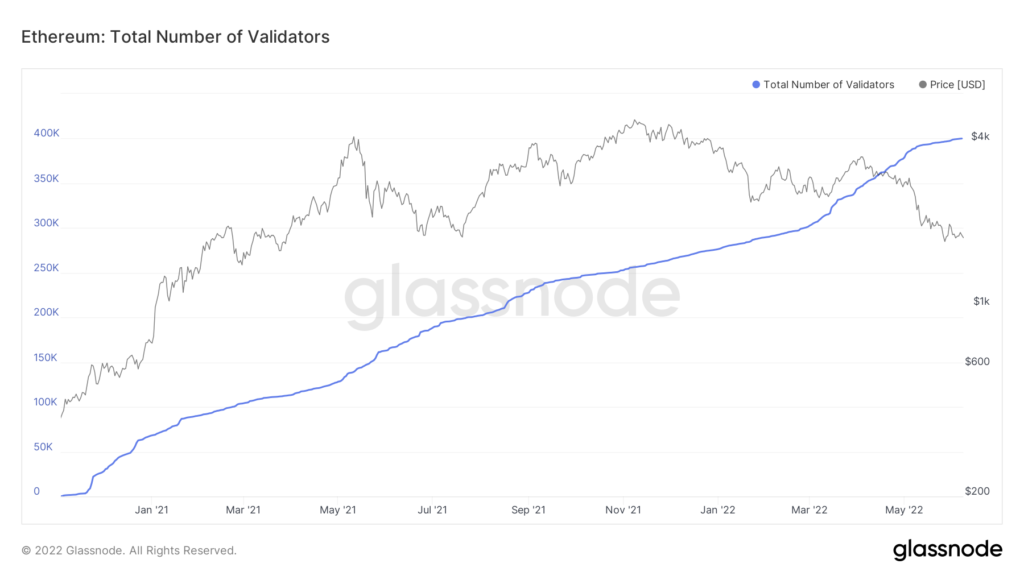
The issuance rate, being algorithmically variable, ensures that validators remain sufficiently incentivised to work, regardless of how much ETH is staked.
«However, this dynamic approach poses challenges when forecasting Ethereum’s monetary policy in the long run», said Galaxy Digital Research.
Beyond the amount of ETH staked and the amount burned, analysts should also consider less obvious indicators: online validators and those subjected to slashing.
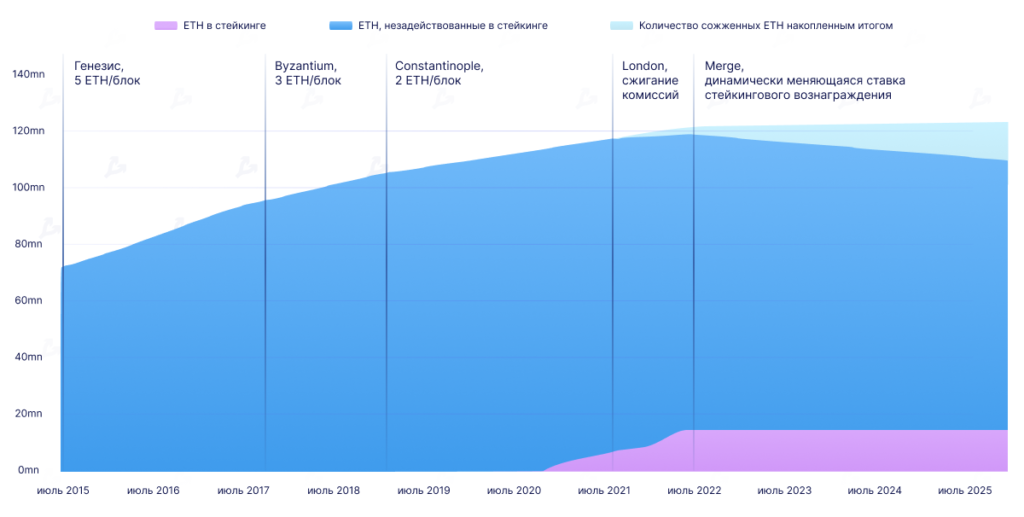
The chart above illustrates the projected decline in ETH supply after The Merge. According to Ultra Sound Money, burning 2.9 million ETH per year (or about 8,000 ETH per day, the average since EIP-1559’s activation) will reduce the circulating supply by about 2% per year.
Other factors will influence the makeup of revenue:
- Priority fees that Ethereum miners currently receive will go to active validators after The Merge. According to Coin Metrics, total such “tips” amount to just over 1,000 ETH per day, and roughly the same as daily validator revenue. Consequently, the latter’s income will double.
- In addition to tips, validators will earn Maximum Extractable Value (MEV). Researcher Flashbots’ Alex Obadia counted that MEV inflows could raise their incomes by about 75%.
Liquid Staking and Centralisation Risks
Increasingly, the Beacon Chain’s stake is concentrated among firms operating under the Staking-as-a-Service (SaaS) model. The undisputed leader in this segment is the liquid staking service Lido.
The chart below shows that large exchanges such as Kraken, Binance and Huobi carry significant weight as well.


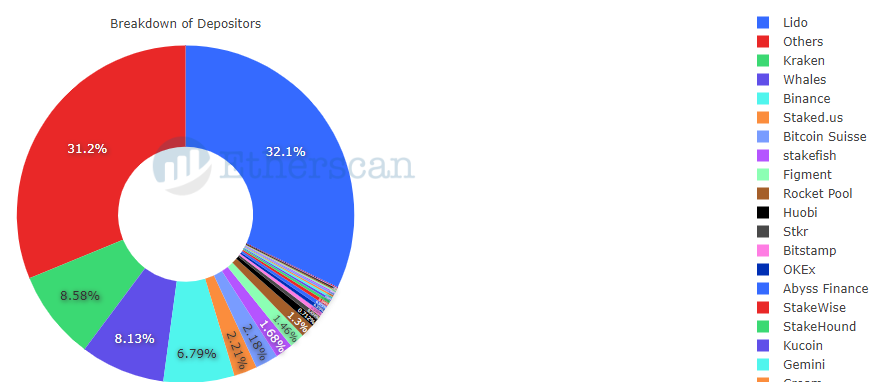
Popular SaaS providers simplify staking by allowing delegation. Users do not need to own 32 ETH — small sums suffice. Moreover, many SaaS providers offer insurance against losses from slashing. Liquid staking services also boost capital efficiency — for example, Lido issues derivative tokens representing funds locked in staking contracts. Such coins can be used in DeFi protocols to earn additional yields.
«Given higher yields on ETH derivatives than ETH itself, tokens like rETH and stETH could at some point become competitors and even surpass Ether in liquidity and acceptance as the baseline for DeFi operations», said Galaxy Digital Research.
The chart below shows that Lido far outpaces competitors in its segment.



Co-founder of Bankless Ryan Sean Adams suggested that, over time, ETH could become something like perpetual internet bonds, whose holders are both creditors and owners of the network. In this sense, Ether, as the base asset, will be less and less used in dapps.
With the range of interesting options from SaaS providers, one can expect further growth in their popularity and, therefore, in the value of assets under management (TVL).
The segment is moving toward greater decentralisation. For example, Lido is implementing distributed validator technology. A newer service — Rocketpool — is gaining momentum as a decentralised staking platform.
When Will the Merge Be Activated?
The Merge testing is in full swing: on June 8, Ethereum developers moved the Ropsten testnet to PoS. In the coming weeks, transitions of Goerli and Sepolia are expected.
In May 2022, one of the leading developers, Preston Van Loon stated that the mainnet transition to PoS would occur in August. Vitalik Buterin also said the latter part of summer was most likely, but allowed postponement to September–October if risks emerge.
According to Messari’s conservative scenarios, The Merge could be activated in November–December.
5/ The fundamental improvements for long-term attractiveness include:
+Protocol Energy Reduction
+Issuance Reduction
+Net Deflationary
+Bond-Like Yields
+Increased Decentralization
+Slightly Increased Throughput pic.twitter.com/dhjRT8tJTF— Messari (@MessariCrypto) June 7, 2022
Analysts are confident that after the upgrade Ethereum will no longer be viewed as a utopian experiment. On the contrary, the cryptocurrency will attract long-term investors.
Messari suggested that staking rewards will lie in the 7%-13% range.
Future Developments
After The Merge, the Shanghai hard fork will be a key milestone. It is intended to improve scalability, enable withdrawals of staked funds, modernise the Ethereum Virtual Machine (EVM).
In March, Vitalik Buterin shared Proto-danksharding ideas — a data-check scenario focused on transactions and the so-called blobs that the EVM cannot execute.
My own EIP-4844 (aka. proto-danksharding) technical FAQ:https://t.co/SlgNERBYVc
— Vitalik Buterin (@VitalikButerin) March 19, 2022
Proto-danksharding is intended to replace danksharding — the technique of sharding, in which only a single proposer selects all transactions and data entering a given shard. This approach was presented by Ethereum Foundation researcher Dankrad Feist in February 2022.
The Ethereum founder proposed automatically pruning data from large binary objects every 30 days, to avoid placing excessive demands on data and storage memory.
There is also EIP-4488, aimed at expanded use of Rollups on Ethereum. Initially, this relatively simple solution was planned to be implemented before The Merge. EIP-4488 reduces the cost of sending batches of transactions from Layer-2 networks to the Ethereum blockchain by a factor of five.
«Although The Merge is the most complex upgrade in Ethereum’s history, this is not the end of network upgrades», said Galaxy Digital Research.
After that, researchers believe developers will focus on other urgent, long-standing issues such as scalability and statelessness.
Galaxy Digital Research also forecast other consequences of Ethereum’s switch to PoS:
- The popularity of GPU mining will wane. Some miners will switch to alternative coins like Ethereum Classic or Ravencoin. Many will simply sell their GPUs, which will then end up with gamers and designers. This will depress device prices and affect manufacturers’ revenues.
- Bitcoin, the largest PoW cryptocurrency, will be lambasted even more for the network’s energy intensity.
Conclusions
Optimistic forecasts foresee activation of The Merge in August. Yet, given the technical complexity and developers’ tendency to delay upgrades, the event could occur in late autumn as well.
One of the most significant consequences of moving to PoS will be the exit of miners. This could substantially affect market dynamics in the short term. Sales pressure is likely to ease, while hash rates of altcoins such as Ethereum Classic may rise.
In the medium to long term, Ethereum could become a more attractive investment. First, the project will prove its antifragility. Second, the asset will align with the trend toward eco-friendliness.
Finally, deflation will surely play its part. That said, the degree of deflation will depend on user activity.
The Merge is by no means Ethereum’s last major upgrade. It will support the scaling agenda, where sharding and Rollups play a central role.
Subscribe to ForkLog news on Telegram: ForkLog Feed — all the news, ForkLog — the most important news, infographics, and opinions.