



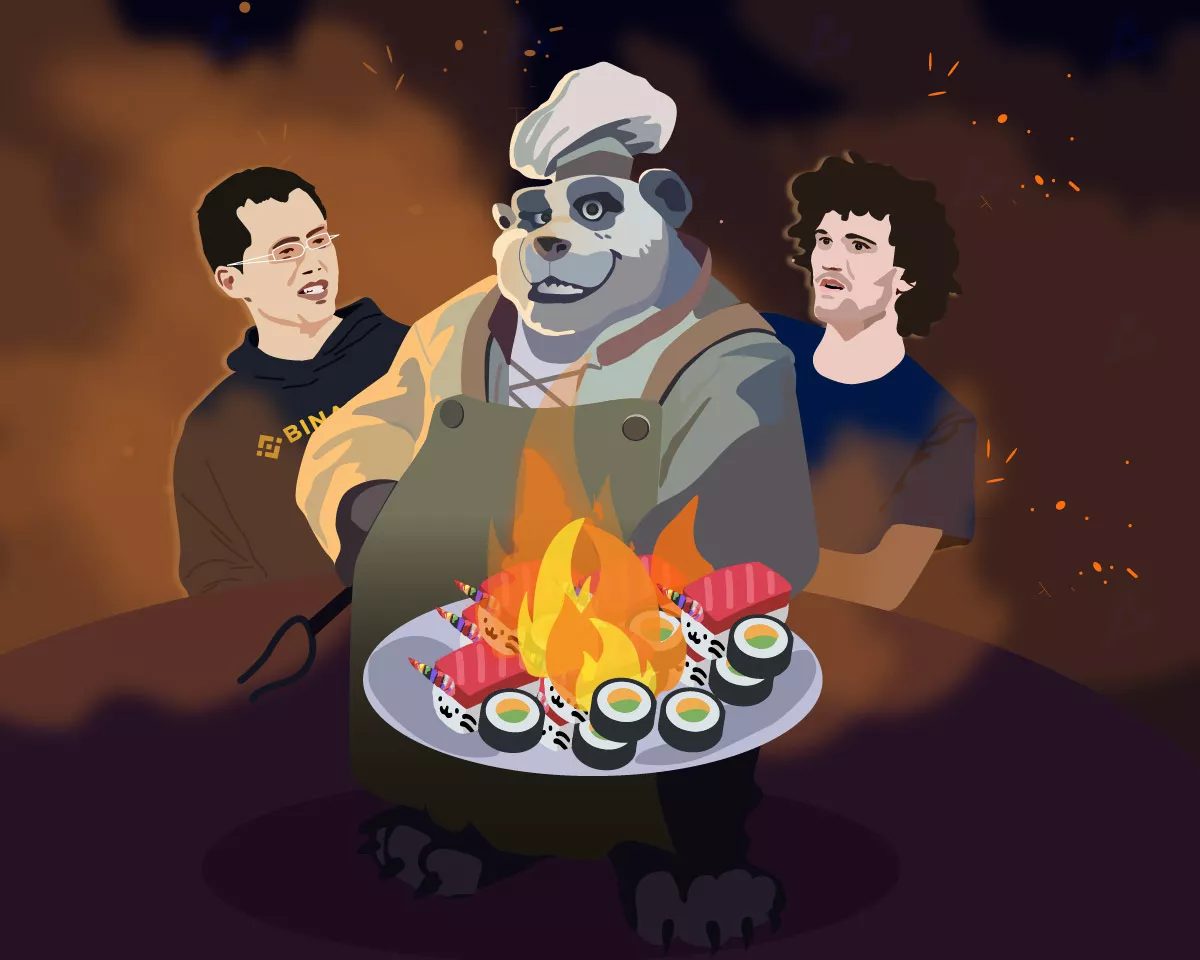
On September 3, the total value locked in the decentralized exchange Uniswap approached a record $1.8 billion. However, by September 10, in a single day, the exchange had lost more than 70% of that amount. Funds migrated to a fork of Uniswap with the culinary name SushiSwap, which had launched just two weeks earlier.
Despite the short window, a number of events surrounded the new project, took $14 million from the developers’ fund, and then returned it with apologies.
ForkLog has delved into SushiSwap’s twists and turns and explained how the project poached liquidity providers from the leader of the DEX space.
How does SushiSwap differ from Uniswap?
Uniswap operates on a liquidity-pool model, which replaces order books. A user who locks up their coins in one of the exchange’s smart contracts becomes a liquidity provider. The locked tokens are pooled into liquidity pools. A pool with the new token can be opened by anyone.
Users can execute swaps between any tokens listed on the exchange. Each trade incurs a fixed 0.3% fee. It is distributed among liquidity providers in proportion to their share of the pool. A liquidity provider can withdraw all their funds from the pool, but then they will stop earning fees.
Despite the elegantly implemented system, Uniswap has repeatedly faced criticism for a lack of decentralisation, namely the absence of a decentralised governance system.
Since launch, the fee rate has remained unchanged, though the advent of yield farming has increased competition with other DeFi applications.
What is yield farming in DeFi and how do you earn from it
What is yield farming in DeFi and how do you earn from it.
On August 26, a Twitter user under the alias Chef Nomi introduced SushiSwap, calling it the “evolution” of Uniswap. The anonymous creators of SushiSwap cited a new incentive system based on the SUSHI governance token as the main difference.
1/ Introducing #SushiSwap🍣, an evolution of #Uniswap with $SUSHI tokenomics. SushiSwap protocol better aligns incentives for network participants by introducing revenue-sharing & network effects to the existing AMM model.https://t.co/Ywe9Gs8Pjx
— Chef Nomi #SushiSwap (@NomiChef) August 26, 2020
“I present SushiSwap, the evolution of Uniswap with SUSHI tokenomics. The SushiSwap protocol provides better incentives for network participants by introducing revenue sharing and network effects to the existing automated market maker model.”
However, SUSHI was used primarily to lure liquidity providers away from Uniswap.
According to SushiSwap’s tokenomics described in the project’s blog, the trading fee remains 0.3%, but only 0.25% goes directly to pool participants — the remaining 0.05% is converted into SUSHI tokens and distributed among all token holders. This provides a way to earn passive income even after exiting the pool.
The Ocean of Liquidity
SUSHI tokens are minted every Ethereum block, starting from block #10,750,000. Initially they were distributed as free rewards to participants in 13 special Uniswap pools, created via the SushiSwap site.
In the SushiSwap protocol the issuance is fixed at 100 tokens per Ethereum block, though the period before migrating to SushiSwap reportedly saw this figure increased tenfold to reward early users.
Users began investing in SushiSwap pools. Yields rose with the locked value, reaching hundreds and even thousands of percent per year (APY). In the native SUSHI/ETH pool, the token reward was doubled, making it the most profitable.
According to DeFi Rate, as of August 31 the SUSHI/ETH yield had reached 1500% per year. The need to acquire SUSHI tokens to participate in the pool also pushed the token price higher.


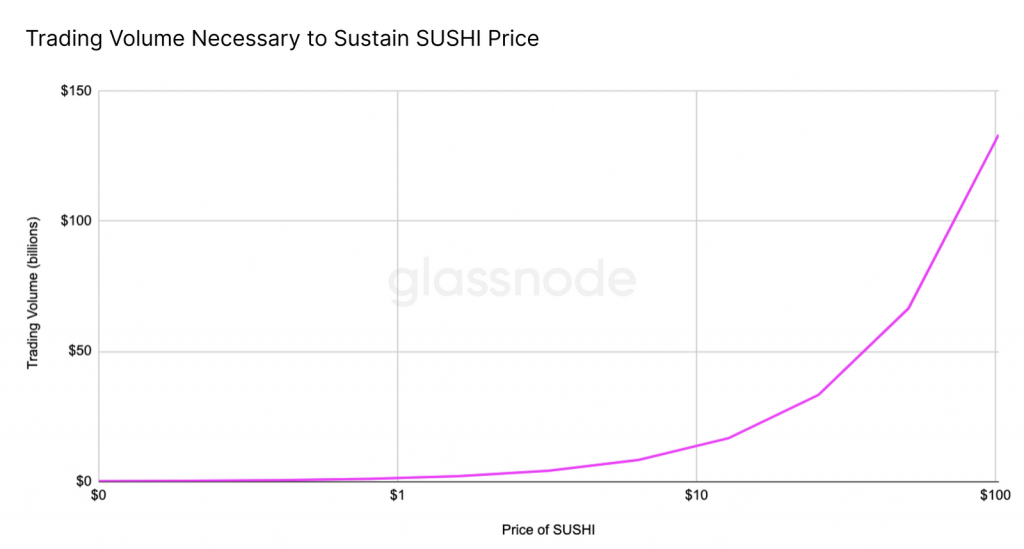
Liquidity vs price of SUSHI in SushiSwap depending on demand for fees. Data: Glassnode.
Sushi for Developers
A crucial point is that holders and liquidity providers do not receive all SUSHI tokens: 10% of new coins are automatically directed to a developers’ fund. This fund was at the heart of a major scandal in the project’s early days.
On September 5 it emerged that the project’s leader, the “Chef Nomi”, unilaterally moved $14 million of SUSHI intended for developers, despite having previously promised in the community’s Discord chat that this would not be done. As a result the price of SUSHI plummeted by 50%.
The hype, FUD and scandals led to pronounced volatility in the native token.
Nomi’s two colleagues are the Discord chat participants going by the handles sushiswap and 0xMaki. It seems that Nomi did not coordinate his sudden departure with them: after news of the exit, 0xMaki apologised to users on Twitter:
“I will wait for @NomiChef to wake up. He has 12 hours to contact me, or I will reveal everything and commit 切腹 of this account. Currently writing the whole story. The project can still live without Nomi. Sorry for being a failure and a disappointment.”
Later in an interview with Chinese outlet CoinDesk, Maki said that SushiSwap’s initial success was aided by an audit of the code from Quanstamp—researchers did not find critical vulnerabilities (although flaws in the code existed).
Maki learned about SushiSwap from social media and joined voluntarily in the early days when, he says, the technical work was largely done, though “Nomi and sushiswap simply copied the Uniswap and YAM code.”
Management Migration and the Return of the ‘Chef’
After Nomi took “his share”, he officially handed over the reins to the head of the exchange FTX and Alameda Research, Sam Bankman-Fried. FTX remains a major holder of funds locked in SushiSwap’s contracts. On September 9, under Bankman-Fried’s leadership, a successful migration of SushiSwap pools worth $1 billion to its own protocol took place.
In addition, Bankman-Fried initiated a nine-member supervisory board with access to the developers’ multisig wallet. Voting on the council elections was conducted with SUSHI tokens. More than two thousand addresses participated. Among those elected was the prominent project critic Adam Cochran.
Meanwhile, on September 11, “Chef Nomi” returned the funds taken from the developers’ fund and apologised to followers. The price of SUSHI rose a quarter as a result.
“I hope that SushiSwap continues to evolve. Don’t let my mistake deter it from becoming a 100% community‑run AMM. The success of SushiSwap will set a precedent for many more community-run projects,” he wrote.
I hope that SushiSwap continues to evolve. Don’t let my mistake deter it from being a 100% community-run AMM. The success of SushiSwap will set a precedent for many more community-run projects.
— Chef Nomi #SushiSwap (@NomiChef) September 11, 2020
Possibly, this move was meant to reassure detractors. After all, some have threatened to sue claiming that the “Chef” triggered a SUSHI dump. While his real identity remains unknown, US authorities, including the FBI and the IRS, could be drawn into the case.
In response to the dump, Binance also faced criticism for listing SUSHI before the dump. Changpeng “CZ” Zhao emphasised that Binance is doing all it can to avoid ceding a competitive edge to rivals. Some in the community argued that listing SUSHI breached the exchange’s own rules. Theories circulated on Twitter as conspiracies.
Are Whales Playing in DeFi?
The threat of liquidity outflows from Uniswap prompted Hayden Adams, the inventor of the protocol, to comment. On September 1 he said that SushiSwap is a project run by a relatively small group of professional speculators:
“Can’t tell who is pretending and who genuinely doesn’t understand that the $1B TVL deposited in incredibly high-risk investments on a one-day notice is mostly massive whales.”
1/
Can’t tell who is pretending and who legitimately doesn’t understand that the $1B TVL deposited in an incredibly high risk investment on a single days notice is mostly massive whales
Anyone talking about community vs VC here is either delusional or intentionally misleading.
— Hayden Adams 🦄 (@haydenzadams) September 1, 2020
Adams may be close to the mark in suggesting whales are involved in SushiSwap—large investors are indeed showing interest in DeFi apps.
On September 1 there were about 2,200 addresses in the SUSHI/ETH pool on Uniswap, with total value around $173 million—roughly $75,000 per address. Nearly the same number of addresses voted for holders of the developers’ multisig wallet.
CoinDesk notes that the governance element in SushiSwap has spawned a generation of “protocol politicians” in DeFi who seek public support on the future of their projects.
Fedor Anashchenkov
Subscribe to ForkLog’s Telegram news feed: ForkLog Feed — all the headlines, ForkLog — the most important news and polls.