




Only recently Ethereum holders could stake ETH and earn up to 4% a year. Now the market also offers restaking protocols that can deliver double—or even triple—benefits.
Anton ProfiT — creator of the YouTube channel and PROFIT MAFIA Telegram channel — discusses several such platforms for ForkLog.
EigenLayer
How it works. The EigenLayer protocol is built on Ethereum and lets users safely deploy assets earned from staking, farming and other activities into third‑party dapps without extra approvals. This allows ether already staked in one place to be redeployed and earn additional yield.
For restaking ETH on EigenLayer, holders also accrue project points. The longer the ether remains here, the more points are credited. The project will convert these points into its own tokens, so you earn not only staking yield but also prospective cryptoassets.
Outlook. EigenLayer has raised $164.5 million from the likes of a16z, Coinbase, Blockchain Capital and Polychain. The project’s TVL exceeded $10 billion on 6 March 2024. On this metric, EigenLayer has overtaken Aave.
Renzo
How it works. Renzo is a new liquid-staking protocol built on EigenLayer. As with EigenLayer, you can stake ether and receive both staking yield and project points that will later be converted into tokens.
Outlook. The project launched only recently and has already raised $3.2 million from Binance and other funds. As of 6 March, TVL ~$860 million and continues to grow.
Zircuit
How it works. Zircuit — the third protocol in this stack, designed to amplify returns. It helps extract maximum benefit from deployed ETH. Here, too, you can stake ether, earn yield and points for which an airdrop will be provided.
Outlook. At publication, the TVL of the project, launched in November 2023, exceeds $490 million.
What next?
And here is the key point — with 1 ETH, a user can farm points in all three protocols at once. There is no need to allocate funds to each project separately to receive tokens from all of them. This materially boosts the chances of a healthy airdrop. We proceed as follows:
1. Go to the Renzo website, click Connect Wallet, accept the terms and connect your wallet on Ethereum Mainnet.


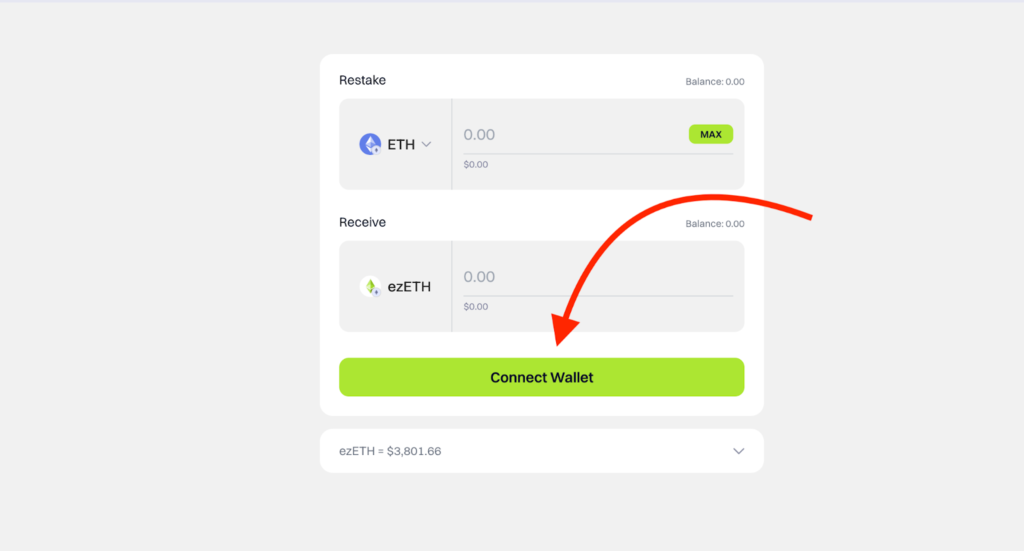
2. Convert ETH to ezETH by clicking Confirm and signing the transaction.
The fee in our case was $80.


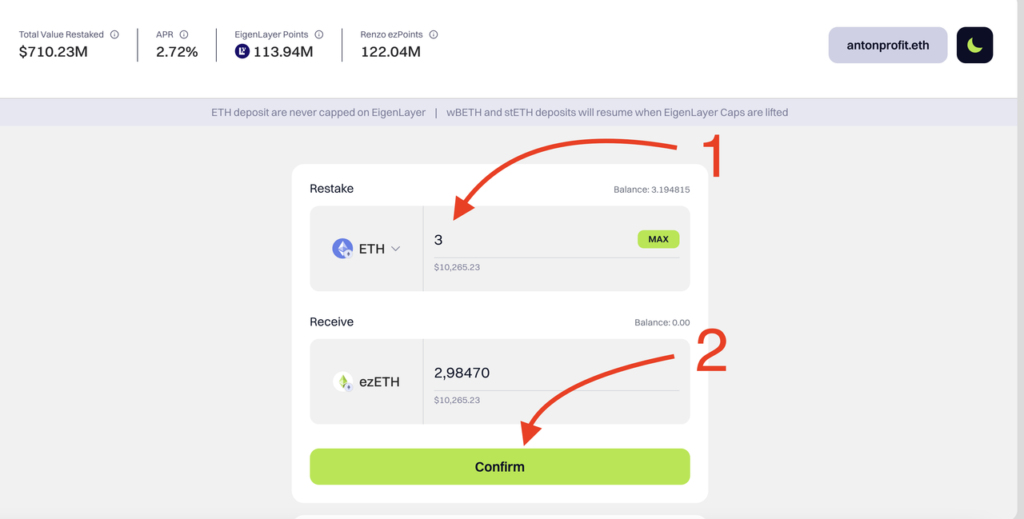
Important notes:
- all actions were executed with gas at 65 gwei;
- we committed 3 ETH to this activity;
- MetaMask warned it would charge $160, but the final amount was half that;
- by converting ETH to ezETH, we accrue EigenLayer points and Renzo ezPoints;
- points can be tracked on the Portfolio tab (credited every 24 hours);
- withdrawals will be available by the end of the first quarter (ie in March).
3️. On the Zircuit website, enter code CA1CCY (if it did not auto-fill) and click Connect Wallet. Without the code you will not be able to register.


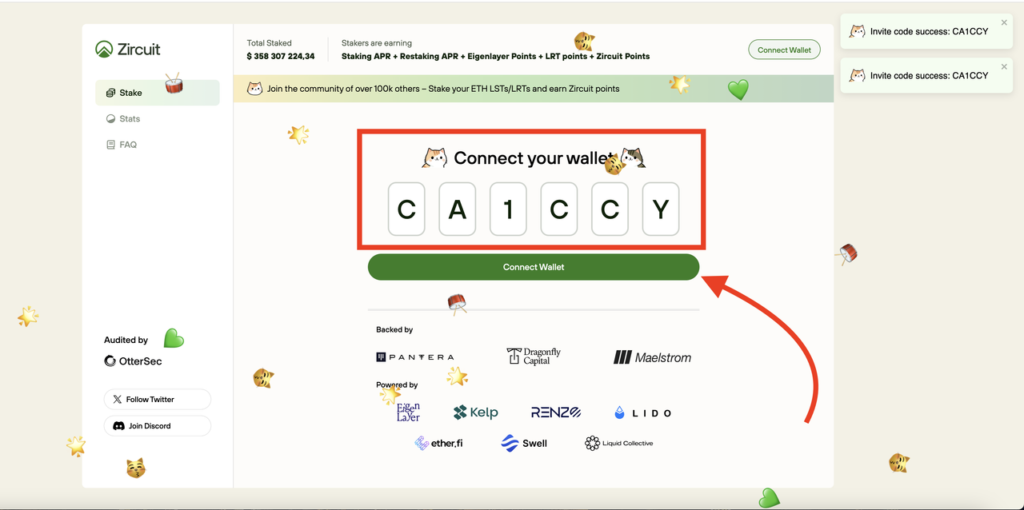
4. Click Sign and authorise the action in MetaMask.
5️. Next to RENZO, click MAX, then Confirm.


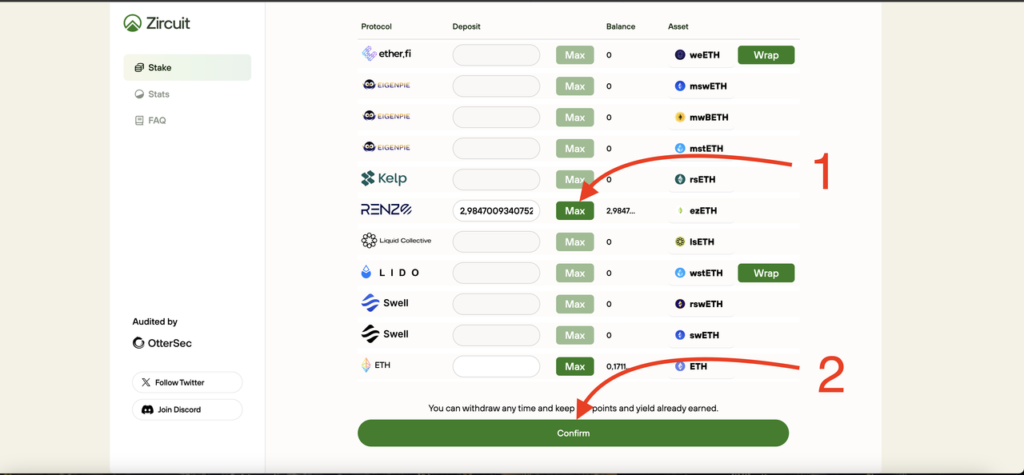
Then sign two transactions in your wallet. The fee was $25.29.
Important notes:
- you can also add weETH from EtherFi and swETH from Swell;
- point data are shown in the Points section and accrue every second.
6. After depositing ETH, you can optionally complete Galxe quests from Renzo, but this is not required.
The entire process took about ten minutes. We spent $105.29 on ETH network fees at 65 gwei.
Conclusions
For ETH holders, such projects are attractive primarily for their airdrops. There is also less competition, since meaningful participation requires substantial capital.
Beyond staking yield, each unit of ether can earn an airdrop in all three projects at once, materially increasing the odds of extra income.
However, note that this approach works only with deposits of at least 0.5 ETH. The longer you hold your tokens, the more points you will have accrued by the time of the airdrop—and the larger your potential payout.