



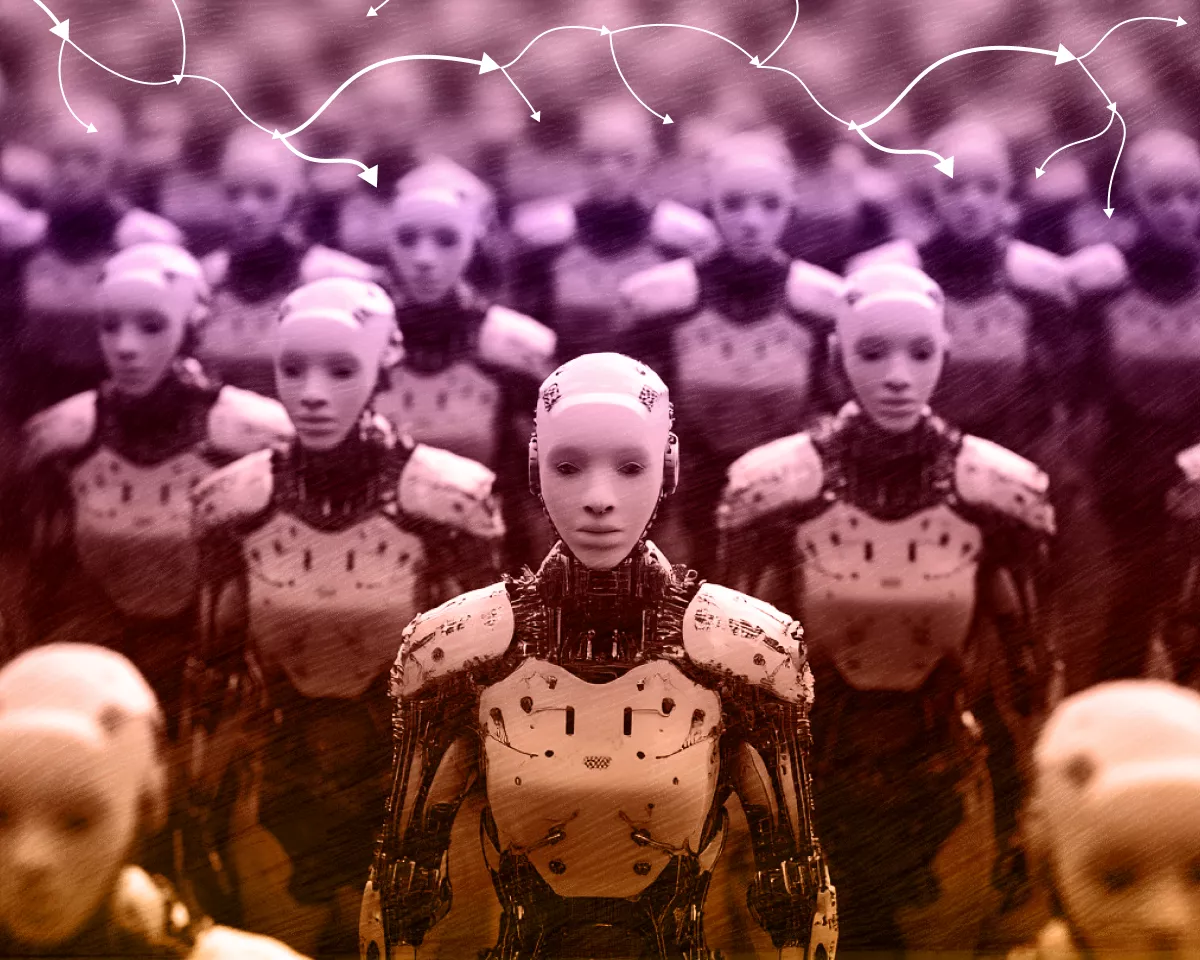
In 2024 Daron Acemoglu, James Robinson and Simon Johnson were awarded the Prize in Economic Sciences in Memory of Alfred Nobel “for research into how institutions are formed and influence prosperity.”
Shortly beforehand, Acemoglu and Johnson published Power and Progress, which touches on the pressing questions of artificial intelligence and Web3 as new actors in the economic system. ForkLog read the book and explains why some of the laureates’ observations are especially salient for the crypto community.
Rich North, poor North
Acemoglu and Robinson rose to wide prominence in 2012 with the popular-science bestseller Why Nations Fail: The Origins of Power, Prosperity, and Poverty (published in Russian under the title “Почему одни страны богатые, а другие бедные”). The book opens with a now-classic example linking the openness of governing institutions to the prosperity of citizens.
They describe Nogales, a city split by historical accident between two states. Nogales, Arizona lies to the north; Nogales, Sonora to the south.
The “northerners’” income, the economists note, is average to above average. The American Nogales is a well-off city whose residents have reliable access to healthcare, electricity, food and entertainment, and live without fear for life and limb. Private business thrives and most people have a good education.
The picture is very different in the southern, Mexican part. There, healthcare and education are privileges not available to everyone; people drive old cars on broken roads and face the daily risk of being robbed. Opening a shop is impossible without paying numerous bribes to officials.
The authors of Why Nations Fail ask why. In essence, Nogales is one city settled by descendants of colonists who share a culture and live in identical climatic and geographical conditions. What then explains the stark difference in their economic fortunes?
For Acemoglu and Robinson, the answer lies in how deeply people are involved in running their city. Residents of northern Nogales elect their mayor, sheriff and judge—and can withdraw their confidence at any time, replacing them with more effective administrators and law enforcers. In Mexico, attempts at democratic reform collide with the resistance of cartels and their corrupt allies in government.
An even more extreme divergence can be seen on the Korean peninsula, where one historical and cultural community, under similar conditions, created two utterly dissimilar states.
The Republic of Korea, with Seoul as its capital, is a full-fledged democracy and one of the world’s leading economies with a high quality of life. The branches of power are independent in practice, not only on paper. In December 2024 this was vividly demonstrated by a political crisis in which parliament swiftly overturned martial law imposed by the now former president Yoon Suk Yeol. Lacking abundant natural resources, the country has developed a thriving tech sector and steadily attracts major international investment.
The opposite holds in the Democratic People’s Republic of Korea, whose de facto capital is Pyongyang. Since 1948 supreme power in this highly authoritarian state has been hereditary, confined to the Kim family. Parliament, nominally multiparty, is purely decorative. The planned economy often fails to meet even basic needs; a black market flourishes on the back of intricate corruption. The DPRK’s budget is conspicuously skewed toward the military‑industrial complex, and talented programmers are invited to apply their skills in openly criminal activity.


In their work Acemoglu and Robinson dismantled the notion that some countries are doomed to fail because of history, culture or geography. They supplied the factual and analytical underpinnings for what had been intuitive: the more open public and financial institutions are to citizens, the likelier a country is to prosper. For this, Acemoglu and Robinson, together with Simon Johnson, received the 2024 economics prize in memory of Alfred Nobel.
Acemoglu’s most recent major work, co‑authored with Johnson, is Power and Progress: Our Thousand-Year Struggle Over Technology and Prosperity. In it the duo applies their insights on open institutions to the problems of technological progress and corporate power. On progress as it is currently unfolding, the authors reach a bleak conclusion:
“Some optimistically assume that new technologies, such as Web3 or metaverses, will produce a different dynamic [counter to the observed erosion of democratic institutions]. But as long as today’s business models dominate the IT sector and governments are preoccupied with monitoring their populations, current trends will most likely intensify, creating ever more resilient information bubbles and an ever greater disconnect from reality.”
There is an alternative, and the laureates contend it is attainable—if we identify the root of today’s problems.
A private general AI
“In three years, in eight years at most, we will have a machine with the general intelligence of an average human. At that point the machine will start to teach itself at a fantastic pace. Within a few months it will reach the level of a genius, and in the following months its capabilities will become incalculable.”
These words were not uttered by Sam Altman or Elon Musk. They were confidently spoken in 1970 by Marvin Lee Minsky, an American scientist and pioneer in artificial‑intelligence research and design. He died in January 2016, before even the beta of OpenAI Gym appeared.
Acemoglu and Johnson argue that we are witnessing a third wave of AI euphoria. The first came in the mid‑20th century, when Minsky’s view was not fringe but a scientific consensus. When enthusiasm met reality, research all but froze.
The second wave arrived in the 1980s, when scientists built early expert systems that, for example, recognised infectious diseases. Again, the community proclaimed that machines would soon replace doctors. When that promise went unfulfilled, funding dried up and the public forgot about AI until the early 21st century.
It seems scholars and entrepreneurs in AI keep repeating the same mistake. It is this.
All automation rests on principles exemplified by the Jacquard loom, which sparked a technological revolution in 1804: let the machine handle the routine (weaving) and allow the human to focus on the creative (designing the pattern). For two centuries, industrial automation put precisely this division of labour into practice.
In the 1990s, for instance, ATMs proliferated, taking over simple tasks once done by tellers. Yet bank branches did not rid themselves of clerks. Indeed, such replacement was never the point: in any branch an endless stream of cases arises that demands human intervention and cannot be delegated to a machine.
For some reason this principle is cast aside whenever AI is discussed. AI is not expected merely to take on routine functions; it is expected to replace humans entirely. Acemoglu and Johnson warn of the danger in this approach.
The threat is not that AI will eliminate jobs. Low‑skill roles have long been automated across most industries; AI adds nothing qualitatively new to that process. The real problem, they argue, is that by shrinking the labour market AI offers no compensation for human agency—save that it does not demand rights:
“In the past, by encouraging uses of machines and algorithms that complemented human capabilities and made people stronger, we achieved technological breakthroughs of great practical value. By contrast, infatuation with artificial intelligence spurs the mass collection of data, the disempowerment of workers and ordinary citizens, and a turn to automation even where it amounts to ‘automation with quality loss’—that is, where automation yields almost no gains in productivity. It is hardly a coincidence that such ‘second‑rate’ automation seriously enriches only one group—the people who control digital technologies.”
This sort of “automation with quality loss”, Acemoglu and Johnson maintain, will ultimately raise neither the productivity of the “optimised” firm nor the quality of life of ordinary people. In their view, AI serves its purpose only when it:
- increases labour productivity;
- creates new tasks and helps execute them with machine intelligence that complements humans;
- provides useful information to ease decision‑making;
- creates new platforms on which people with different skills and needs can interact.
Otherwise AI does not improve economic outcomes or living standards; it accelerates the drift toward what they call a new estate‑based society.
“Today we are ever closer to the future described in The Time Machine, H. G. Wells’s dystopia. Our society already consists of two estates. At the top are magnates, firmly convinced they earned their fortunes through exceptional intellect and talent. At the bottom are ordinary people, whom IT leaders deem ‘error‑prone’ and dream of replacing with machines. As AI plays a greater role in the modern economy, the upper and lower strata will, most likely, drift ever farther apart,” the authors of Power and Progress conclude.
For AI to meet the hopes placed in it, relationships far beyond labs and data centres must be reconsidered.
The progressives’ lesson
In 1933 US president Franklin Delano Roosevelt launched the New Deal, a sweeping plan to exit social and economic crisis. Crypto‑users know its darker side well: Satoshi Nakamoto chose April 5—the day the president signed the order to confiscate gold from the public—as his “birthday”.
What concerns Acemoglu and Johnson is not the administration’s methods but how such radical socio‑economic changes, which predictably met resistance, became possible at all.
The New Deal did not emerge out of thin air. Reforms associated with Roosevelt were in fact the culmination of work by several generations of American activists from the progressive wing.
The movement arose in the late 19th century when, as now, technological progress made a sudden leap. New means of production enabled factories of unprecedented scale, yet the quality of life of most Americans barely budged.
The spoils of progress accrued to the trusts—combinations of the most influential industrialists and financiers, among them the still‑extant JPMorgan. Today they would instantly face trouble not only with regulators but with law enforcement investigating straightforward crime.
The trusts effectively monopolised every significant sector—from oil extraction to threshers. Their leaders resorted to bribery, intimidation and violence against rivals, and broke strikes by force.

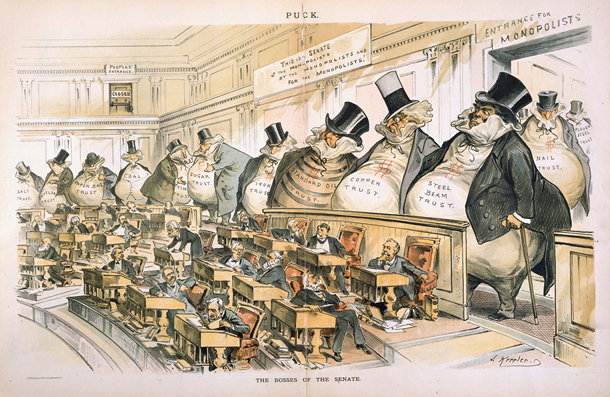
The progressive movement emerged from the middle class in response to the state’s inability and unwillingness to remedy obvious injustice. Investigative journalists played a key part, publishing exposés of the closed world of the “robber barons”.
This shift in outlook allowed progressives to mobilise the middle class and trade unions and, ultimately, to put forward the Populist Party, which challenged Republicans and Democrats—an exceptional event in American politics.
“The Populists set an example of how to consolidate a protest movement into an influential federal party. In the 1892 election the party won 8.5% of the vote. That success made the urban middle class a noticeable political player; later, politicians as different as William Jennings Bryan, Teddy Roosevelt, Robert La Follette, William Taft and then Woodrow Wilson brought progressive ideas into big‑league politics, won elections with them and opened the way to reform,” write Acemoglu and Johnson.
It is also worth noting that America owes progressives not only direct election of senators, women’s suffrage, modern consumer‑protection and anti‑corruption law.
The movement also injected into American politics a host of negatives whose lamentable, sometimes tragic consequences are felt to this day: racial segregation and bans on mixed marriage; the popularisation of eugenics; the forced sterilisation of non‑white women; and Prohibition, which did not solve alcoholism but enriched and entrenched the mafia.
Surveying half a century of history, Acemoglu and Johnson identify three sequential stages that could generalise to large‑scale change:
- Changing prevailing narratives and values.
- Nurturing forces that counter the establishment.
- Adopting policies grounded in the new narrative, research and expert advice.
Extrapolate this “reformer’s catechism” to the crypto world and its applicability to a global Web3 community is obvious.
Blockchain and digital assets are one big new narrative, albeit drawing on the Austrian school. In place of unions and civic associations, Web3 technologies offer self‑organisation into communities of enthusiasts and full‑fledged DAOs. And there are already “crypto presidents”, of a sort: Donald Trump, Nayib Bukele and Javier Milei have, with mixed success, styled themselves as such.
But tactical wins do not guarantee strategic success. A packed 2024 laid bare the ever closer ties between crypto and traditional finance, while big institutions such as MicroStrategy no longer hide plans to monopolise bitcoin capital and fuse it with the state.
Some will call this the market’s maturation and mass adoption; others, the loss of independence from the financial mainstream for which bitcoin was created. If Acemoglu, Robinson and Johnson are right, the accelerated rollout of cutting‑edge technologies—including AI agents—will only widen the already yawning gulf between the “whales” and the “hamsters”.
And so long as mass participation is reduced to minting tokens on something like Pump.fun, there is a good chance of waking up one day on the southern side of the wall that divides Nogales.
Quotes are reproduced with slight changes from the edition: Daron Acemoglu, Simon Johnson. Power and Progress. Our Thousand‑Year Struggle for Technology and Prosperity. Moscow: AST, 2024. Translated from English by Natalia Kholmogorova.