


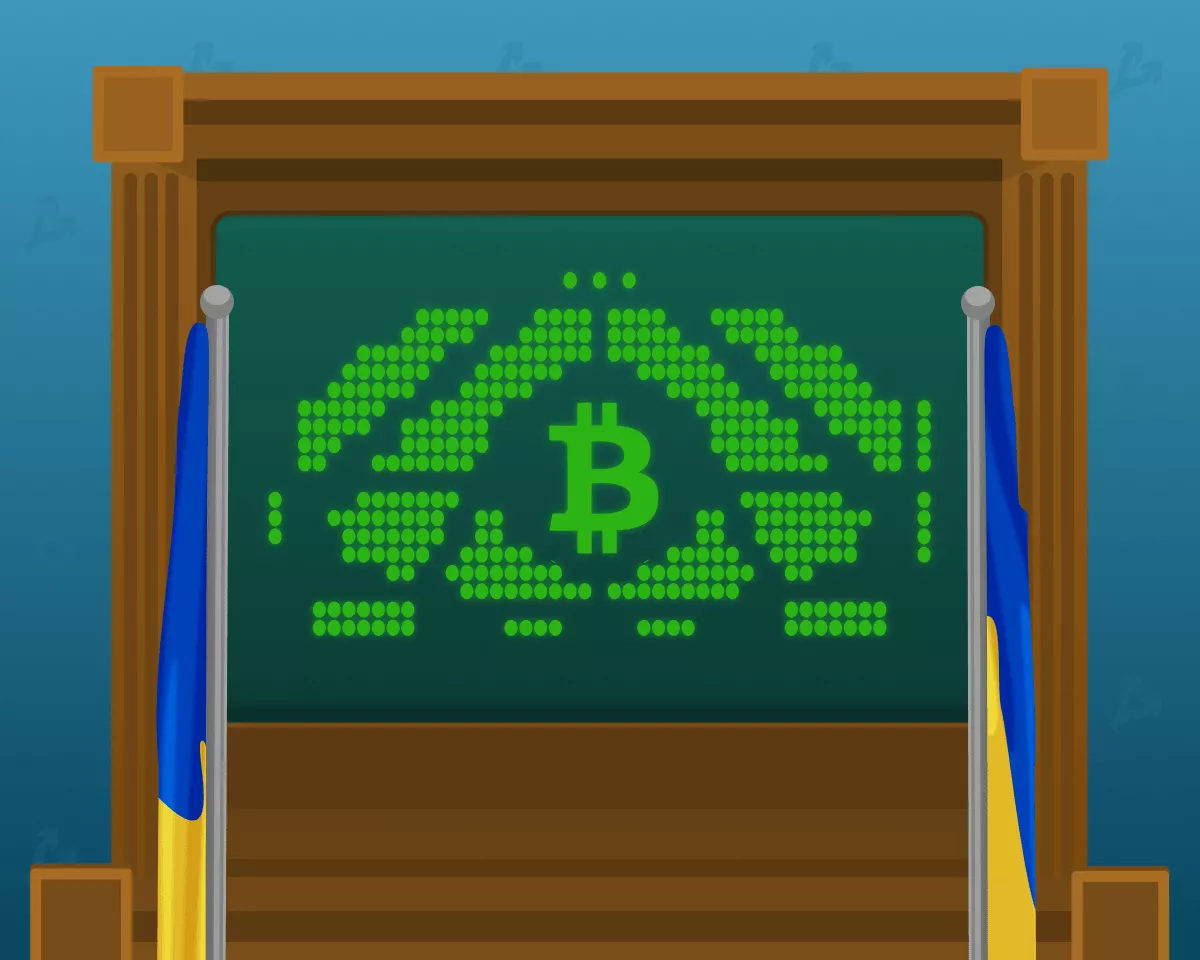
Ukraine Recognises Cryptocurrencies: A Detailed Analysis of the Law on Virtual Assets
The Verkhovna Rada of Ukraine adopted the Law on Virtual Assets, regulating cryptocurrency transactions.
According to the minister’s remarks, Mikhail Fedorov, the minister of digital transformation, the daily turnover of virtual assets in Ukraine stands at 1 billion hryvnias, but ‘all of this is in the shadows’. The law is intended to bring the market for digital assets into the legal framework.
The document was amended and supplemented several times. ForkLog discussed the final version with the bill’s authors, the Ministry of Digital Transformation, and independent lawyers.
- Virtual assets (VAs) are recognised as intangible property and objects of civil rights, but not as a means of payment. They are divided into collateralised and uncollateralised. The document also introduces a category of financial VAs.
- The market regulators will be the National Bank, the National Commission on Securities and the Stock Market and a newly created dedicated body. Until its formation these functions will be performed by the Ministry of Digital Transformation.
- For Russian business, the VA market is shut to them.
- The law will not come into force until Parliament passes amendments to the Tax Code. When that will happen is unknown.
Key Provisions
Law defines virtual assets as intangible property that is the object of civil rights. They are split into collateralised and uncollateralised. Cryptocurrencies, such as Bitcoin or Ethereum, are classified as the latter. Collateralised VAs must certify property rights, in particular rights to demand other objects of civil rights.
VAs are not recognised as a means of payment and cannot be exchanged for goods and services.
As ForkLog explained, one of the law’s authors, the head of the inter-factional association Blockchain4Ukraine, Alexey Zhmerenetsky, said that under the Civil Code of Ukraine property has material substance, whereas VAs represent information that the Civil Code classifies as intangible property:
«First, VAs as digital code or software are far more intangible than property. Second, FATF regards VAs as ‘a digital representation of value,’ and that definition, of course, is closer to an intangible asset than to property».
The Blockchain Association of Ukraine (BAU) notes that the definition of VA as an intangible asset raises questions, as its status is ‘still unclear’.
Market participants have rights to:
- choose counterparties for transactions;
- open bank accounts for settlements related to VA operations;
- seek judicial protection of their VA rights;
- receive information from service providers about their activities and user-rights protections;
- independently determine VA prices at which operations are conducted;
- protect personal data.
Opening bank accounts will allow business to conduct VA operations as a primary or sole line of activity, said ForkLog Deputy Minister of Digital Transformation for IT development Alexander Bornyakov:
«Of course, banks that wish to issue the so-called ‘Bitcoin cards’ (which probably refer to banks’ services for storing and automatically converting VAs into fiat) will be able to open accounts for their own purposes, as will their clients.»
It is known that plans to issue Bitcoin cards are being pursued by Ukraine’s popular monobank. According to ForkLog, the project has already been implemented in partnership with the WhiteBIT exchange.
Service providers are recognised as legal entities that engage in one or more activities, of which four are highlighted:
- holding/manage VAs or VA keys;
- exchanging;
- transferring;
- providing intermediary services related to such assets.
They cannot be companies registered or located in the territory of a “state recognised by the Verkhovna Rada as an occupying or aggressor state”. That status has so far been assigned only to Russia.
Bornyakov said this means VA providers from the Russian Federation will not be able to operate legally in Ukraine.
Other service providers will be able to operate only on the basis of a special licence.
«There will be a Lego-like approach. Based on the business model, companies will submit applications for each type of activity as VA providers», — said ForkLog, Konstantin Yarmolenko, head of the advisory group Blockchain4Ukraine.
The Ministry of Digital Transformation expects this to be a very straightforward, highly automated process, feasible to perform remotely.
According to lawyer Dmitry Nikolayevsky, Ukrainian law provides for the possibility of implementing regulatory policy either through licensing or through authorisations:
«In practice in other sectors of the economy, the second option is usually simpler. That is probably why it was preferred».
The cost of the licence, as with the minimum charter capital for residents and non-residents of Ukraine, differs.
| Type of activity | Resident | Non-resident |
| holding/manage VA or VA keys | 136,000 hryvnias (≈$5,000) | 680,000 hryvnias (≈$25,000) |
| exchange | 85,000 hryvnias (≈$3,100) | 425,000 hryvnias (≈$16,000) |
| transfer | 85,000 hryvnias (≈$3,100) | 425,000 hryvnias (≈$16,000) |
| provision of intermediary services | 68,000 hryvnias (≈$2,500) | 340,000 hryvnias (≈$12,700) |
To extend a licence, providers must re-submit documents and pay for it.
| Type of activity | Resident | Non-resident |
| holding/manage VA or VA keys | not less than 1,190,000 hryvnias (≈$44,000) | not less than 5,950,000 hryvnias (≈$222,000) |
| exchange | not less than 595,000 hryvnias (≈$22,000) | not less than 2,975,000 hryvnias (≈$111,000) |
| transfer | not less than 595,000 hryvnias (≈$22,000) | not less than 2,975,000 hryvnias (≈$111,000) |
| provision of intermediary services | not less than 595,000 hryvnias (≈$22,000) | not less than 2,975,000 hryvnias (≈$111,000) |
Alexey Zhmerenetsky noted that there is currently no direct ban on forming VA charter capital, but it could be introduced in the future.
«Capital formed by Bitcoin, however, cannot adequately perform all the necessary functions», — he said.
The licence is valid for one year. Information about service providers is entered into a special state registry.
«All exchanges, custodians, and brokers will become regulated objects of financial monitoring and will have to conduct KYC/AML procedures», — stressed Kuna lawyer Anna Voevodina in a ForkLog interview.
Bornyakov said the law creates legal prerequisites for professional market participants and those issuing VA to be identifiable:
«If they do not conduct business honestly — a harmed market participant will know who is involved in the violation of their rights and will be able to approach either the courts or law enforcement authorities with the appropriate complaints».
Penalties are envisaged for non-compliance, applying only to VA providers.
«The law does not grant additional rights or obligations for any existing or new state bodies to oversee Ukrainian citizens», — said ForkLog’s Alexander Bornyakov.
| Offence | Fine |
| VA provider activity without regulator permission | from 34,000 (≈$1,200) to 119,000 hryvnias (≈$4,400) |
| carrying out another legally envisaged activity without permission | from 17,000 (≈$630) to 85,000 hryvnias (≈$3,100) |
| providing false information when obtaining permission | from 8,500 (≈$320) to 17,000 hryvnias (≈$630) |
| failure to notify the regulator of changes in the VA providers register | up to 17,000 hryvnias (≈$630) |
| failure to provide, provide incompletely or provide misinformation to the regulator | up to 17,000 hryvnias (≈$630), and for a repeated similar offence within a year — up to 34,000 hryvnias (≈$1,200) |
| non-fulfilment or late fulfilment of regulator instructions to remedy violations | from 17,000 (≈$630) to 85,000 hryvnias (≈$3,100), and for a repeated offence within a year — from 34,000 (≈$1,200) to 102,000 hryvnias (≈$3,800) |
| violation of publication requirements during a public VA offering | from 17,000 (≈$630) to 85,000 hryvnias (≈$3,100), and for a repeated offence within a year — from 34,000 (≈$1,200) to 102,000 hryvnias (≈$3,800) |
Three Regulators and a New Supervisory Body
The issuance of licences and market supervision will be handled by a specially created central executive body. The Ukrainian cabinet must establish it within six months of the law’s publication. Until then, its functions will be performed by the Ministry of Digital Transformation.
«In effect, the principal regulator of the sector will be the Ministry of Digital Transformation, which will formulate regulatory policy. But implementing it in practice will be carried out by a completely new state body — the specially created service that will bear all interaction with market participants», — said ForkLog lawyer Dmitry Nikolayevsky.
The new body will regulate the circulation of all VAs, except those that, under the law, are financial virtual assets, noted Alexander Bornyakov.
BAU called the regulator issue ‘the biggest and most controversial’.
«To date, the necessary infrastructure has not been created, there is no adequate staff, and there are many nuances that need to be refined and optimised», — said Anna Voevodina of BAU.
Author: Alina Saganovskaya.
Read ForkLog’s bitcoin news in our Telegram — news on cryptocurrencies, rates and analysis.
Рассылки ForkLog: держите руку на пульсе биткоин-индустрии!