




Blockchain technology remains one of the hottest trends among financial, governmental and commercial organisations worldwide. ForkLog magazine offers an overview of the most interesting recent initiatives.
Australia and Singapore have completed a blockchain pilot for the verification of accompanying documentation
The Australian Border Force (ABF), the Singapore Infocomm Development Authority (IMDA) and the Customs Department of the island state have completed a pilot test of using blockchain systems to confirm the authenticity of digitised trade documents.
According to the press release, the project was initiated under a bilateral agreement on the development of the digital economy to simplify cross-border trade processes.
The parties tested the interoperability of two verification systems—those of ABF and IMDA.
The pilot demonstrated that documents are tracked and authenticated almost instantly.
“QR codes embedded in digital certificates of origin with unique proofs allow immediate verification of the document’s authenticity and integrity when scanned or machine-read,” the statement said.
ABF Commissioner Michael Outram said he was pleased with the positive results, which help improve cross-border processes for Australia’s trading community.
Velo Labs leverages the Stellar network for remittances between Thailand and Europe
Velo Labs, in partnership with two Thai financial institutions, launched a new remittance corridor. It connects Southeast Asian and European markets, representing nearly 600 million customers with cross-border transfers of about $17 billion per year.
The Velo Labs financial protocol uses the Stellar blockchain and its own Velo tokens for network transactions.
The partners are confident that the solution will offer “fast, inexpensive and secure” ways to send money between Europe and Thailand.
A blockchain art installation unveiled in Vancouver
The Canadian non-profit Vancouver Biennale unveiled an art installation that blends physical and digital realities with blockchain technology.
The Voxel Bridge object, covering about 167 square metres, is located on the south side of the Cambie Street bridge in Vancouver. It comprises an interior finished beneath the structure with augmented reality on distributed ledger technology, visible on iOS or Android devices.


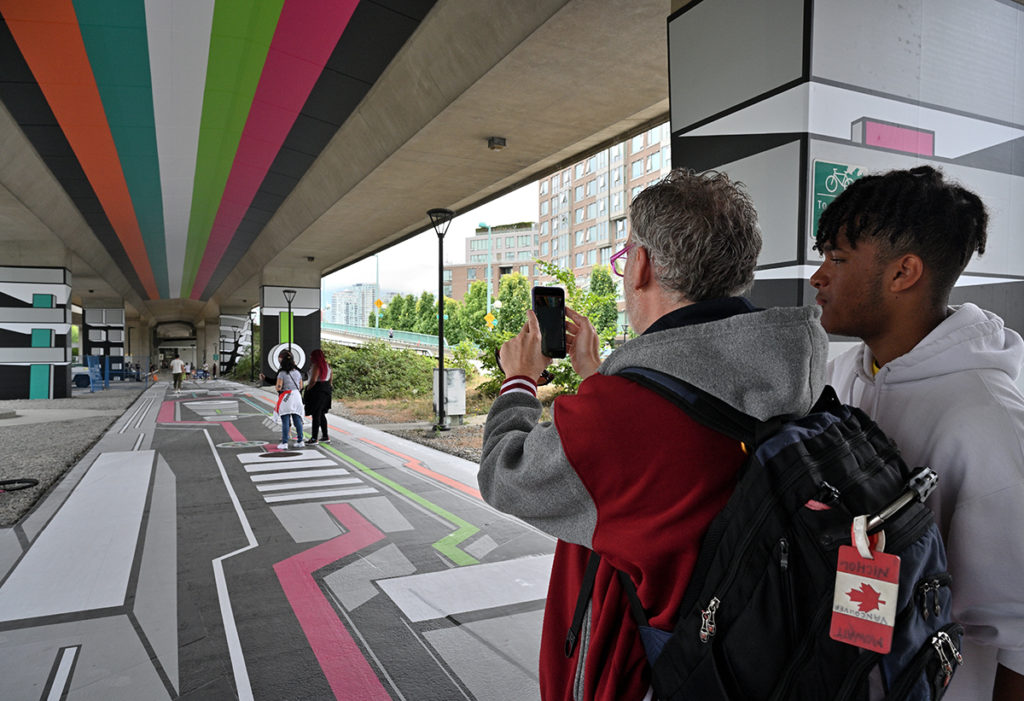
The digital component of the installation comprises works by Colombian artist Jessica Angel.
Australia urged to use blockchain in the fight against counterfeit vaccination certificates
With the spread of counterfeit COVID-19 vaccination certificates in Australia, local experts proposed using blockchain technology to verify the authenticity of records. The Australian reports.
Journalists found online several offers from scammers who claim that with their certificates “no one will know that you were not vaccinated.” Prices range from A$13 to A$120 (~$9-$85).
In some offers, the scammers claim they work with foreign doctors and can provide false data at an international level.
Robert Potter of Internet 2.0 argues that Australia should use DLT technology to prevent certificate compromise.
“We are capable of offering a robust system that only we can use, but in reality we need a global solution for everyone. That would be the cryptographic equivalent of a hologram,” he said.
Blockchain Australia deputy head Karen Cohen is confident that such a solution could pave the way for secure health data exchange worldwide.
“This would indeed be a wonderful test case for a globally secure method of data exchange,” she noted.
Kakao Group to expand the footprint of its blockchain division in Singapore
South Korean tech giant Kakao Group has created two entities in Singapore to globalize its blockchain project Klaytn. The Korea Herald reports.
The Klaytn Foundation will fund ecosystem projects for the Klaytn network in the city-state. The Krust organisation will act as an accelerator for them.
Kakao plans to invest $300 million in related startups and developers for global expansion of its blockchain platform.
Subscribe to ForkLog news on Facebook.