




Ethereum’s creator, Vitalik Buterin, has shifted his stance on software licenses. Previously a proponent of permissive licensing, he now prioritizes copyleft.
Why I used to prefer permissive licenses and now favor copylefthttps://t.co/aPGhY0Y0kX
— vitalik.eth (@VitalikButerin) July 7, 2025
He explained his position by citing increased competition and the threat of market monopolization. Buterin highlighted the difference between two approaches to open-source software:
- permissive licenses (MIT, CC0) allow anyone to use, modify, and distribute code without restrictions;
- copyleft licenses (GPL, CC-BY-SA) require that any derivative products also be distributed under the same terms, including the publication of source code.
Buterin previously favored the former to maximize the use of his developments. He also opposed the very idea of copyright, viewing such licenses as the closest analogue to placing work in the public domain.
Shifting from Permissive to Copyleft
Firstly, open-source code has “become mainstream,” noted Buterin. Large companies like Google and Microsoft actively use it. Thus, encouraging corporations to adopt a model with free access has become easier.
Secondly, the industry has become more competitive and “ruthless.” It is no longer feasible to rely on developers to open their code out of altruism. Copyleft becomes a tool of “hard power” that compels sharing of the product.


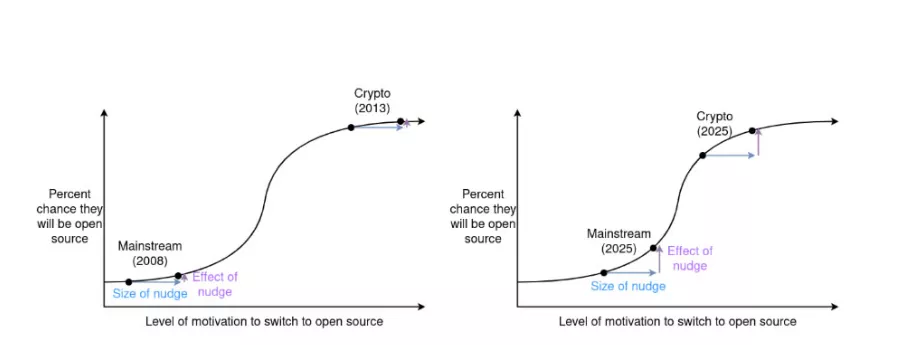
Thirdly, Buterin referred to economic arguments. In a scenario where major players gain “super-profits” from scale, strict property rights lead to monopoly. In his view, without the forced dissemination of innovations, the world could end up with a single player controlling everything.
He believes that modern technologies exacerbate this problem. Closed software and hardware allow the distribution of a product without revealing its workings or allowing modifications.
Buterin sees copyleft as a neutral way to encourage the “diffusion of progress.” Unlike government mandates, such as the EU’s unified USB-C charging standard, licenses do not create advantages for specific political or business interests.
According to him, projects that would have chosen a permissive approach 15 years ago should at least consider transitioning to copyleft today.
In June, Buterin introduced a digital “pluralistic” identity system aimed at enhancing privacy protection.