



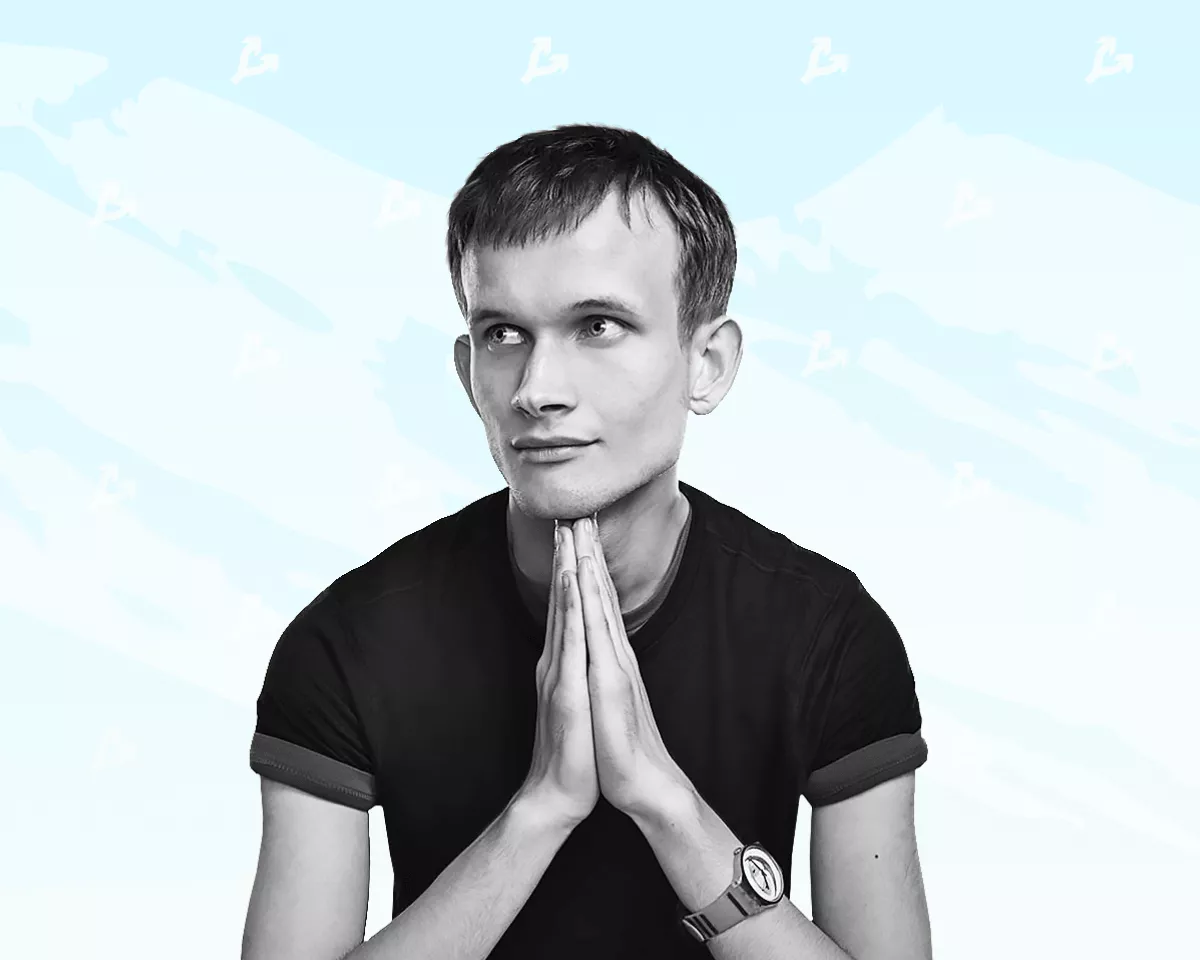
On January 31, Vitalik Buterin published an essay titled “The End of My Childhood” to mark his 30th birthday. The Ethereum co-founder reflected on his journey as a blockchain developer and shared his thoughts on the future of digital assets.
Leaving University and Setting Priorities
In addition to recalling his trip to a “hacker house” in South Korea and other travels, Buterin recounted his path to creating the second-largest cryptocurrency by market capitalization. He noted that it all began in 2013 when he decided to take a paid internship at Ripple while still in college.
However, visa issues thwarted his plans, and he spent the summer working for Bitcoin Magazine in Spain. Over time, Buterin realized he wanted to devote more time to studying cryptocurrencies and took a 12-month academic leave.
During the Ethereum presentation in January 2014 at the BTC Miami conference, which demonstrated people’s interest in the technology, he decided to drop out of university.
For the next three years, Buterin focused on managing the project, which included “responding to pressure and answering requests from others.” In 2017, at the St. Petersburg International Economic Forum, he met with Russian President Vladimir Putin, “briefly” discussing blockchain integration.


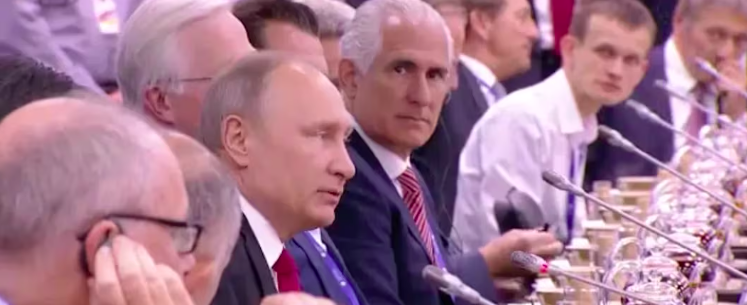
He stated that he did not seek to arrange the meeting; it was offered to him. Buterin later regretted the event for various personal and political reasons.
“I decided to be cautious about which plans of others I support and more thoughtful about the plans I create myself: fewer thoughtless meetings with random influential people who were interested in me only as a source of legitimacy, and more things like Zuzalu,” added the Ethereum co-founder.
Buterin also recalled his viral photograph. He explained that the bulge was a “rolled-up USB cable” in his pocket.
The Past and Future of Cryptocurrencies
According to the Ethereum co-founder, the crypto industry emerged in late 2008 following the global financial crisis. He reminded that Bitcoin’s genesis block contained a reference to an article from the British The Times about additional government assistance for banks amid a “credit crunch.”
This narrative influenced Bitcoin’s development and its perception as a “banking system killer,” Buterin emphasized. However, he noted that such theses have nearly vanished 15 years later.
He believes the blockchain industry has long surpassed the financial system, although it remains a part of it:
“Go beyond and use our technologies to create a more holistic vision of an alternative, freer, open, and democratic technology stack, and how developments can either significantly improve society or provide tools to those without access to digital infrastructure.”
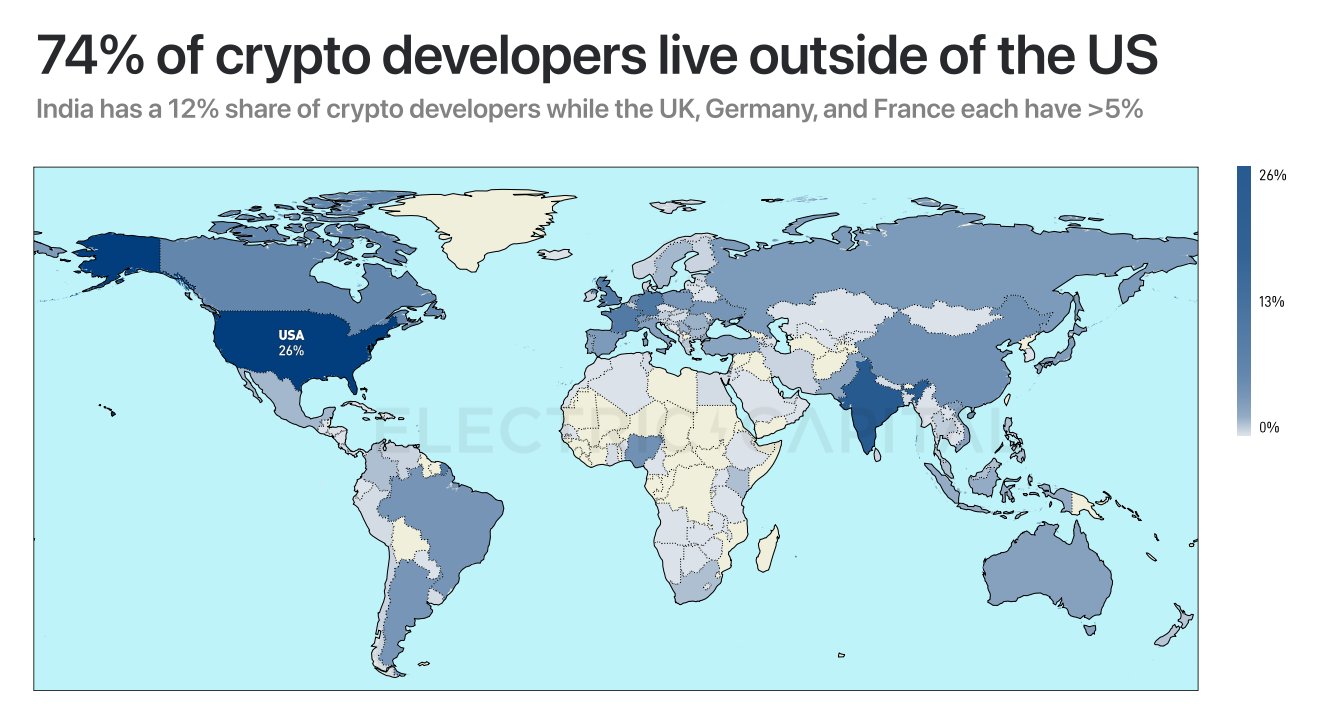
Buterin added that cryptocurrency is one of the few technological sectors that is “truly highly decentralized, with developers scattered worldwide.”
According to Electric Capital data for 2023, 74% of blockchain developers are outside the United States, with 12% based in India.

Referring to a previous essay on the “cypherpunk revolution,” Buterin reminded the crypto community of the need to “expand horizons” and create a fully decentralized technology stack independent of traditional Silicon Valley developments.
He cited existing solutions that replace traditional tools as examples:
- banking system — stablecoins, Ethereum, DEX;
- payment receipts — transaction links in block explorers;
- corporations — DAOs;
- DNS — ENS;
- restrictions “by the all-seeing big brother” — restrictions through zero-knowledge proofs;
- Twitter and Facebook — Lens and Farcaster.
Moreover, blockchain can transform the democratic system through the integration of voting systems, as seen in many crypto projects, Buterin added.
“This is a form of the world that I think is truly achievable both within the crypto industry and among neighboring communities whose values largely align,” the developer mused.
Previously, Buterin discussed the prospects of cryptocurrency interacting with AI. For instance, blockchain can counteract AI centralization, ensuring transparency, storage, and data security.
Back in late November 2023, the Ethereum co-founder released an essay titled “My Techno-Optimism,” where he shared his views on the impact of new technologies on the development of human civilization.