




To address the limitations of the current fee system, Ethereum co-founder Vitalik Buterin proposed a ‘multidimensional’ gas pricing structure.
He noted that the network currently employs a peer-to-peer model where all computational processes, including storage, data transfer, and encryption operations, are evaluated using a single metric—gas.
Vitalik pointed out a significant drawback: this approach treats various resources as interchangeable, which they are not in reality.


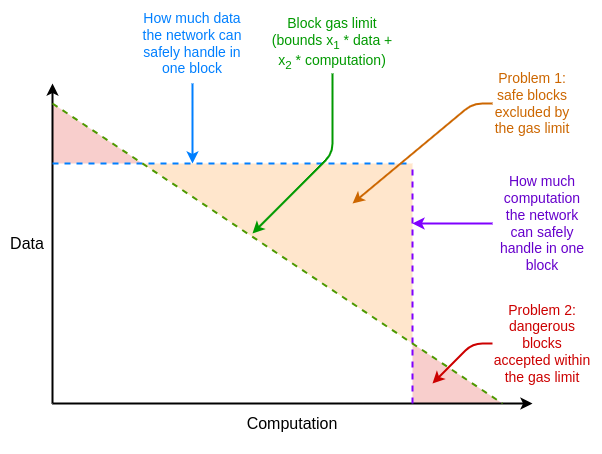
For instance, a typical transaction costs 47,085 Gwei. This amount is divided into base costs (21,000 Gwei), call functions (1,556 Gwei), storage interaction (16,500 Gwei), and block writing (2,149 Gwei). While this system simplifies market operations and fee calculations, it combines fundamentally different types of resources, Buterin noted.
He explained that such mixing leads to inefficient use of computational power and the potential rejection of safe blocks or inclusion of unsafe ones in the blockchain.
According to the Ethereum co-founder, transitioning to a multidimensional gas model could better reflect the network’s true constraints and capabilities, potentially ‘increasing throughput without simplifying resource interchangeability.’
The concept of multidimensional gas is not new, and Buterin noted its active implementation in EIP-4844. Introduced during the Dencun hard fork, the new transaction type for large binary data arrays (BLOB) significantly reduced costs for L2 solutions, especially those based on Rollup technology.
Essentially, BLOBs set limits and costs for different types of operations, which has already reduced costs for various transfers like batched transactions.
Vitalik believes that the next major challenge will be integrating ‘stateless clients,’ which do not need to store information about each node. This can be addressed through a ‘cleaner gas’ model, where different types of data and operations are evaluated according to their network needs.
However, the real potential of a multidimensional gas system lies in its flexibility, allowing for independent management of various network resources, the developer stated.
Among the challenges of implementation, Buterin highlighted the need to configure multiple gas metrics, complicating the creation and execution of smart contracts.
Despite these challenges, he is convinced that the benefits, particularly in terms of scalability and efficiency, justify the efforts.
Previously, the Ethereum co-founder proposed an alternative approach to enhancing wallet capabilities based on EIP-3074.
In April, the programmer discussed the advantages of Binius, a new zero-knowledge proof system.
In March, Buterin described the next five years as ‘crucial’ for the widespread adoption of Ethereum and its acceptance in the ‘real world.’