




The unprecedented pace at which institutional investors are accumulating the second-largest cryptocurrency by market capitalization poses fundamental threats to Ethereum, according to Vitalik Buterin at the Devconnect conference, reports DL News.
Risks
The first challenge is the potential exodus of developers. According to the Ethereum co-founder, the core community that has been developing decentralized infrastructure for years is unlikely to want to work with Wall Street.
The main goal of the project is to create transparent and open systems, not tools for traditional finance. If the platform focuses on the latter, some developers may leave the ecosystem. Without them, Ethereum risks losing technical expertise and the community’s foundational ideals.
Currently, nine Wall Street giants, including BlackRock, manage $19 billion in assets through exchange-traded funds. An equivalent amount is held on the balance sheets of several dozen DAT companies.


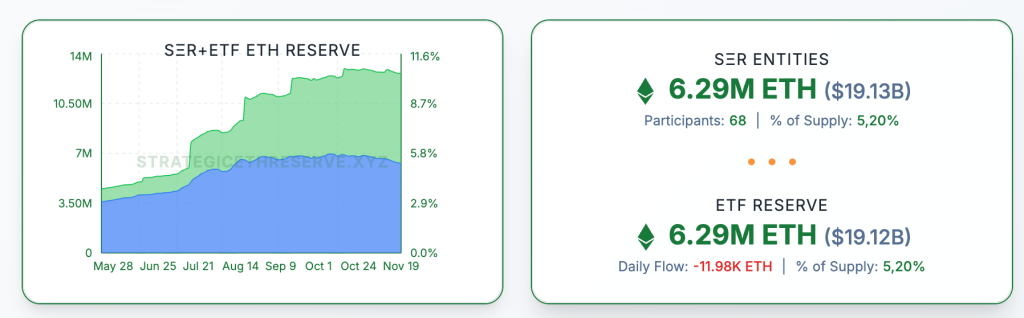
These market participants have accumulated 10.4% of the total supply of the leading altcoin.
The second risk involves pressure on technical development. Investors may lobby for changes to the core protocol that benefit them but are detrimental to ordinary users.
Buterin provided a hypothetical example of reducing block creation time to 150 milliseconds. This would make it impossible for ordinary users outside financial hubs to operate a node.
Meanwhile, BlackRock has registered a new Ethereum ETF with staking functionality in Delaware, noted Bloomberg analyst Eric Balchunas.
BlackRock is planning to file for a Staked Ethereum ETF, as per the Delaware name registration. ’33 Act. Filing coming soon. pic.twitter.com/NmAsQhcq5D
— Eric Balchunas (@EricBalchunas) November 19, 2025
The procedure is one of the first steps an issuer must take to launch an exchange-traded fund. BlackRock still needs to file other relevant documents for the proposed product to receive regulatory approval.
The new instrument will complement ETHA, which has attracted $13.1 billion since its launch in 2024.
Solution
As a solution, the programmer suggested focusing on Ethereum’s unique advantages:
“We need to focus on things that would otherwise be lacking: a global, unbiased, and censorship-resistant protocol.”
According to Buterin, Wall Street does not need a “high-speed, super-efficient Ethereum for processing transactions” — companies have their own systems for that.
The true value of the platform is in creating a truly global system accessible to everyone without the need for permissions and trust mechanisms. This is unattainable for traditional financial institutions, the project’s co-founder believes.
Vitalik Buterin emphasized that maintaining the qualities he named — “a strong core community focused on these principles” — is crucial, not adapting to institutional demands but staying true to original values.
Earlier at Devconnect, the programmer also expressed concern about the development of quantum computers. He noted that they could break the current security model by the next U.S. presidential election in 2028.
In October, Geth client developer Péter Szilágyi pointed out the centralization of power around Buterin. At the same time, the head of Polygon spoke of a loyalty crisis to Ethereum.