



Ethereum co-founder Vitalik Buterin has unveiled a system of digital ‘pluralistic’ identification aimed at enhancing privacy protection in a new essay.
Does digital ID have risks even if it’s ZK-wrapped?https://t.co/rye1q5G90G
— vitalik.eth (@VitalikButerin) June 28, 2025
He examined the benefits and associated risks of ID solutions based on zero-knowledge (ZK) proofs, which are gaining traction. Among the most notable examples, Buterin cited World ID by Tools for Humanity’s Sam Altman, projects by Taiwanese authorities, and initiatives in the EU.
A Single ID Operator Threatens Privacy
These systems operate on a similar principle. A user receives a secret value s, and a public hash H(s) is stored in a global on-chain registry. To access an application, a specific identifier is generated, which cannot be linked to the original data.


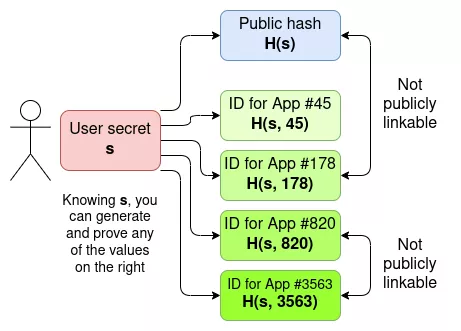
According to the expert, ‘ZK-wrapping’ addresses many issues related to personal information disclosure but leads to the danger of enforcing a single identifier per person. This undermines the principle of anonymity, as in the real world, it ‘usually requires multiple accounts.’
Unified identification also increases the risk of data being obtained by authorities or employers if forced to disclose the secret value s.
These issues are exacerbated if a single ID operator dominates the market, Buterin emphasized.
He also criticized the alternative proposed by ‘cypherpunk purists’ in the form of ‘proof of wealth.’ This approach allows for the creation of paid accounts, which users risk losing along with their funds in case of misconduct. This method is most often used to protect decentralized governance or airdrops from Sybil attacks.
‘There are certain classes of situations where this approach does not work at all,’ Buterin explained.
The Alternative Lies in True Decentralization
The Ethereum co-founder considers a pluralistic identification system, where no single entity fully controls the issuance of digital IDs, to be a more flexible approach.
One way to implement the concept could be verification based on account graphs in social networks like Circles or confirmations from multiple identification providers. In these cases, ZK solutions would simplify anonymization, allowing authorization based on proven past actions or an existing primary account.
Buterin believes the best outcome would be achieved by combining individual identification schemes with social graph systems to create diverse global ID networks.
Earlier, the Ethereum co-founder called privacy a key factor for maintaining decentralization and freedom, ensuring order, and fostering progress.