


Vitalik Buterin Reflects on Ethereum’s Technical Missteps
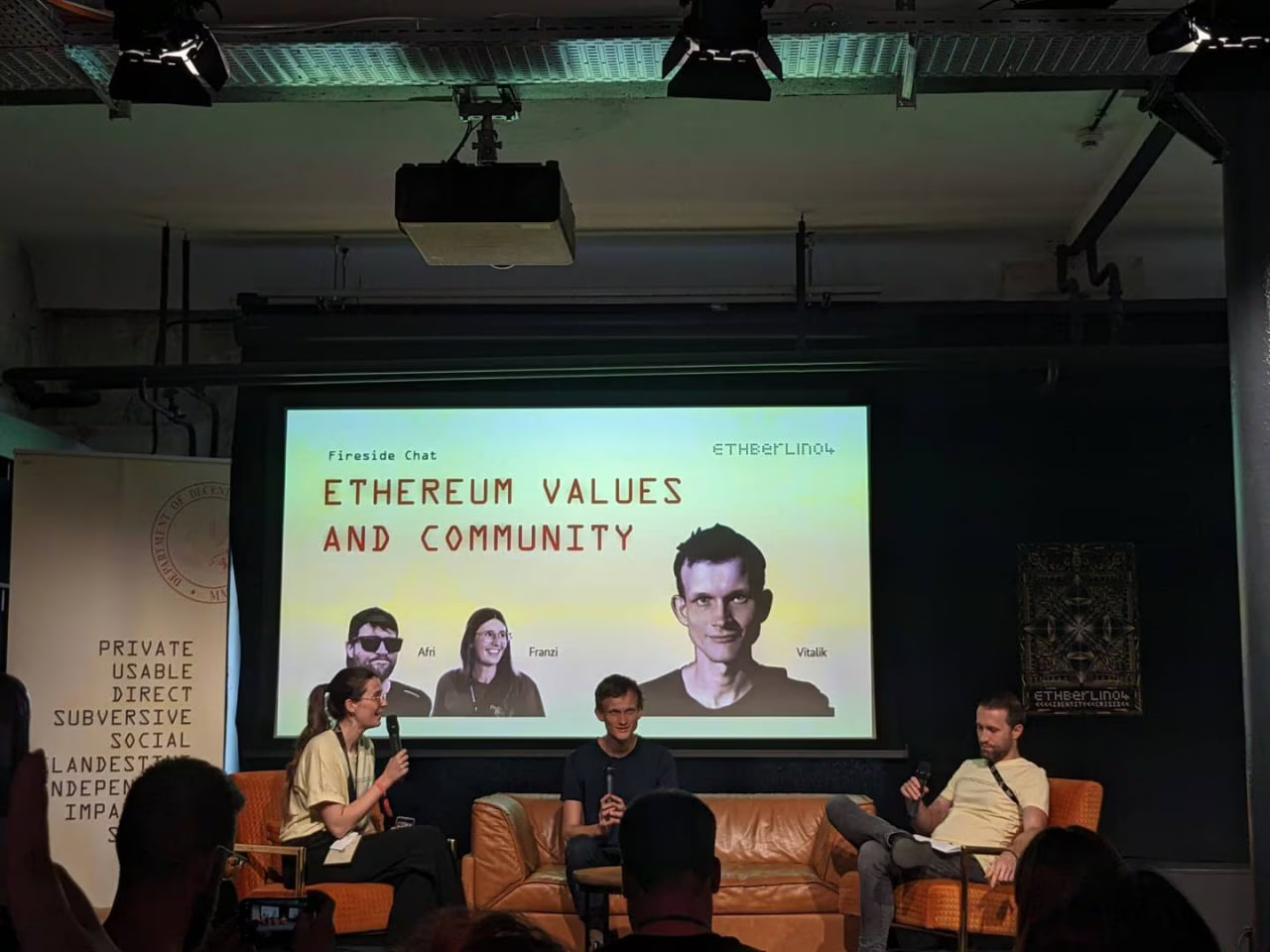
At the ETHBerlin conference, Ethereum co-founder Vitalik Buterin outlined five blockchain architectural decisions he would change if given the chance. This was reported by DL News.
The developer noted that while the ecosystem is gaining popularity, it is still “misunderstood.”
“Bitcoin has a simple story—digital gold. But with Ethereum, it’s like, ‘Wow, what the heck is Ether?’” he stated.
After reminiscing about celebrating the launch of the hard fork The Merge in Berlin, Buterin was asked what he would change in the blockchain if he had to start from scratch.
Too Many Bits
Buterin’s first concern involves the Ethereum Virtual Machine (EVM). He explained that the original design of the technology uses 256-bit processing instead of 64- or 32-bit.
This increased capacity ensures high efficiency in verifying large data sets but is extremely inefficient for simple operations, as it significantly “bloats” the blockchain.
In Ethereum’s early days, optimization was unnecessary, but as the user base grew, blockchain congestion became an issue.
“The initial design [of the network] was too tailored to the 256-bit version,” Buterin clarified.
Optimization
The Ethereum co-founder noted that early network developers should have focused on simplifying smart contracts.
In his view, with fewer lines of code, “people would be able to properly see and verify what is happening inside the protocols.”
Delayed PoS
Buterin added that Ethereum’s transition from the Proof-of-Work consensus algorithm to Proof-of-Stake could have occurred much earlier.
“[Even before the official launch of The Merge] the team was ready to switch to a more crude version of PoS. In the end, we spent a lot of time trying to make the mechanism perfect,” the developer recounted.
According to Buterin, the transition replaced “crude and energy-intensive computational power” with economic incentives.
However, he acknowledged that he could have “saved a huge number of trees if a more developed consensus algorithm had been in place in 2018.”
Log Journal
Ethereum is considered an open blockchain where any transaction can be traced.
However, as the shift from external wallets like MetaMask to account abstraction in Safe occurred, some aspects of network logs began to be lost, Buterin noted. In particular, he emphasized the need for automatic ETH transfer logs.
“This feature should have existed from the start. It would have taken only about 30 minutes of coding. Now we have to implement EIP,” the programmer added.
Buterin’s EIP-7708, presented on May 17, introduces precisely this change.
A Different Hash Function
The Ethereum co-founder would also prefer to use the SHA-2 hash function in the blockchain instead of the current Keccak.
During the network’s development, a “hash function competition” was held by the National Institute of Standards and Technology. Developers were invited to devise an alternative to SHA-2, but most proposals were rejected.
Keccak ultimately won the competition, and it was later modified to become SHA-3.
However, the Ethereum team was already working with an early version of Keccak and essentially used an iteration before SHA-3, Buterin explained. Therefore, developers had to create a special library to support both algorithms in the EVM.
“In the grand scheme of things, it doesn’t matter, and it certainly doesn’t affect current development,” noted another Ethereum developer, Marius Van Der Wijden.
Despite some design errors, Buterin remains confident in the network’s future and is convinced that any project will have shortcomings.
“I’m just very glad that our core developers and their capabilities continue to grow each year. We are able to effectively and safely correct some of these mistakes,” he concluded.
Earlier, the Ethereum co-founder supported developer X Wang Haofei’s idea of confidential likes and suggested transferring the initiative to the social network Farcaster.
In May, Buterin called for the creation of a unified interoperability solution for L2 networks.
He identified MEV, liquid staking, and the cost of running a full node as the three main threats to blockchain decentralization.
Рассылки ForkLog: держите руку на пульсе биткоин-индустрии!