



Vitalik Buterin Unveils Details of Ethereum’s Next Update
Ethereum co-founder Vitalik Buterin has outlined the next phase of the blockchain’s roadmap, known as The Purge. This initiative aims to simplify the network’s structure and reduce the load on nodes.
A quick note on next steps in Ethereum protocol simplification and node resource load decreases (aka “the Purge”):https://t.co/BAebCGrisB
— vitalik.eth (@VitalikButerin) April 1, 2024
EIP-6780
The central focus in protocol development at this stage is the implementation and advancement of EIP-6780, introduced during the recent Dencun hard fork. It optimizes the SELFDESTRUCT operation code, enhancing security and simplifying protocol implementation.
“This EIP is a key example of the often underappreciated part of Ethereum development: attempts to simplify the protocol by eliminating complexity and adding new security guarantees,” explained Buterin.
EIP-6780 reduces the functionality of the SELFDESTRUCT operation command, which destroys the contract that calls it, freeing up storage space.
Alongside the update, Ethereum introduced a maximum number of storage slots (approximately: gas limit/5000) that can be edited in one block. This approach significantly simplifies the creation of protocol clients and other types of infrastructure, according to Buterin.
He noted that more such proposals for network improvement will emerge as part of The Purge.
Network “Cleansing”
Buterin highlighted several other “cleansings” within Ethereum aimed at optimizing the protocol. Recently, the Geth client removed thousands of lines of code by dropping support for networks added before The Merge.
EIP-7523 addressed the issue of “empty accounts.” Thanks to the update, support for most empty accounts from Ethereum’s PoW networks ceased.
The developer noted that the 18-day storage window for large binary objects in Dencun also contributed to protocol simplification. This approach limited the volume of stored information to 50 GB, which does not increase over time.
Precompilations
Additionally, Buterin proposed using the precompilation mechanism. These are Ethereum contracts that contain logic implemented directly by the clients instead of EVM code.
“The idea is that precompilations can be used to implement complex forms of cryptography that cannot be efficiently applied in the EVM. Such solutions are used very successfully today, particularly so that ZK-SNARK-based applications can precompile elliptic curves,” he explained.
There are also other rarely used precompilations:
- RIPEMD-160 — a hash function designed for better compatibility with the Bitcoin network;
- Identity — a precompilation that outputs results based on input data;
- BLAKE2 — a hash function for better compatibility with Zcash;
- MODEXP — modular exponentiation with very large numbers to support RSA-based cryptography.
However, Buterin emphasized that most of these solutions have shown relatively low demand. He suggested the removal of some precompilations to optimize transaction processing and the consensus mechanism.
EIP-4444
Reducing the storage volume required to run an Ethereum node could significantly increase the number of individuals willing to run their own node, the developer believes. The reduction in node synchronization time, provided by EIP-4444, also simplifies workflows for many operators.
“Ethereum is permanent, but requiring literally every node to store all data forever is a very ‘excessive’ way to achieve such permanence,” stated Buterin.
Thanks to EIP-4444, blocks in the network are automatically deleted from nodes after some time.
“The key question that needs to be addressed: if old history is not stored literally in every node, then who stores it? In reality, this will be done by large-scale organizations, such as block explorers. It is not so difficult to create P2P protocols for storing and transmitting information that are more optimized for this task,” Buterin suggested.
The Ethereum co-founder also proposed using peer-to-peer torrent networks to preserve the full history of the blockchain.
New Format
Currently, much of Ethereum’s block structure, including transactions and receipts, is still stored in outdated formats based on RLP and Merkle Patricia trees. This makes it unreasonably difficult to create applications that use this information, Buterin emphasized.
However, he noted that Ethereum’s consensus layer has already transitioned to the cleaner and more efficient SimpleSerialize (SSZ).
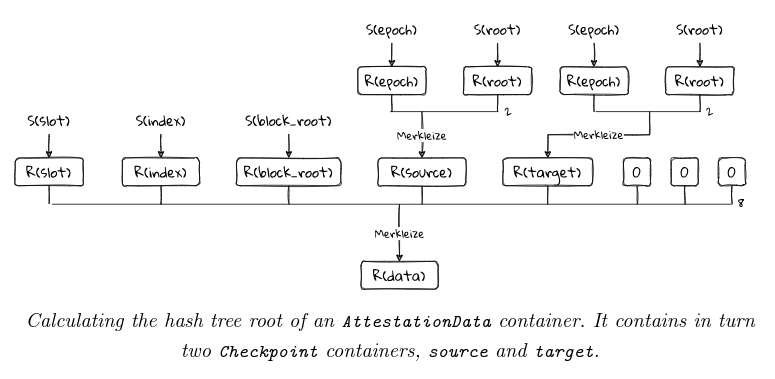
The main task in this direction is to transfer the execution layer to the same structure, the developer explained.
“In the more distant future, once we learn SNARKing hashes, it is quite possible to replace SHA-256 binary trees and Verkle trees with binary Merkle trees that use a SNARK-compatible hash — one cryptographic data model for the entire blockchain,” Buterin concluded.
Back in March, the Ethereum co-founder highlighted the need for internal network scaling and parallel processing of rollups to build on the success of the Dencun update.
Рассылки ForkLog: держите руку на пульсе биткоин-индустрии!