


Vitalik Buterin’s techno-optimism: how AI and blockchain will shape the future
Ethereum co-founder Vitalik Buterin wrote an essay My Techno-Optimism, in which he shared his views on the impact of new developments, particularly blockchain and artificial intelligence, on the development of human civilization.
Technology and its adoption
As Buterin explains, his feelings about techno-optimism are ‘warm, but nuanced’. In the future, technologies could transform people’s daily lives for the better, but there are many dangerous factors ahead that must be considered, he added.
Nevertheless, delaying the deployment of new technologies comes at a very high cost to humanity, the developer argues. As an example, he cited a chart of average life expectancy in different countries.
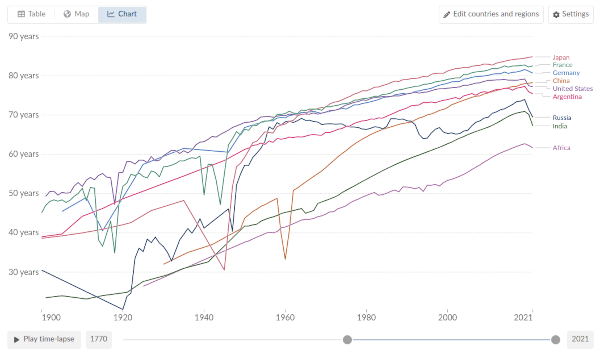
The image shows how life expectancy declined during the world wars, the ‘Spanish flu’, and the ‘Great Leap Forward’ in China. But Buterin noted that advances in food, medicine and infrastructure in the 20th century mitigated the consequences of these global tragedies.
Regarding new technologies, at the turn of the century people gained convenient access to the Internet, and thus to unlimited information.
‘If biotechnologies advance as far in the next 75 years as computers have over the past 75 years, the future could be more impressive than all conceivable expectations’, said the Ethereum co-founder.
At the same time, skeptical arguments against progress often reach dead ends, or even give rise to anti-science currents, he argued. The thesis of the ‘Limits to Growth’, proposed in the 1970s, posits that growth in population and industry will exhaust Earth’s resources. Such ideas inspired China’s one-child policy and mass coercive sterilisation in India, he emphasised.
‘And for these reasons I am deeply concerned by arguments in favour of slowing technological or human progress. Given how all sectors are interconnected, even industry-wide lag is risky’, he added.
The virtually only argument against technological progress, he said, is climate change, but even pessimistic scenarios of continued warming would not lead to humanity’s complete extinction.
Artificial intelligence
According to the Ethereum co-founder, AI is fundamentally different from other developments, and one should be especially cautious with it. He called neural networks ‘a new kind of mind’ with the potential to outstrip human cognitive abilities and to become the planet’s dominant species.
The very existence of artificial intelligence is considered an existential risk to the world, which in theory could lead to humanity’s complete extinction.
‘No matter how much harm the worst-case scenario of climate change, pandemics or nuclear war may cause, there are many islands of civilisation that will remain intact to pick them up piece by piece. But a superintelligent AI, if it decides to rise against us, could well leave no one alive and end humanity for good. Even Mars would become unsafe’, noted Buterin.
The main reason for concern lies with instrumental convergence — the hypothetical ability of intelligent beings to achieve similar intermediate goals.
Two directions can be assigned to AI: consumption of resources and ensuring their safety. Yet Earth contains plentiful fossil fuels, and humans pose a direct threat to their preservation.
In another scenario, an AI could be taught to protect humans, the programmer suggested. But it remains unclear how to ensure that the AI ‘does not break down completely in unforeseen situations’.
According to a 2022 survey, a large majority of researchers in the field of machine learning assess the chances of humanity’s extinction due to neural networks at 5-10%.
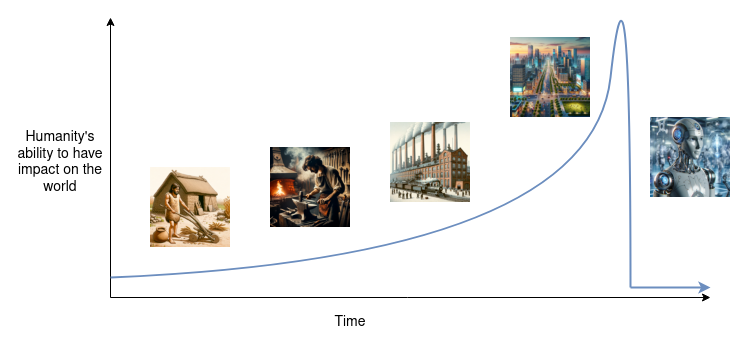
‘Many science-fiction series envision a world where superintelligent AI exists but submits to human biological hosts. […] Yet this seems like an incredibly unstable balance’, added Buterin.
The Ethereum developer sees great risks in centralisation of the technology, which, in theory, could fall into the hands of unscrupulous politicians. He cited OpenAI, a company with a staff of 500, which ‘serves more than 100 million people worldwide’.
Buterin also noted the rise of the e/acc movement (‘effective accelerationism’), which implies recognising the benefits of technological progress and a desire to accelerate the trend.
The second-largest blockchain developer by market capitalisation shares the idea of e/acc, but regards it with caution with respect to AI and the defence-industrial complex.
Therefore Buterin devised his own philosophy, d/acc (where ‘d’ stands for defence, decentralisation, democracy or difference). It emphasises thoughtful, risk-aware approaches to technology and decentralised development.
Blockchain and cryptocurrency
Blockchains enable the creation of economic and social structures with a ‘shared hard drive’ without depending on centralised actors, and cryptocurrency gives people the ability to save money and carry out financial transactions, the Ethereum co-founder said.
In particular, newer forms of distributed ledger development — account abstraction and zero-knowledge proofs — help increase security and privacy on the network.
‘These technologies are an excellent illustration of the principles of d/acc: they allow users and communities to verify reliability without compromising privacy and to protect their security without relying on centralisation that imposes its own definitions of who is good and who is bad’, explained Buterin.
But he still believes crypto wallets require greater ‘autonomy’, and some projects need decentralisation. There are also cybersecurity and crime-prevention concerns.
Human well-being, he concluded, is possible only through cooperation between people and computers. The first step toward this symbiosis could be brain–computer interfaces that give people access to more powerful computing systems.
‘If we want a future that is simultaneously superintelligent and humane, where people are not merely household animals but actually retain meaningful influence on the world, then [controlled human–machine interaction] is the most natural option’, the developer stressed.
Earlier, Vitalik Buterin recalled the old Plasma technology and spoke of new possibilities for its use in Ethereum.
In October, the blockchain founder said how account abstraction can make user accounts resistant to hacking with quantum computers.
Рассылки ForkLog: держите руку на пульсе биткоин-индустрии!