



Several Russian activists reported that their cryptocurrency wallets in Telegram’s integrated Wallet service were frozen, resulting in losses. The bot’s team outlined the grounds for such restrictions.
What happened?
Daniil Chebykin, co-founder of the Omsk Civic Association, said that in early February Wallet froze his cryptocurrency soon after the activist was added to Rosfinmonitoring’s list of “extremists and terrorists”.
Telegram Wallet сотрудничает с российскими силовиками
Не рекомендую использовать криптовалютный кошелек Telegram Wallet @wallet_tg , если у вас есть преследование в России, так как они сотрудничают с правоохранительными органами и блокируют средства на основании российских… pic.twitter.com/maW8UXbytv
— Daniil Chebykin (@chebykin_d) March 17, 2025
According to him, support cited violations of the User Agreement, so the assets were frozen with no right of withdrawal.
“The loss is small, ~170 USDT. But I wanted to warn all anti-war Russians about the situation,” Chebykin said, accusing the bot of cooperating with the Russian authorities.
In comments under the tweet, Lev Gyammer, editor-in-chief of Skat Media, who has been on the “extremists and terrorists” list since September 2023, reported a similar case. He lost about $100.
+++
Та же фигня, чуть больше $100 потерял так
— Лев Гяммер (@HammerOfFreedom) March 17, 2025
Mikhail Klimarev, head of the Internet Protection Society, also faced a wallet freeze. He has been on Rosfinmonitoring’s list since August 2024.
Михаил Климарев (директор ОЗИ, канал За Телеком) тоже пишет, что ему заблокировали wallet , причём давно
Судя по всему приложуха просто сверяется со списками Росфинмониторинга
Вот тебе и свободный обмен криптой! pic.twitter.com/9gtCDFwFiI
— Daniil Chebykin (@chebykin_d) March 17, 2025
The clauses of the User Agreement cited by Wallet’s support concern limitations on services and interaction with third-party providers.
Clause 5.5, in particular, sets out the service’s right to refuse services and freeze assets if “anti-money-laundering policies or other Wallet policies” are violated. Funds may also be frozen in cases of confirmed suspicious activity or at the request of law-enforcement agencies.
“Wallet reserves the right to refuse to return any deposit that has not passed anti-money-laundering screening if the deposit amount is insufficient to cover the blockchain network fees required for its return,” the document states.
Clause 7 notes that responsibility for purchasing cryptocurrencies and conducting other transactions via third-party services lies with the user. Wallet also stresses its independence from the non-custodial TON Space wallet, access to which is governed by separate terms and conditions.
Wallet’s comment
In a comment to ForkLog, the Wallet team said it independently monitors various sources to determine users’ risk profiles and follows “clearly defined KYC, AML/CTF policies and procedures”.
They added that, like any custodial service, Wallet cannot take responsibility for evaluating decisions issued by courts and law-enforcement bodies in different countries.
“The wallet strictly adheres to the principle of neutrality. That is, it screens users objectively and impartially, without bias or discrimination. We believe it is important that all users, regardless of their race, gender, religion, nationality or political beliefs, pass through equally fair KYC, AML/CTF procedures,” the team said.
When an account is frozen, funds remain on balance but cannot be withdrawn until all required internal or external checks are completed. This is necessary to prevent illegal use of the service and to protect the wallet and its users from dubious crypto transfers.
The Wallet team does not disclose detailed statistics on freezes.
“Temporary or permanent blocks in custodial services are standard practice, codified in international standards and local AML/CFT laws and regulations. All freezes are based on identified risks and on internal or external reviews aimed at preventing unlawful operations,” representatives of the service added.
Freezing USDt is standard practice
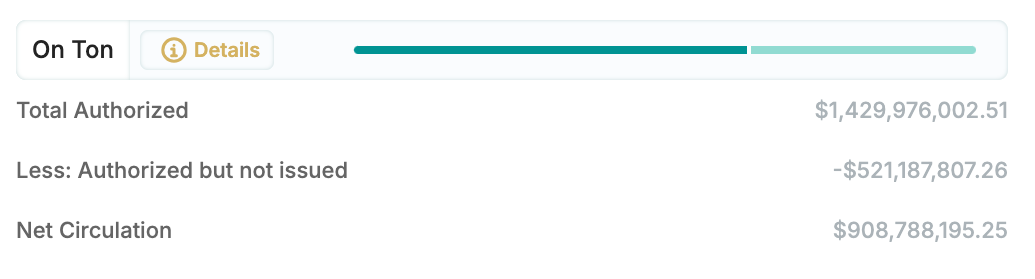
In April 2024, the USDT issuer Tether added support for The Open Network (TON) blockchain. At the time of writing, aggregate liquidity of USDt stands at $1.42bn.


In January 2025, on a ForkLog podcast, Anatoliy Makosov, technical lead of TON Core, said the USDT freeze function exists on all networks.

“Because compliance must be observed; it is standard equipment for stablecoins,” he said.
Asked about freezing Toncoin, the speaker hesitated to answer:
“I did not check; I think there wasn’t. Unfortunately, we have scammers and spammers, as in any other blockchains.”
Shortly after the arrest of Telegram founder Pavel Durov by the French authorities as part of an investigation into illegal activities by third parties via Telegram, the messenger announced tighter moderation of content and began to handle and respond promptly to legal requests from authorities.
Asked whether wallet information is disclosed alongside user data, Makosov noted that “TON and Telegram are different things, and the Telegram team does not develop TON”.
“We have integrations in the messenger—for example, Stars [Telegram Stars] can be converted into Toncoin on the Telegram side, or usernames can be converted into NFTs and auctioned on the blockchain. However, TON is a decentralised blockchain: we have no censorship, and we have no way to block any wallets, simply because that is the essence of a blockchain,” he added.
Journalist Maria Kolomychenko wrote on her channel that Telegram is unlikely to disclose statistics on cooperation with Russian security agencies because it is classed as an organiser of information dissemination (ORI). The framework is set out in Russian government decree No. 743 of 31 July 2014.
“It explicitly states that an ORI ‘ensures non-disclosure of any information about specific facts and the content of such interaction to third parties’. The wording is vague, but Russian companies interpret it unambiguously—if you are in the ORI register, publishing statistics on requests from security agencies is prohibited,” she wrote.
On 15 March, Pavel Durov was allowed to leave France temporarily; the judicial control obligations in his regard have been suspended until 7 April. The businessman said the investigation into criminals’ activity on the messenger continues.