



- The Blast Layer-2 network offers a 4-5% passive income.
- Developers are preparing for the mainnet launch and a native token.
- The community has begun chasing an airdrop.
On November 21, the developers announced Blast — L2-solution on the Ethereum base with native yields in ETH and stablecoins. In a few days the total value locked in the protocol reached $292 million.
Introducing Blast: The only Ethereum L2 with native yield for ETH and stablecoins.
We’ve raised $20m from @Paradigm and @StandardCrypto to build the L2 that helps you earn more.
Details on how to get early access at the end of the thread? pic.twitter.com/AYYmK8YFx4
— Blast (@Blast_L2) November 20, 2023
How the platform works
Blast is an EVM-compatible scaling protocol that employs Optimistic Rollups. The project was created by the founder of the NFT-marketplace Blur under the pseudonym Pacman, and the team comprises alumni of MakerDAO, MIT and Seoul National University.
Earlier, Blast representatives announced that they secured $20m in funding from Paradigm and Standard Crypto.
The protocol provides a service for earning passive income by locking digital assets. The platform promises yields of 4% for Ethereum and 5% for stablecoins.
According to the developers, the deposited ETH is instantly moved into staking on Lido, and the profits from it are paid out to users upon withdrawal.
«We rebuilt the second layer from scratch: if your Blast wallet contains 1 ETH, over time it will automatically grow to 1.04, 1.08, 1.12 ETH», — the announcement said.
USDC and USDT in the L2 network are automatically converted to DAI and deposited into MakerDAO protocols using U.S. Treasury notes. Interest is returned in the native stablecoin USDB.
As of now, Blast does not even have a testnet; the team has opened only a bridge for transferring crypto. The mainnet launch is scheduled for February 24, 2024 — until then, deposits cannot be withdrawn.
Polygon’s Jarrod Watts noted that all five of Blast’s multisig addresses are new wallets with unknown owners. Signatures require only three of the five confirmations.
The Safe contract that now owns the Blast contracts has 5 signers set up in it.
This means that the majority, i.e. 3/5 signers are required to execute transactions on behalf of this Safe contract.
All 5 of these are pretty fresh wallets, with unknown owners.
(3/24)
— Jarrod Watts (@jarrodWattsDev) November 23, 2023
According to him, the principle of the single contract at this stage is to take user funds and place them in other protocols to earn yields.
The main wave of hype around the project is driven by the promised airdrop. According to Blast, the number of users has surpassed 42,000; they have already deposited into the bridge protocol $249 million in ETH and $74,000 in stablecoins.
How to get the Blast airdrop
The project team will distribute BLAST tokens among developers and community members. Early recipients can expect rewards after the mainnet launch in February, and users in May when the native token launches.
The developers have introduced a Blast Points scoring system, on the basis of which the amount of tokens to be received will be calculated. The more points, the more generous the drop to the user.
Points are awarded for deposits via the bridge and for completing activities on social media.
One ForkLog journalist decided to experiment by locking a small amount of Ethereum in Blast. The platform proposed the following actions:
1. Enter an invite code in the bridge protocol or follow a referral link (they can be found on social networks or from influencers).
2. Subscribe to Blast’s account on X.
3. Join the project’s Discord channel.
4. Link a crypto wallet.
5. Make a deposit. The larger the amount, the higher the chance of receiving an airdrop.


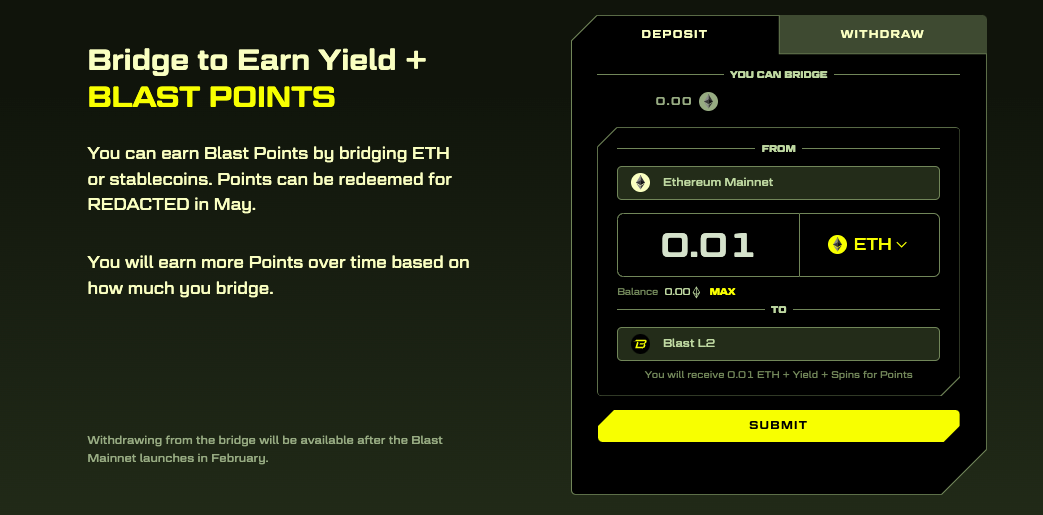
6. A free spin is offered for a top-up, after which a certain number of points will be awarded depending on your luck (the author of this article received 45 points).

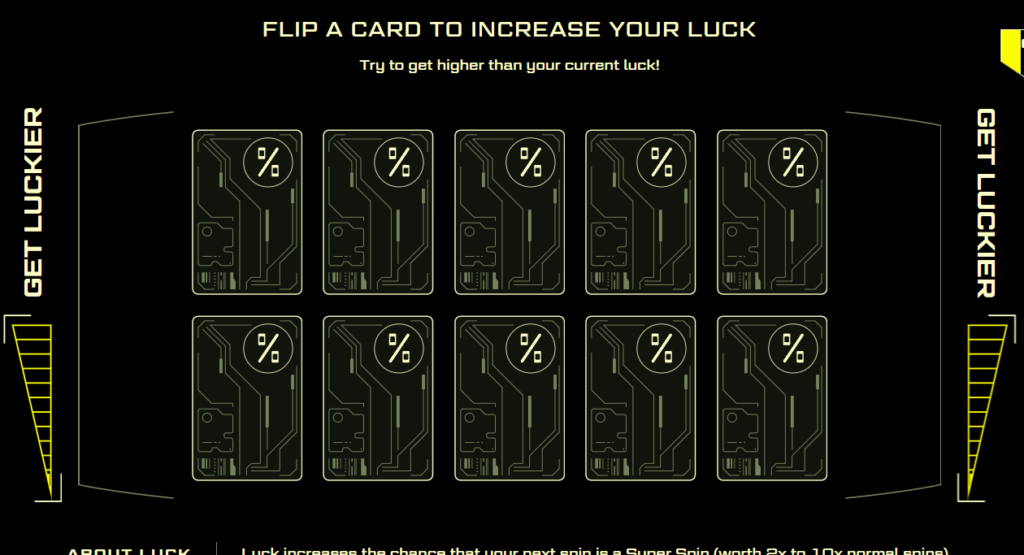

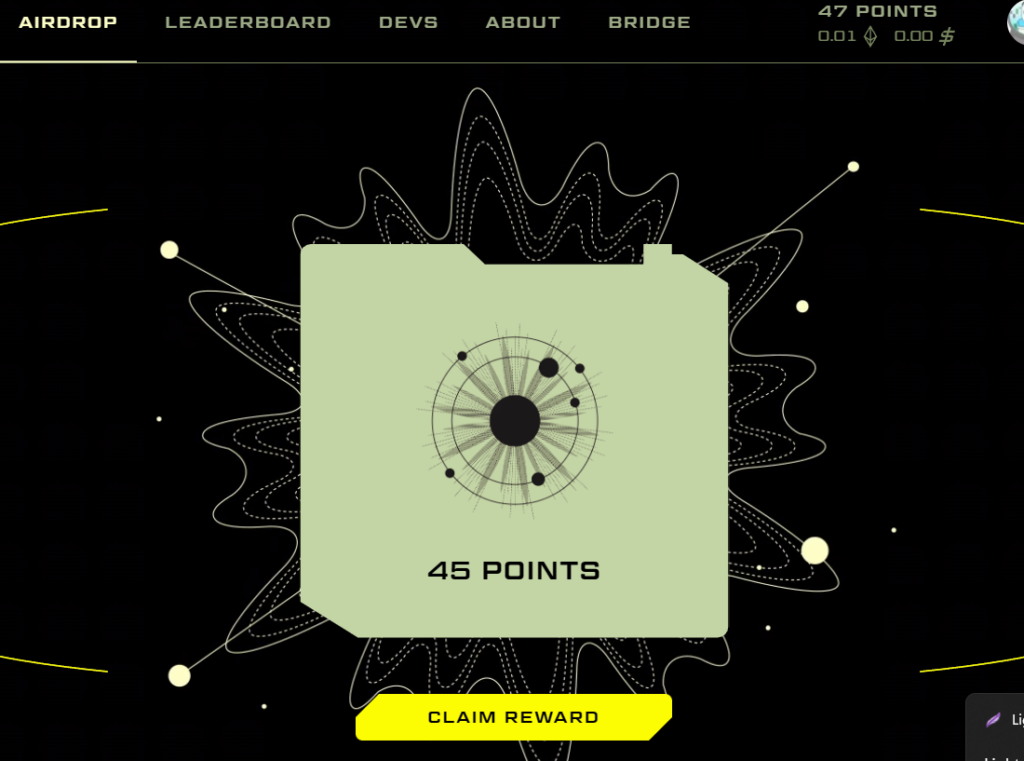
7. Completing activities, for example a repost on X, can earn additional free spins. New deposits also grant another try.


You can track wallet status and check the leaderboard on the platform itself.
Community sentiment
Despite the hype around Blast, many remain skeptical, likening it to a Ponzi scheme. A user going by LexNode noted that “it’s easier to invest in a crypto hedge fund,” given the risks surrounding the protocol.
legally speaking, this is beyond crazy, particularly when only managed by a multisig
you are simply investing in a crypto hedge fund https://t.co/SO7PGj0nil
— _gabrielShapir0 (@lex_node) November 21, 2023
«From a legal standpoint, this is pure madness, especially when you are simply managing a multisig»,