



What is Compound?
Compound Finance is a decentralised lending protocol in which interest rates are set algorithmically based on supply and demand. It functions as an open money market where users supply cryptoassets and borrow funds.
Who created Compound Finance?
The creator of the Compound Finance protocol and CEO of Compound Labs is web developer and financial-market analyst Robert Leshner.
Compound Labs’ co-founder and CTO is programmer Geoff Hayes.
How did Compound Finance emerge and develop?
Penn graduates Leshner and Hayes collaborated for several years on various projects (Britches, Postmates and others). In 2013 Leshner, who had worked as a certified auditor, portfolio manager and banker, took an interest in cryptocurrencies.
On August 28, 2017 Leshner and Hayes registered Compound Labs, Inc. with headquarters in San Francisco.
On January 31, 2018 Leshner published an article about building the Compound protocol.
On May 7, 2018 the company raised $8.2m in seed funding. The round included Bain Capital Ventures, Andreessen Horowitz, Polychain Capital, Transmedia Capital, Compound Ventures, Abstract Ventures, Danhua Capital and Coinbase Ventures.
In September 2018 Compound Labs introduced the first version of the protocol, enabling borrowing of five cryptoassets: ETH, TUSD, ZRX, BAT and REP.
In February 2019 the project’s white paper was published. On May 23, 2019 Compound Labs released the second version of the protocol with cTokens, which represent claims on the underlying assets of Compound Finance money markets.
In November 2019 Compound Labs raised $25m in a Series A round led by Andreessen Horowitz. Bain Capital Ventures, Polychain Capital and Paradigm also participated.
Early on, Robert Leshner stated an intention to decentralise the protocol progressively, removing Compound Labs’ admin privileges in favour of the community.
In February 2020 Compound Labs issued the COMP governance token to encourage community participation.
On April 16, 2020 governance on Compound shifted from administrators to COMP holders, who gained the ability to change the list of supported assets, adjust risk parameters, interest-rate curves, and more.
How does Compound work?
Compound resembles a bank: users deposit various cryptocurrencies and earn interest. Unlike a bank, however, Compound does not custody deposits: funds sit in smart contracts that users interact with directly.
Lenders and borrowers do not negotiate terms. They interact directly within the protocol, which controls interest rates and collateral requirements. There are no intermediaries holding funds.
Anyone with a Web3 wallet such as MetaMask can access the platform.


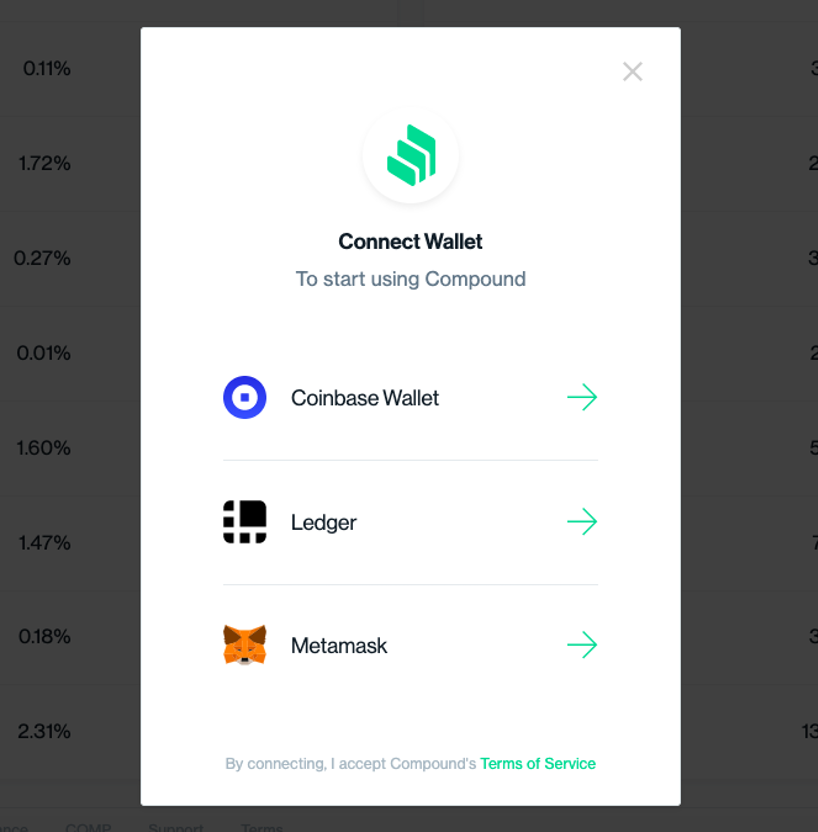
After approving the Web3 wallet connection, a user gets access to a dashboard showing supported assets. To supply or borrow an asset, select its page and unlock it.


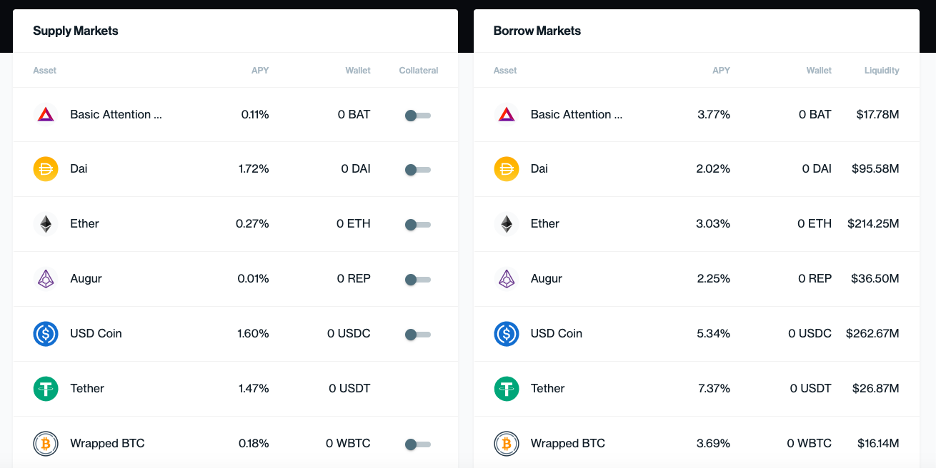


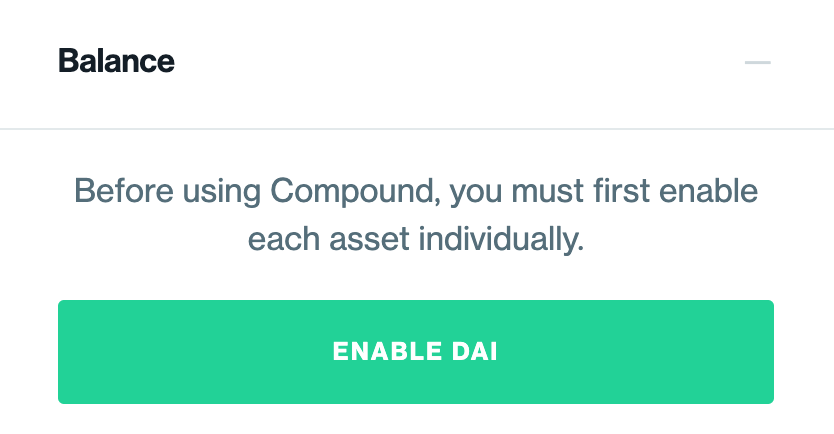
Once an asset is unlocked—authorising the smart contract to interact with the funds—the user can lend it at a preset annual percentage rate (APR). Each asset has its own annual percentage yield (APY).
To borrow, the user must first supply funds to the platform and obtain so‑called borrowing power. This metric is the amount that can be borrowed and increases with more collateral.
This is what a depositor’s balance looks like after the transaction is processed:


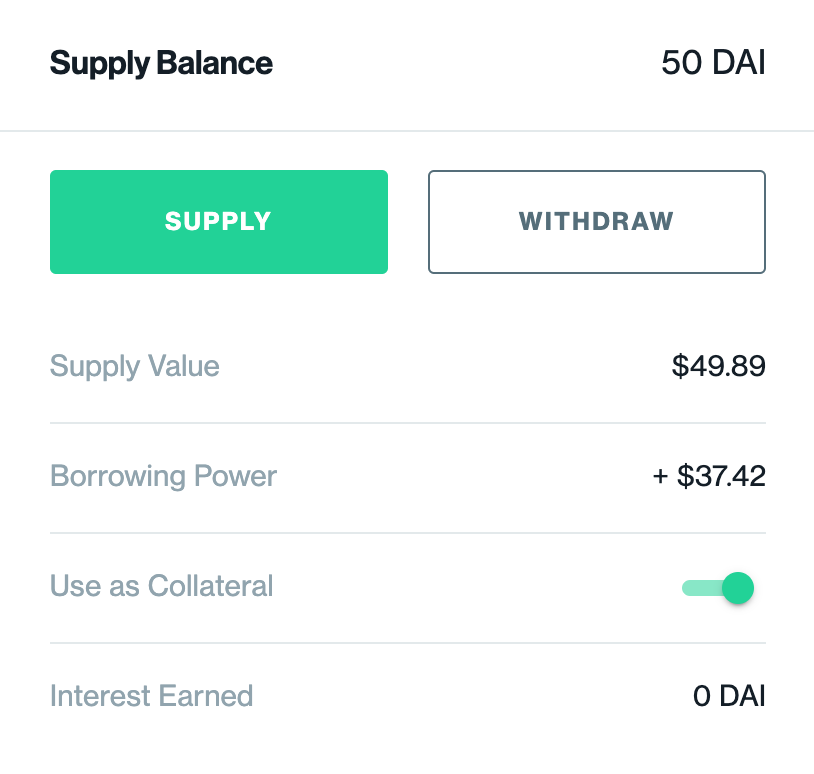
After supplying assets to the platform, cTokens appear in the user’s wallet—for example, Compound Dai (cDAI).
To withdraw supplied assets with accrued interest, click Withdraw.
Borrowing on the platform
Borrowing is as simple as supplying. Provided the user already has borrowing power, they can take out loans using the borrow panel.
Compound requires one‑time permission from the Web3 wallet to interact with its smart contracts. Granting permission is an on-chain transaction that incurs an Ethereum fee.


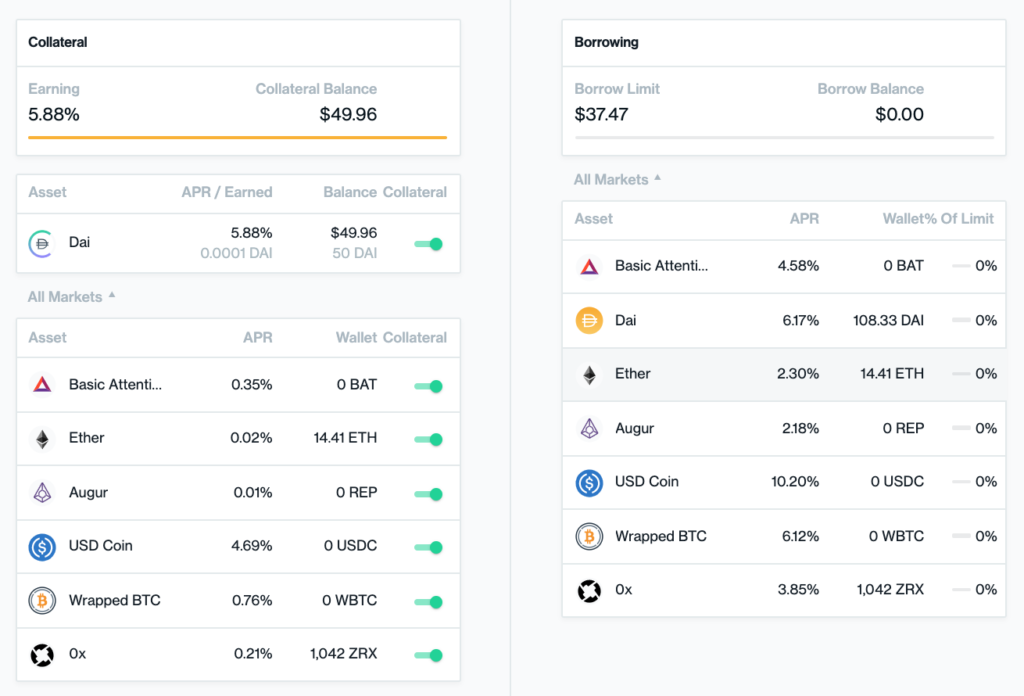
After choosing a supported asset on the right side of the panel, the user specifies the amount to borrow. Safe Max is the maximum loan size with low liquidation risk if the collateral’s price falls.


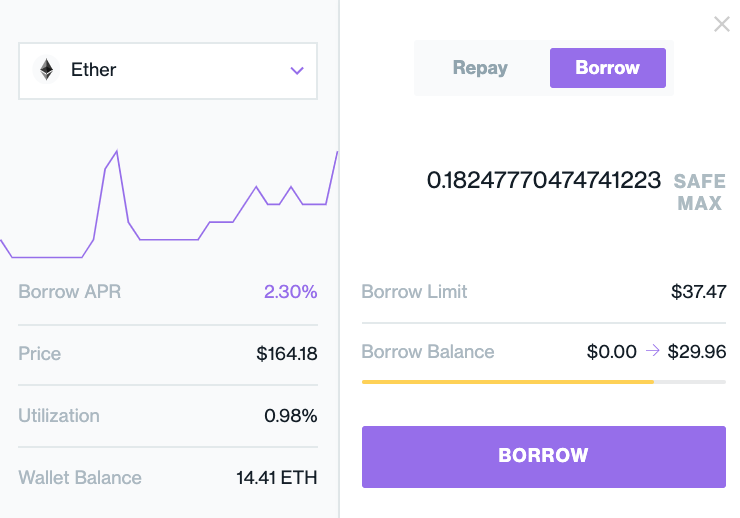
Once the transaction is initiated, the borrowed asset (ETH in this example) is sent to the Web3 wallet.
Loan interest accrues at the preset rate. The debt can be repaid at any time by clicking Repay.
How does Compound’s two‑token system work?
cToken
These tokens represent the balances of users interacting with a Compound liquidity pool. A given cToken’s underlying asset both earns interest and serves as collateral.
cTokens are ERC‑20 assets: they can be viewed in the Etherscan block explorer, stored in a wallet and sent to others. Compound currently supports 14 cryptoassets.
Example. A user supplies 1,000 BAT to the liquidity pool at an exchange rate of 0.02. They receive 50,000 (1,000/0.02) cBAT. If, after a few weeks, the exchange rate is 0.021, withdrawing will convert 50,000 cBAT into 1,050 BAT (50,000*0.021).
cToken features:
- You can borrow 50–75% of your cToken value depending on the underlying asset’s market characteristics, and add or withdraw tokens at any time.
- If collateral coverage becomes insufficient, a debt position may be liquidated.
- Liquidators receive 5% of liquidated assets.
- cTokens are viewable on Etherscan.
How to obtain cEther?
The method for receiving cETH differs from cBAT or cDAI.


When a user supplies ETH, the app forwards tokens directly to the payable mint function of the cEther contract. After activation, cEther appears in the wallet.
As a result, by invocation the cToken contract pulls the specified amount of underlying tokens from the sender’s address.
COMP
The other key asset in the Compound ecosystem is COMP, the native governance token.
COMP features:
- Total COMP supply is 10m. Of these, 55.71% are allocated to team members, founders, investors and partners. The remaining 42.29% are to be distributed to users over four years.
- Pace of liquidity mining: 0.5 COMP/block (~2312 COMP/day).
- Distribution dynamics depend on market‑set interest rates. For example, if USDT has the highest rates, users who supply and borrow Tether’s stablecoin accrue more COMP.
- Within each market, COMP rewards are split equally between suppliers and borrowers.
- Users can check rates on the User Distribution page.
- COMP holders can earn additional native tokens by voting on governance proposals.
- COMP is listed on many exchanges, including Coinbase and FTX.
How are Compound’s interest rates formed?
- Rates depend on the liquidity available in each market.
- They fluctuate with real‑time supply and demand.
- When liquidity is ample, rates are low.
- When liquidity is scarce, rates rise.
How is the interest rate calculated?
Each asset on Compound’s markets has its own supply and borrow APR, set by supply–demand dynamics. Interest accrues with each new Ethereum block, roughly every 15 seconds.
Excess liquidity exists only when supplied assets exceed borrowed amounts. If there are more lenders than borrowers, lenders’ yields decline. An asset’s utilisation rate determines returns.
How is the collateralised borrowing limit set?
A user’s borrowing power correlates directly with posted collateral. Each asset has a collateral factor determined by its volatility.
For example, Basic Attention Token (BAT), with a 50% collateral factor, confers less borrowing power than the Dai stablecoin. DAI has a higher, 75% collateral factor because it is less risky. Thus, posting $100 of BAT yields $50 of borrowing power, whereas posting $100 of DAI yields $75.
In calculating a collateralised loan’s limit, the collateral factors of all supplied assets are considered. A base rate is set for the maximum that can be borrowed relative to supplied collateral.
The collateral factor for each asset is set by Compound Finance governance.
How are positions liquidated?
If a user’s debt exceeds their maximum borrowing power, Compound swaps the over‑borrowed asset for the user’s collateral at a slight discount to market, incentivising prudent debt management.
Compound allows community members to act as liquidators using tools such as Compounder Liquidator. Participants can repay others’ loans in exchange for ETH at the best market rate.
For example, a 10 ETH loan whose collateralisation has fallen short can be repaid (re‑collateralised) by another user, who receives the loan’s underlying collateral at a discount of 5% or more (paid in ETH).
To help prevent liquidation, Compound also offers an Account Service API to monitor at‑risk addresses.
How does Compound Finance governance work?
- Any user with more than 1% of COMP’s total supply can submit proposals.
- Each proposal has a three‑day voting period.
- Any address with voting rights may vote for or against a proposal.
- If a proposal receives at least 400,000 votes, it is queued and implemented after two days.
- If the threshold is not met, the proposal is rejected.


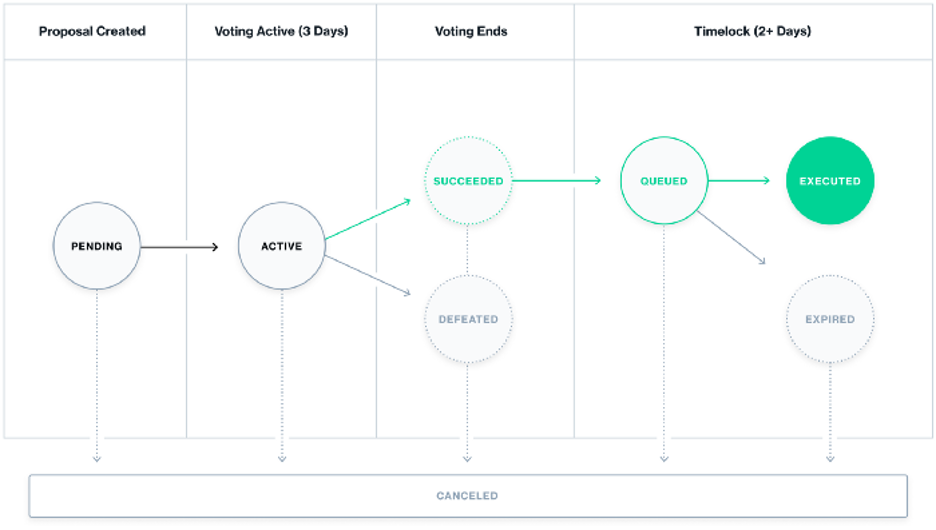
Examples of matters COMP holders vote on:
- Supporting a new cToken market.
- Changing the interest‑rate model.
- Updating the oracle address.
- Withdrawing a cToken reserve.
- Electing new administrators.
To update Compound Finance risk parameters such as interest rates or collateral factors, Compound employs a Timelock. It applies changes with a delay, providing protection: any attempt to tamper with the system can be spotted and thwarted.
The website compound.finance specifies:
“Any governance proposal is published with a minimum two‑day delay. For proposals concerning important updates, such as changing risk parameters, the delay may be 14 days. At present the Timelock controls the address whose administrators are members of the Compound team.”
Thus, the platform’s risk parameters are currently controlled by the company, albeit with a delay. Using smart contracts for control, Compound may in time open Timelock access to a distributed community committee. That would allow Compound Finance to become a decentralised autonomous organisation (DAO), similar to MakerDAO.
What is Compound Finance used for?
- Earning interest on assets supplied to the platform.
- Decentralised apps and exchanges can use Compound as a monetisation source within the Ethereum ecosystem.
- Traders can borrow ETH from the liquidity pool and post it as collateral in their portfolios to participate in crowdsales.
- Traders looking to short a token can borrow it from the pool and sell it.
How is Compound evolving?
In August 2020 Compound joined the Global DeFi Alliance, an international consortium of centralised and decentralised financial providers and platforms formed by the Huobi exchange.
In August 2020 the project launched its own crypto price oracle as part of a transition to the open‑access Open Price Feed.
The developers also created an aggregator of reported prices. Data are available directly from each publisher via their API.
In September 2020 the MakerDAO community voted to add COMP as a new collateral option for issuing the DAI stablecoin.
Compound currently works only with Ethereum‑ecosystem assets. In future it plans to support tokenised versions of real‑world assets: the US dollar, the Japanese yen and Google shares.
On December 17, 2020 Compound unveiled a white paper detailing Compound Chain, a new protocol to enable interoperability across blockchains.
Compound Chain was later renamed Gateway. The protocol’s testnet launched on March 1, 2021. Mainnet would launch in the summer or towards the end of 2021.
Gateway functions similarly to Compound on Ethereum, with some differences:
- Gateway enables borrowing and lending of assets on any blockchain.
- Interest is paid in dollars (stablecoins) via CASH, Gateway’s native unit of account.
- Gateway has a more efficient risk‑assessment mechanism based on the volatility of collateral and borrowed assets, improving capital efficiency for less volatile coins.
Gateway targets cross‑chain interoperability and resembles THORChain in function.
Gateway users can upload supported assets from different independent blockchains via a system of connected peer chains. Each chain has an associated Starport contract, which locks and unlocks assets on Gateway.


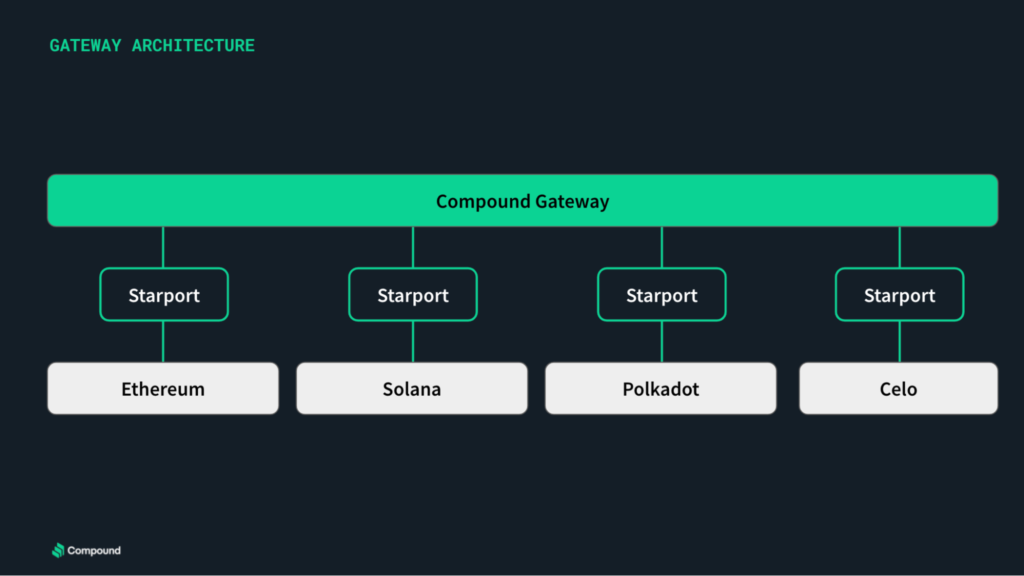
After assets are uploaded to Gateway, users can supply and borrow across chains. For instance, one can borrow Ethereum tokens using Solana as collateral, or borrow Celo assets using Polkadot, and so on.
Gateway is designed to let blockchains interoperate directly, without wrapping tokens.
For example, to create Wrapped Bitcoin (WBTC), DeFi users currently rely on intermediaries such as BitGo or Ren, weakening control over their private keys. Gateway proposes a way for bitcoin holders to interact with other blockchains without third parties.
Migrating to Gateway would help Compound users avoid Ethereum’s high fees.
CASH is Gateway’s native unit of account used to pay transaction fees. Like MakerDAO’s DAI, it is created through borrowing. The amount of CASH in circulation equals the amount borrowed.
Initially, CASH is intended to track one US dollar. The community may change this later via collective decision. CASH could potentially compete with DAI and USDC.
All users and validators holding CASH receive income that increases via an interest‑rate index. This occurs whenever a user/validator mints, redeems, borrows, repays or liquidates CASH.
Gateway uses a Proof‑of‑Authority (PoA) algorithm. The network is run by trusted validators. Consensus holds even if one‑third of nodes misbehave. A block is finalised when at least two‑thirds of nodes agree to add it. Borrowers pay validators interest for every confirmed block. Validators also earn fees for transferring assets.
The PoA model allows banks and centralised crypto exchanges to become Gateway validators.
COMP holders will govern Gateway via Compound Governance on Ethereum.
Initially, Gateway will be primarily a yield market across interconnected blockchains. Over time, other dapps—such as decentralised exchanges—may integrate with it.
On June 28, 2021 Compound Treasury went live—a new company under Compound Labs. Compound Treasury enables neobanks and other fintech firms to convert US dollars into USDC. Those USDC are deployed in Compound at a guaranteed 4% rate—well above typical traditional savings accounts (0.55%–0.7% APY).
Links:
Official site: compound.finance