


What is Grin?
1
What is Grin?
Attention! The article is outdated and requires an update.
2
What are Grin’s key features?
- Enhanced privacy: elliptic-curve cryptography and a Pedersen commitment scheme enable opaque yet verifiable transactions.
- Blockchain: small in size (~300 MB) and simple in design, it scales with the number of users rather than the number of transactions. The number of users equals the number of unspent outputs, so there is no need to include individual transaction data in every block. A block in Grin’s blockchain consists of a header, a list of inputs after “cut-through”, a single kernel for the entire block, and a kernel for each individual transaction in the block. “Cut-through” is the process of aggregating transaction inputs or outputs into a single set before they are added to the network. MimbleWimble protocol enables transaction verification while concealing user information and amounts.
- Launch: Grin was launched without a premine or ICO. Developers do not receive a share of mining rewards. The project is funded by donations.
- Mining: Cuckoo Cycle, Grin’s PoW algorithm, is the simplest of known PoW algorithms and allows mining rewards to be distributed across device types, including ASICs and GPUs.
3
How does Grin work?
The Grin protocol does not support scripts; it cannot run smart contracts or decentralised applications (dApps). At the same time, “scriptless scripts” allow for constructs such as multisignatures, atomic swaps and payment channels. Grin has unlimited issuance, but inflation decreases annually as the total number of coins in circulation grows.
Until 20 January 2020, the inflation rate will be 7500%; in 2020–21 it will be 100%; in 2021–22, 50%; in 2022–22, 33%; in 2023, 25%; in 2024, 20%; in 2025, 17%; in 2026, 14%; in 2036, 5.6%; and in 2050, 3.1%.
Addresses and amounts are hidden in transactions. Two transactions can be merged into one within a block—the intermediate information is removed. Each Grin transaction consists of three components:
- A set of inputs that reference and spend previous outputs.
- A set of new outputs.
- A transaction kernel.
Within this scheme, only the direct participants in a transaction can see its inputs and outputs. To anyone not directly involved, the inputs and outputs appear as a chaotic, meaningless data set.
4
Who develops Grin?
Development is led by a council of seven/eight developers and numerous volunteers.
According to the Grin repository on Github, since 2016 141 developers have been involved. Six people have made significant contributions to the project, two of them anonymously.
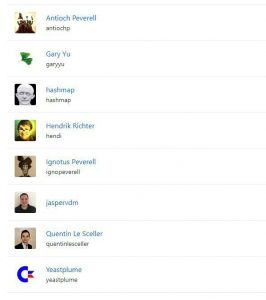
Some lead developers of the GRIN project
The project has received donations from the Spark Pool and bminer mining pools, the Gate.io and Poloniex exchanges, and the Qtum project. Development costs are covered by the Grin General Fund (Grin General Fund). This fund is managed by the Grin Technical Council, and all spending decisions are public.
Two donations of 50 BTC each stand out in the project’s history of voluntary financial support.
5
How are GRIN issued and stored?
6
What are Grin’s next goals?
Commits to the project’s centralised code repository (last 12 months):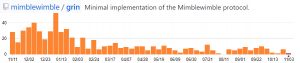
By the metric of overall development activity, Grin ranks 35th among cryptocurrencies.
According to the 2020 roadmap, developers intend to focus on developing atomic swaps for off-chain transactions between bitcoin, Ethereum and Grin, and to implement the Lightning Network.
Рассылки ForkLog: держите руку на пульсе биткоин-индустрии!