



What is Ethereum’s roadmap?
The Ethereum roadmap is a multi‑stage plan to improve the protocol. Although there are no hard deadlines or a strict order of upgrades, the community embraced a proposal by Vitalik Buterin, founder of the world’s second‑largest cryptocurrency, published in November 2022.
Updated roadmap diagram! pic.twitter.com/MT9BKgYcJH
— vitalik.eth (@VitalikButerin) November 4, 2022
The plan lays out six tracks named by the ecosystem’s co‑founder: The Merge, The Surge, The Scourge, The Verge, The Purge and The Splurge.
He has said the roadmap is not a strict sequence of upgrades. Pieces from different tracks are implemented in parallel, advancing goals across blocks at the same time.
In simplified form, priorities for Ethereum’s sustainable development include L2 scaling, stronger wallet security and data privacy. That is the direction Buterin outlined in June 2023.
What does The Merge change?
The best‑known track on the roadmap is The Merge, which ended mining and introduced Proof-of-Stake (PoS). By September 2023, the ETH community had marked one year since the move to PoS.


The aim of The Merge is a simple, robust and decentralised PoS consensus.
The September 2022 transition to PoS did not complete this track. In April 2023 the network executed the Shapella hard fork, enabling ETH withdrawals from staking. The upgrade also reduced gas costs for certain transaction types, optimised on‑chain data storage, and introduced EVM improvements and new cryptographic primitives.
What does The Surge include?
This track targets Ethereum’s scaling via rollups, better known as L2 solutions. Notable projects on ETH include StarkNet, zkSync, Loopring, Arbitrum and Optimism.

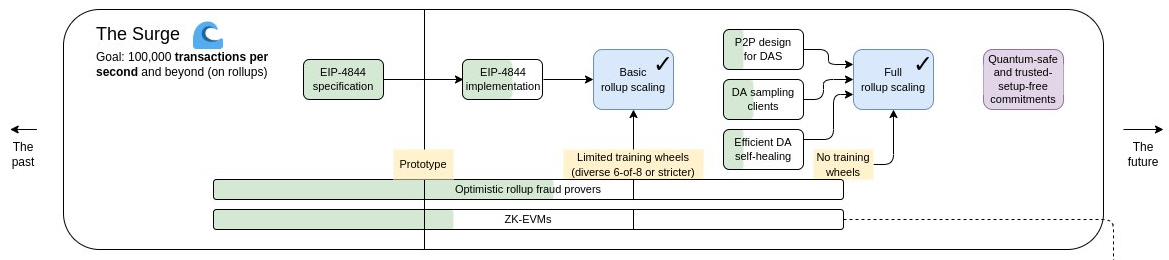
The goal of The Surge is to reach 100,000 TPS (transactions per second) and beyond through rollups.
A keystone is EIP‑4844, known as Proto‑Danksharding. It introduces a new transaction type for large binary data blobs and organises their storage, cutting fees for rollup‑based L2s.
In early September, ETH developers approved details of an upcoming network hard fork dubbed Dencun, which will implement EIP‑4844 alongside several other changes.
What does The Scourge entail?
The Scourge addresses Maximal Extractable Value (MEV), a mechanism that lets validators include, exclude or reorder transactions in a future Ethereum block. MEV, which harms the broader ecosystem, is dubbed an “invisible tax” on using the network.
Beyond enabling complex speculative strategies, MEV has raised acute questions about censorship. For instance, in October 2022 the share of transactions compliant with the requirements of the U.S. Office of Foreign Assets Control exceeded 50%.


The aim of The Scourge is to create a robust, neutral mechanism for transaction inclusion, avoiding centralisation and other MEV‑related risks.
The principal upgrade here is PBS (proposer‑builder separation), which curbs validators’ powers in block formation and introduces a new class of actors that order transactions.
What is The Verge for?
This stage aims to remove barriers to storing and exploring the blockchain’s full state. According to Etherscan, a full Ethereum node weighs over 1.2 TB, while a full archive node is over 15 GB, and syncing new nodes can take several days.
Processing and querying such data sets demands significant resources, a potential problem as Ethereum adoption widens.

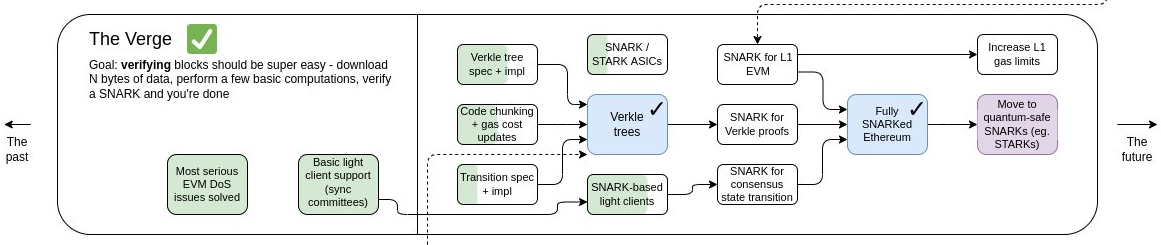
The aim of The Verge is to make block verification very simple and fast.
Buterin proposed easier access to Ethereum’s full state via an upgraded Merkle tree structure and the use of zero‑knowledge technologies zkSNARK and zkSTARK. Such changes would permit higher gas limits, aiding L2 scaling, and enable new kinds of light clients.
What problems will The Purge solve?
While The Verge focuses on verifying Ethereum’s history, The Purge seeks to update how historical data are stored and recorded.
The key proposal is EIP‑4444, which introduces conditional checkpoints for syncing. For example, developers could choose a block depth of 300 days without downloading the chain all the way back to genesis.

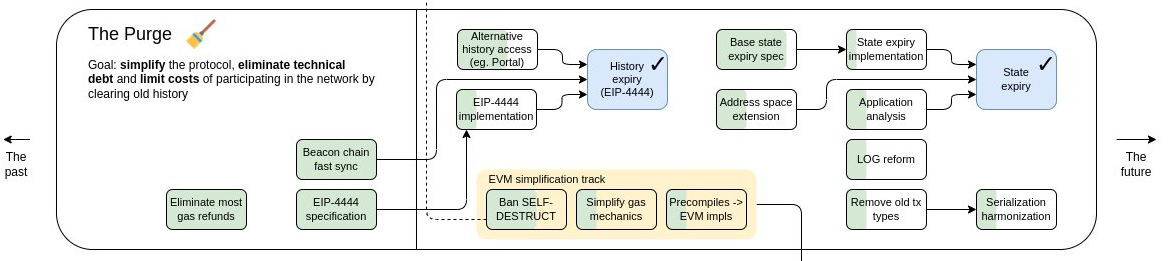
The aim of The Purge is to simplify the protocol by pruning Ethereum’s history.
Active debate on these issues began in 2021. Buterin and other community members warned that, in time, full access to the ETH network might be possible only with specialised, expensive hardware—risking centralisation and adding technical complexity to core operations.
What is in The Splurge?
The Splurge is a grab‑bag of developments that do not fit elsewhere. Its best‑known milestone is the EIP‑1559 token‑burning mechanism, activated in August 2021.


The aim of The Splurge is to implement and refine items not covered in other tracks.
ETH developers delivered account abstraction via the ERC‑4337 token standard, enabling variants of smart‑contract‑based wallets.
Beyond account abstraction, The Splurge allocates work to improve EVM efficiency and to tune the EIP‑1559 burn mechanism.
What updates are expected by end‑2023?
As of now, the Ethereum community has reached consensus on the forthcoming Dencun hard fork, expected at the end of the year.
The upgrade will include elements from almost all tracks: scalability, data storage, removal of legacy features, EVM modifications and stronger infrastructure security.
Additionally, the largest ETH test network, Goerli, will be shut down at the end of 2023. It is to be replaced by the Holesky testnet, designed for staking trials, infrastructure assessment and protocol testing.
The only public estimate of completion across all planned upgrades came from Buterin: 55% as of July 2022.