



What is Tezos?
Attention! The article is outdated and awaiting an update.
Who created Tezos, and when?
Tezos was created by Arthur Breitman, son of the well-known French playwright, writer and actor Jean-Claude Dere. Arthur Breitman studied applied mathematics, computer science and physics at the École Polytechnique in Paris, then moved to the United States to study financial mathematics at New York University. He worked at the investment banks Goldman Sachs and Morgan Stanley, and at Google X and Waymo.
For several years, Breitman helped organise seminars and meet-ups of anarcho-capitalists in New York. Participants in this movement styled themselves as “radical libertarians advocating unfettered capital accumulation, intensive technological progress and high living standards of the capitalist system,” as well as a rejection of confrontation with the state.
At another anarcho-capitalist meeting in 2010, Breitman met American student Kathleen McCaffrey from New Jersey. Arthur and Kathleen married in 2013. After graduating from Cornell University, Kathleen worked at the hedge fund Bridgewater Associates, at Accenture and at R3 CEV, a company specialising in distributed databases. From the outset of Tezos’s development, Kathleen assisted her husband on the project.
In August 2014, Arthur Breitman, under the pseudonym “L. M. Goodman,” published a memorandum devoted to Tezos, and in September 2014 the project’s white paper. The pseudonym L. M. Goodman alluded to Newsweek journalist Leah McGrath Goodman, who became known after attributing the authorship of Bitcoin to Dorian Prentice Satoshi Nakamoto, an American of Japanese origin.
In the memorandum and white paper, the Breitmans noted weaknesses in Bitcoin such as its inability to provide a more inclusive governance system and the creation of new tokens, predicted that many flash-in-the-pan tokens would soon appear, and presented their own blockchain solution: Tezos, billed as the world’s first “self-amending” cryptocurrency.
The cryptocurrency’s name was generated by Breitman’s algorithm, which searched for pronounceable, unclaimed domain names in English.
How has Tezos developed?
In 2015, the Breitmans founded Dynamic Ledger Solutions (DLS) to write Tezos’s source code. At the time, Breitman was a quantitative finance specialist at Morgan Stanley. Not wishing to risk his job, he chose not to disclose his involvement in the project (he left the bank in April 2016).
When registering the company in the United States, Breitman, in violation of Financial Industry Regulatory Authority (FINRA) rules, failed to disclose his participation in “other business activities”. As a result, in April 2018 FINRA fined him $20,000 and barred him for two years from associating with broker-dealers.
In 2016, DLS released the project’s source code. In February 2017, an alpha network of the protocol was launched based on that code.
Because Swiss law permits the creation, for the public benefit, of independent foundations to support open-source software platforms, a non-profit Tezos Foundation was registered in Zug. The Breitmans asked South African entrepreneur Johann Gevers, founder of the Swiss fintech company Monetas, to serve as the foundation’s president.
The foundation obtained control over the project’s crowdsale proceeds; intellectual property was controlled by the Breitmans’ company, DLS.
After the ICO, the Breitmans planned to sell DLS to the Tezos Foundation, after which control over Tezos’s source code would pass to the foundation’s leadership. However, by the time the ICO, scheduled for May 2017, was due to start, the project was short of funds. Kathleen Breitman turned to venture capitalist Tim Draper, who invested $1.5m via Draper Associates and received a minority stake in DLS.
On 1 July 2017, the Tezos ICO began: over two weeks, 32,000 users purchased approximately 607.8m XTZ tokens, created and distributed at the moment the genesis block was formed in the Tezos network upon the beta launch. The organisers raised around $232m in bitcoin and ether (although they had planned to raise at most $20m).
According to the official data on the Tezos Foundation website, tokens were distributed as follows:
- ICO participants: ~ 88.43% (607,489,040.89 XTZ);
- Early backers and contractors: ~ 0.46% (3,156,502.85 XTZ);
- Tezos Foundation and Dynamic Ledger Solution, Inc. (DLS).
In the agreement with contributors, the raised funds were defined as “non-refundable donations,” not “venture investment”. The company warned that token issuance might not occur.
As Gevers claimed in October 2017, the foundation’s contract with the Breitmans stipulated that if the sale of DLS to the foundation did not take place “within the agreed time,” the Tezos Foundation would receive it for free. However, Gevers failed to show journalists a copy of the agreement. If the company operated successfully within three months after the sale, DLS shareholders (the Breitmans and Tim Draper) were to receive 8.5% ($19.7m) of the crowdsale proceeds and 10% of all Tezos tokens. The deal did not happen because of a conflict between the Breitmans and Gevers.
According to Gevers, disagreements flared because the couple opposed the foundation’s decision to hire certain people. He said DLS retained control of the foundation’s “domains, websites and email servers”.
Work on the project and the expansion of the developer team proceeded very slowly, and XTZ tokens were not distributed to contributors on time. Angry investors filed several class-action lawsuits against the foundation and DLS. In mid-February 2018, Gevers and several members of the Tezos Foundation board resigned. Development resumed thereafter, and in June 2018 the Tezos Foundation launched the platform’s beta version; the main network went live in September 2018.
On 29 May 2019, the Tezos protocol was upgraded under the name Athens A. Athens A introduced several backward-incompatible changes. The first change raised the gas limit to increase the network’s computational capacity and throughput. The number of tokens required to gain baker status fell from 10,000 XTZ to 8,000 XTZ.
On 18 October 2019, the Babylon 2.0 upgrade was activated, changing the network’s consensus algorithm, smart-contract functionality and governance. Smart-contract development was simplified; the reward system for bakers (validators) was revised to maximise participation in block approvals; and delegating XTZ to bakers became easier. Previously, users created special KT1 addresses for this; after the upgrade, funds could be delegated from a main address.
In March 2020, Tezos holders voted for the Carthage 2.0 upgrade, aimed at optimising code and addressing a number of issues. In particular, it allows a 30% increase in the gas limit per block and per operation, enabling developers to run more complex applications.
How are Tezos tokens issued?
The native token of the Tezos blockchain is the tez; its exchange ticker is XTZ.
Tezos uses an inflationary model: annual inflation is intended to be about 5.5%. XTZ are minted as new blocks are created; some tokens may be destroyed as a penalty for validator misconduct.
Another issuance path exists: when a baker proposes a protocol upgrade, they may include an invoice in XTZ. If the proposal is adopted, the author receives that amount via additional issuance.
XTZ can be used as follows:
- As rewards for participating in the creation and approval of new blocks (either directly or via delegating tokens).
- As votes in the decentralised governance system.
- As a payment instrument for transferring value.
- To pay for gas — the unit used to cover fees. Gas is required not only for ordinary transactions but also when interacting with smart contracts and running decentralised applications.
Some projects (for example, Ethereum) face high inflation caused by unlimited issuance, but within Tezos’s on-chain governance users can propose changes to the issuance model, which are adopted if supported by a majority of users.
What consensus mechanism does Tezos use?
Tezos runs on Liquid Proof-of-Stake (LPoS). Because the algorithm involves delegation, it is sometimes mistakenly assumed that Tezos uses Delegated Proof-of-Stake (DPoS), like TRON and EOS. In some earlier official documents, the project used the term “Proof-of-Stake with delegation”. To avoid confusion, the designation Liquid Proof-of-Stake (LPoS) was later introduced. Under LPoS, new blocks are created by a randomly selected participant (a delegate), and 32 other randomly selected participants endorse it.
The process of creating new blocks is called “baking”. Miners, accordingly, are called bakers.
As in Proof-of-Stake, the right to create new blocks is distributed among delegates in proportion to the size of their stake.
To speed up the selection of delegates, XTZ are aggregated into rolls of 8,000 XTZ. The number of rolls determines a delegate’s voting weight.
Because not all network users wish to bake, participants may delegate their tokens to others without transferring ownership: the recipient cannot spend them. Delegated tokens become part of the delegate’s stake. Delegation transfers the rights to participate in consensus and to vote in on-chain governance.
To create new blocks, from among delegates willing to participate the protocol selects two categories of participants:
- Block producers (bakers) — one participant per block, who creates and signs the new block. Each validator is randomly assigned a priority for each block, starting at 0. If the baker with priority 0 skips their block, the right to produce it passes to the next.
- Endorsers — thirty-two participants for each new block who attest they have seen and validated the new block.
Delegates receive rewards for producing new blocks:
- 1.25 XTZ to endorsers.
- 40 XTZ plus fees to the block producer (baker).
If a block is confirmed at a priority other than 0, the reward to endorsers is 0.833333 XTZ, and to the baker it is 0.1875 XTZ multiplied by the number of endorsers. The reward for producing a block with priority 0 also decreases if the number of endorsers is less than 32 and equals 1.25 times the number of endorsers. The total reward for producing a new block is no more than 80 XTZ.
To enhance network security and reduce the risk of dishonest behaviour by delegates, a security deposit is used. The deposit is 512 XTZ for block production and 64 XTZ for endorsement.
Blocks are aggregated into cycles, each containing 4,096 blocks. The security deposit is frozen for the preserved_cycles period, equal to five cycles in the past and at least 14 days, 5 hours and 20 minutes. Under current network parameters, a delegate wishing to participate in block creation must hold in deposit about 8.25% of the total tokens delegated to them.
If a participant detects a delegate’s misbehaviour (for example, attempting to create two blocks at the same height) and provides proof, they receive half of the security deposit as a reward; the other half is burned.
Payouts to users who delegate tokens are not automatic; they are performed manually. Terms offered by public delegates — such as fees, minimum thresholds and payout schedules — may vary. The Tezos protocol imposes no such restrictions, so users must find this information on third-party resources.
What is Tezos’ architecture?
The Tezos platform is written in the functional programming language OCaml. Smart contracts are written in Michelson. Like OCaml, Michelson is a strictly typed language, optimised for writing Turing-complete smart contracts and enabling formal verification (checking code against a specification to detect discrepancies).
The diagram below shows the architecture of Tezos:

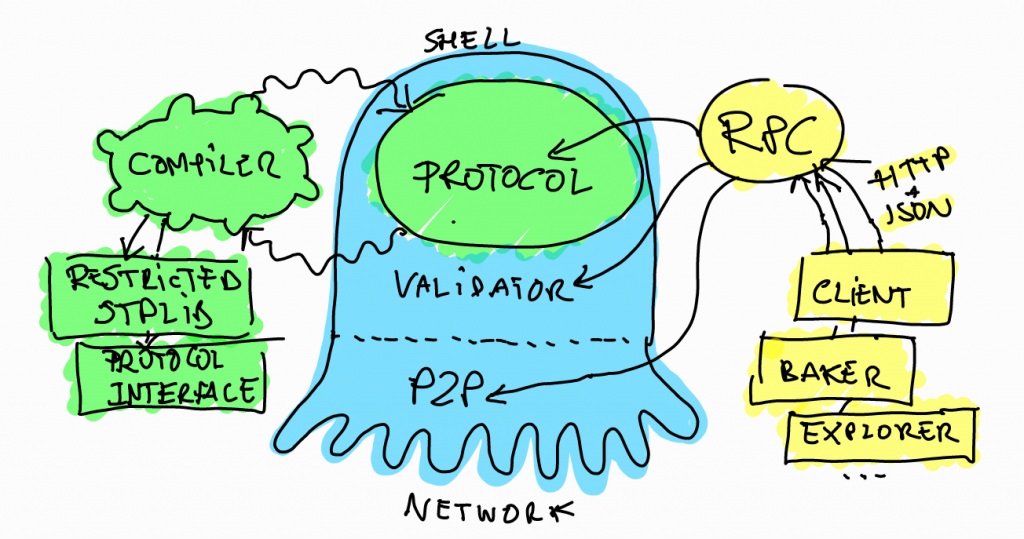

- The protocol (shown in green) is responsible for interpreting transactions and performing other administrative operations.
- The protocol identifies invalid blocks.
- The protocol knows only a single canonical chain from the genesis block and does not envisage nodes proposing alternative chains.
- The shell (shown in blue) recognises the possibility of multiple chains and is responsible for selecting proposals from block creators (bakers).
- The shell selects and loads alternative chains into the protocol, which checks them for errors and assigns an absolute score.
- The shell then selects the valid chain with the highest score — this part of the shell is called the validator.
- The shell contains the p2p layer, on-disk block storage, operations for bootstrapping new nodes and a versioned state of the ledger.
- The RPC layer (Remote Procedure Call, shown in yellow) supports JSON format and the HTTP protocol, through which external clients issue requests and inspect node state.
One of Tezos’s key features is that the protocol can evolve. This is implemented by embedding two functions in the protocol that allow a new protocol version to be installed on the testnet or the mainnet.
Improvement proposals can be submitted via the governance system. Proposals may include code, which is first deployed to the testnet and, after sufficient testing, promoted to the mainnet.
The ability to change the protocol to reflect user demand helps minimise forks and reduces the risk of community splits.
Tezos has two types of accounts:
- Smart contract — an account that may contain smart-contract code or a token. Such account addresses start with KT.
- Implicit account/Manager — an account that does not execute code and may act as a manager for other accounts. It can be used for ordinary storage, delegation and baking. Addresses of this type start with TZ.
How is Tezos governed?
Tezos is governed through on-chain voting in four stages:
Proposal Period
During this period, delegates may submit up to twenty proposals. By submitting a proposal, a delegate automatically votes for it. At the end of the period, votes and proposals are tallied, and the leading proposal advances to the next period.
Testing Vote Period
During this period, delegates may vote for one proposal. If it receives a supermajority of votes, it moves to the next period; if not, the system returns to the Proposal Period.
Delegates may vote “for”, “against” or “abstain”. A supermajority is when “for” votes account for more than 80% of “for” + “against”. Participation is calculated as all votes cast divided by the number of possible votes.
The quorum starts at 80% of votes and is then updated at each vote according to newQ = oldQ * 8/10 + participation * 2/10, where:
- newQ is the new quorum value;
- oldQ is the previous quorum value;
- participation is the participation ratio.
Testing Period
During this period, the proposal is tested for effectiveness and correctness. The Tezos testnet performs a 48-hour fork in which the proposal is tested.
Promotion Vote Period
During this period, delegates may cast one vote for or against the proposal that passed testing. If quorum is reached, the proposal is activated on the mainnet. Otherwise, the process returns to the Proposal Period.
Each period lasts about three weeks; a full cycle takes roughly three months.
What else should you know about Tezos?
- In December 2018, leading Tezos developers founded Nomadic Labs, which conducts research and development for the Tezos protocol. The company has more than thirty specialists, including Benjamin Canou, Gregoire Henri and Pierre Chambart — leading Tezos architects who previously worked with OCamlPro. Nomadic Labs regularly publishes progress reports.
- The tezosprojects website lists projects building solutions for the Tezos ecosystem.
- The Tezos Foundation runs a grants programme for ecosystem projects. Applications go through several selection stages. Read more on ForkLog.
- The official site hosts the second version of the white paper, outlining changes in the platform’s implementation versus the initial plans.
- The developer section on the official site provides full technical documentation describing how the platform works.
- The Tezos Foundation’s news section features weekly updates on the project’s progress.
- Working groups are formed on key integration topics, for example the wallet working group, in which Arthur Breitman participates.
- The independent Paradigm Fund project regularly publishes Medium blog updates on events in the Tezos ecosystem.
Subscribe to ForkLog news on Telegram: ForkLog Feed — the full newswire, and ForkLog — the most important news and polls.