


What is TON?
1
What is TON?
Attention! This article is outdated and requires an update.
Telegram Open Network (TON) is a next-generation peer-to-peer multi-blockchain system with a built-in cryptocurrency, Gram (GRM), from the developers of Telegram. The creators of TON aim to outpace existing blockchain projects, including Bitcoin and Ethereum, in speed and scalability. They plan to achieve this through Proof-of-Stake (PoS) consensus, a Byzantine Fault Tolerant protocol, sharding and intelligent routing (Instant Hypercube Routing).
TON could offer users:
- secure messaging;
- micropayments;
- the ability to pay for goods and services in Gram;
- data storage;
- decentralised applications.
The project first surfaced in late 2017, but Telegram effectively confirmed its involvement only in autumn 2019. Nikolai Durov, who handled the technical launch of VKontakte and Telegram, describes TON as “a huge distributed supercomputer or superserver” for numerous services.
On 12 May 2020, Pavel Durov announced the closure of the Telegram Open Network project.
2
What is Gram?
Gram (GRM) is the native currency of the TON network. It was expected to be used for:
- paid content and subscriptions (on the bot platform, in groups, channels and Telegram’s ad exchange);
- staking and paying commissions (gas) to network validators for processing transactions;
- paying for goods and services across all TON components.
According to the project documentation, the issuance would total 5 gigagrams (5 billion) Gram.
3
Is Gram a security?
The initial Gram offering was conducted under the US Securities and Exchange Commission’s Rule 506(c), and the project had not yet issued the tokens. At this stage the regulator considered GRM a security. The SEC alleges that the offshore entities TON Issuer and Telegram Group violated the Securities Act, notably Sections 5(a) and 5(c). According to the agency, the companies sold 2.9 billion unregistered digital tokens for $1.7 billion to 171 investors in the US and abroad.
In October 2019 the SEC secured a temporary court order halting token distribution. The developers therefore postponed TON’s launch to 30 April. In February 2020 a court extended the ban indefinitely. Telegram disputes the Commission’s legal position; neither company intended to retain control of TON after launch.
Another regulator — the CFTC — has said that digital currencies are commodities, and TON’s developers asked to have their token recognised as such. Commodities fall outside the SEC’s jurisdiction, but many securities exhibit commodity-like properties, complicating classification.
On 30 April 2020, the second deadline, Durov informed investors that the launch would not happen because of the conflict with the SEC and a US court’s ban on distributing Gram tokens. He offered investors a deal: take back 72% of funds or sign a new agreement giving the project until 30 April 2021 to launch. The latter option envisaged either receiving Gram or another cryptocurrency at launch, or a 110% refund. Durov was even ready to sell part of his stake in Telegram if the effort failed.
Investors then received several more letters that again changed the terms. American investors were told separately that they could no longer participate and were left only with the option to take back 72% of their funds. Others were informed they would receive neither Gram nor any other cryptocurrency.
A definitive answer to whether Gram is a security would be known after the SEC’s lawsuit against Telegram, and this section will be updated.
4
What does TON comprise?
The TON system comprises several components that can be integrated with third-party applications and messengers, the first of which would be the multi-blockchain platform TON Blockchain. Access to it will be provided via the TON peer-to-peer network (TON P2P Network). TON Service will be a platform for third-party services, decentralised applications and smart contracts.
TON DNS will simplify access to services, smart contracts, nodes and accounts by assigning human-readable names.
TON Storage will enable distributed file storage within the TON network and access via smart contracts, reminiscent of IPFS and Filecoin. It will also host archives of TON Blockchain.
The anonymiser TON Proxy will provide anonymity and confidentiality by hiding node identifiers and IP addresses, and together with other components will help circumvent censorship.
The TON Payments platform will enable instant transfers and payments without registering on the blockchain and without paying fees.
At the expected mainnet launch, the TON wallet would be available as a standalone application without integration with Telegram Messenger. Such integration is not ruled out, but its depth would depend on regulatory barriers.
5
How is TON Blockchain designed? (if you are not a developer, you may skip this section)
TON Blockchain is, in essence, a collection of blockchains composed of smaller blockchains. Its design represents all data in blocks and states as trees of cells, or directed acyclic graphs (DAG) of cell collections (a “bag of cells”), each carrying up to 1,023 bits of data and up to four references to other cells. The architecture provides for a master blockchain — the Masterchain — and up to 292 additional blockchains. This approach is meant to keep the system flexible and minimise problems caused by main-chain growth.
The Masterchain governs the entire system, storing block hashes, information about validators, coin issuance, workchain status and the like.
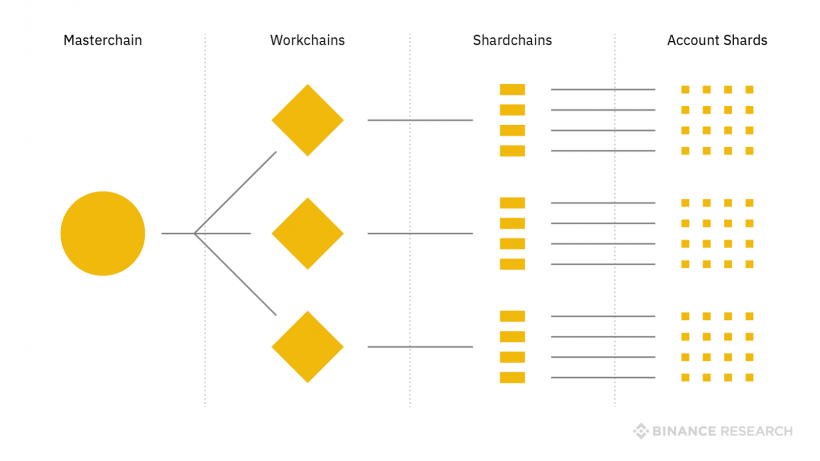
A Workchain supports up to 232 virtual workchains (operating blockchains), split into shards. Workchains execute Turing-complete smart contracts written in the new programming language Fift, have their own virtual machines (TVM) and identifiers, and can include up to 260 shards.
Any community participant can create and activate a workchain by paying a high fee to publish its specification in a Masterchain transaction and obtaining approval from two-thirds of the network’s validators. To date, only the main workchain (Workchain Zero, workchain_id = 0) has an identifier; it processes TON smart contracts and Gram transactions.
Shardchains provide scalability. Under the “Infinite Sharding Paradigm”, TON blockchains could split and merge automatically depending on network load, ensuring high throughput and low fees.
A Shardchain contains many small virtual blockchains — Accountchains — holding an account’s outgoing and incoming messages, whose senders and recipients may be inside TON or outside it (for example, TON users could receive and send funds from blockchains such as Bitcoin, Ethereum and others).
6
How does TON Blockchain work?
The main chain was expected to have no more than 100 validators — node operators who deposited significant amounts of Gram (stakes) to generate and confirm new blocks. Every 1,024 blocks the set of validators assigned to a shard would change pseudo-randomly. The group’s task is to reach consensus on adding a new Shardchain block. Validators share transaction fees and newly issued coins; if a validator adds an invalid block, its stake can be automatically reduced or it can be temporarily removed from the validator pool.
Once new Shardchain blocks are produced and BFT consensus is reached among all validators, a new Masterchain block is generated. It includes the hashes of the latest Shardchain blocks and makes all previous blocks canonical. Thus, without waiting for 20 confirmations, a transaction included in a Shardchain can already be used in the next Shardchain block.
For details of the Catchain Consensus Protocol, see the documentation presented by Nikolai Durov.
Catchain Consensus: An Outline by ForkLog on Scribd
7
How is cryptocurrency mined in TON?
In TON, new coins are issued not by miners but by validators. To obtain this status, one would need several high-performance servers and robust internet connectivity. More precise parameters and validator requirements were to be published before the project’s launch. Node owners can increase a validator’s stake and, in return, receive a proportional share of rewards when new blocks are added.
Another way to earn cryptocurrency in TON is to look for bugs in the system as a “fisherman”.
You could also earn as a collator node, proposing new blocks to validators for inclusion in a Shardchain after checking its state, the state of neighbouring shardchains and the relevant Merkle proofs. However, this option would not be available in the early stages of deployment.
8
Which currencies will TON Blockchain support?
The primary cryptocurrency of Workchain Zero will be Gram. In theory, TON Blockchain could support up to 232 cryptocurrencies — the number of virtual workchains that can operate under the Masterchain. Each workchain is expected to have its own base currency and several auxiliary ones. If a workchain charges fees in its own coins, its creators should implement a smart contract for automatic conversion into Gram.
Subscribe to ForkLog news on Telegram: ForkLog Feed — the full newswire, ForkLog — key news and polls.
Рассылки ForkLog: держите руку на пульсе биткоин-индустрии!