




1
What is venture capital?
Venture capital is long-term, high-risk equity investment in new high-tech startups (or in already well-established venture-backed companies). The latter are typically relatively small firms focused on developing and producing knowledge-intensive products.
The venture industry is most developed in the United States. It is also expanding in Europe and China.
2
How does venture capital differ from traditional investing?
Venture financing is usually associated with a high risk of losing the investment in any given company (often above 50%). It is therefore linked not only to fast-growing innovative firms, but also to expectations of high returns and significant risk.
Investors typically recoup capital when they sell their stake in a company. Overall profitability is driven by outsized gains from the most successful projects.
3
What are the advantages and drawbacks of venture financing?
For startups, the advantages include:
- The ability to raise substantial capital for high-risk projects when other sources are unavailable.
- No need for collateral or other security, unlike bank loans.
- Funds can be provided quickly.
- Typically no interim payments (interest, dividends) are required.
- Access to capital not only at the outset but as the company matures and the product improves (through subsequent funding rounds).
Drawbacks for startups:
- Difficulty finding investors and securing the targeted amount.
- Venture investors may offer funding on unfavourable terms.
- Access to venture money depends heavily on market conditions.
- The risk of an investor exiting unexpectedly or selling a stake to third parties.
- Equity dilution (venture funding can reshape ownership and lead to loss of control over decisions).
- In many countries the industry remains underdeveloped.
For investors, the chief advantage is high return potential. The obvious downsides are the high risk of loss and a relatively long investment horizon (3–7 years). Venture investing is also largely the preserve of experienced investors with specialist knowledge of the project’s field.
4
What are the stages of raising venture capital?
To organise investments and reduce risk, financing is often divided into stages, or rounds. An investor may fund a project across several rounds or just one. In other words, the breakdown into rounds is conventional and by no means obligatory.
Seed round — the first stage of fundraising, where investors are often the startup’s founders, their relatives or friends. Initial capital typically covers part of the team’s expenses, a business plan and a prototype, as well as market research. At this stage the startup generally cannot fund itself. Even so, the product may already solve a real customer problem.
Sometimes venture investors participate in a pre-seed round, the very earliest phase, when a fledgling startup may have little more than an idea.
Seed financing is the riskiest, as the investor does not yet see a finished product and relies only on preliminary assessments. In the United States, seed cheques usually start at several hundred thousand dollars and rarely exceed $1m.
Series A typically involves investing in a company with a working product, loyal customers and clear development plans. The amounts raised at this stage far exceed previous funding. The startup formalises its structure, goes to market and expands.
Series B implies scaling after meeting predefined milestones. Startups often enter new markets, deepen their niche and grow profits. Funding amounts usually start from $1m.
Series C — the company generates cash flows sufficient for self-financing. In other words, the startup becomes profitable and can do without external support.
Series D usually precedes an IPO or a sale to a strategic investor.
5
Who are business angels?
A business angel is a private venture investor providing financial and expert support to companies at early stages of development.
Historically, business angels have been the main source of external funding for new companies with rapid-growth potential. They help startups bridge the gap when required resources exceed founders’ means. This lets a startup expand its team, finish a first product version and win initial customers.
Business angels invest directly using their own capital. Unlike institutional investors, an angel can back not only a finished project but also an idea. After taking equity, a business angel typically receives a board seat and the ability to block founders’ decisions deemed irrational.
6
Which venture firms specialise in crypto?
Some of the best-known venture firms focused on blockchain and cryptocurrencies include Pantera Capital, Blockchain Capital, Polychain Capital, Andreessen Horowitz, Digital Currency Group, Galaxy Digital and Morgan Creek. The latter is notable for being the first in the industry to attract capital from pension funds.
Pantera Capital is regarded as one of the most profitable venture firms. Last year it emerged that the firm was launching a $175m venture fund targeting blockchain and cryptocurrency projects. The fund focuses on later-stage startups developing, among other things, infrastructure solutions and trading platforms.
A prominent player is Blockchain Capital. Last year it raised a then-record $150m for a fund specialising in bitcoin and blockchain startups. Its partners include Wall Street analyst Spencer Bogart and bitcoin developer Jimmy Song. Over time, Blockchain Capital has invested in Coinbase, Ripple, Circle, Kraken, 0x, Xapo and Abra.
The infographic below shows the investment portfolio of Digital Currency Group, whose CEO and founder is Barry Silbert, a prominent figure in the crypto industry.

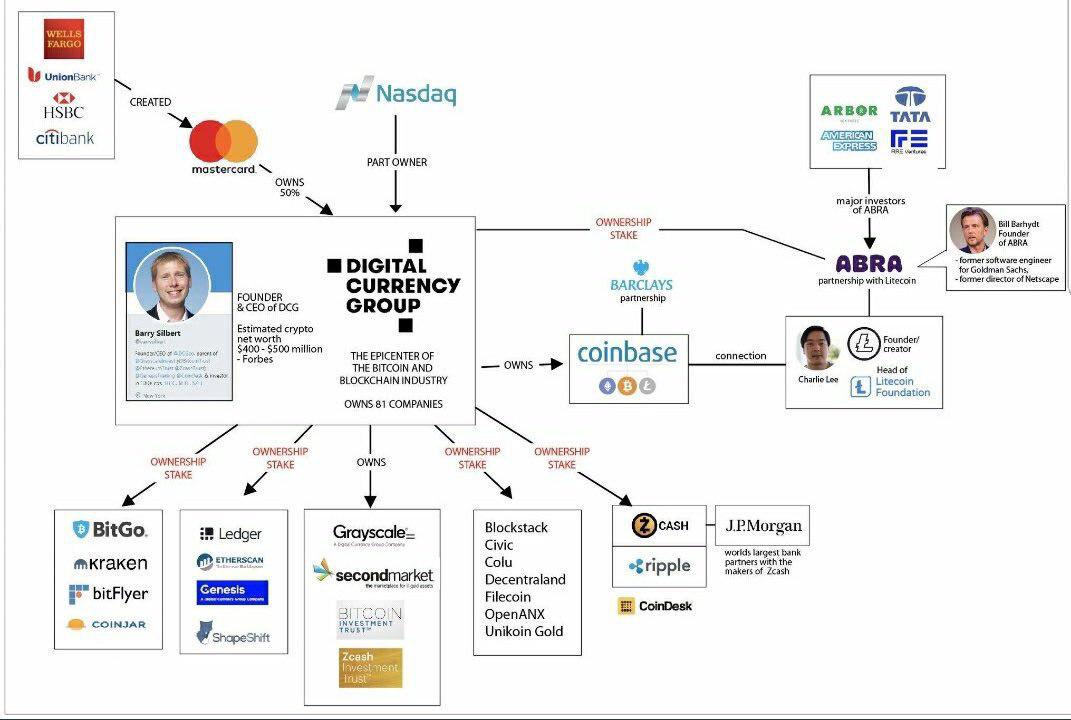

Polychain Capital, considered one of the largest hedge funds in the industry, raised $175m at the beginning of this year. The money will be used to buy stakes in cryptocurrency projects facing difficulties.
In 2018 Polychain became the first crypto hedge fund with assets under management above $1bn. Size, however, does not always mean profitability: in less than a year the value of assets managed by Polychain fell by a third.
7
What is more popular — venture capital or ICO/IEO?
The market for initial coin offerings (ICO) is in deep decline. In the first quarter of 2019, ICO projects raised $118m — 58 times less than the previous year’s $6.9bn.
Of the 2,500 projects that TokenData tracked from 2017, only 45% managed to raise money. Only 15% of tokens from successful ICOs trade at or above their issue price.
By contrast, initial exchange offerings (IEO) are gaining popularity. They are an ICO alternative in which an exchange plays the key role, screening projects it deems promising and viable. IEOs are now run on many trading platforms and attract substantial sums. Even so, the segment is not comparable in scale to the ICO market of 2017–early 2018.
The IEO model is not without flaws and has its own set of problems. Nor is there any guarantee that regulators will not soon turn to this area, as they did with ICOs.
Security Token Offerings (STO) are also developing gradually, but the segment remains very small.
According to Diar, in the first three quarters of 2018 venture investments in blockchain and cryptocurrency startups reached $3.9bn, 280% more than in all of 2017. The average cheque also rose by nearly $1m: from $1.5m in 2017 to $2.5m by the end of last year.
The trend suggests that old-fashioned venture capital is growing at a steady clip, far outpacing such innovations as ICO/IEO/STO. Bitcoin’s market price also correlates closely with venture activity. As the price of the first cryptocurrency recovers to previous highs, further growth in venture capital can be expected.