



What is ZKSwap?
Attention! This article is outdated and pending an update.
ZKSwap [ZK-Rollups based Swap protocol] is a protocol and a decentralised exchange built on ZK-Rollup technology.
ZKSwap users can trade Ethereum (ETH) and ERC-20 tokens, and earn the exchange’s governance token (ZKS) through community mining [Community Mining].
ZKS holders can vote on token listings on ZKSwap, and propose or champion changes to the protocol.
What is a ZK-Rollup?
A ZK-Rollup is an Ethereum Layer-2 solution based on zero-knowledge proof [zero-knowledge proof].
It reduces load on the main network by batching transactions and moving part of the computation off Ethereum.
The system continuously generates zero-knowledge proofs (zk-SNARK). ZK-Rollups use them to include transactions on-chain and synchronise the states of the main network and Layer 2.
What is community mining?
Community mining is how users of ZKSwap support the protocol’s liquidity and security. Participants receive rewards in ZKS.
Community mining includes:
- providing liquidity [Proof-of-Liquidity-Mining, PoL]. Under PoL the exchange will distribute 14m ZKS;
- paying Ethereum fees [Proof-of-Gas, PoG]. Under PoG the exchange will distribute 9m ZKS;
- generating zero-knowledge proofs [Proof-of-ZK-Snarks, PoZK]. Under PoZK the exchange will distribute 14m ZKS;
- trading on ZKSwap [Proof-of-TransFee, PoT]. Under PoT the exchange will distribute 9m ZKS.
ZKSwap is working on ZKS staking [Smart Contract Staking, PoS]. During staking the exchange will distribute 9m tokens.
Who created ZKSwap, and when?
The ZKSwap team remains anonymous. Project lead Alex Lee said in an interview with Huobi Global that about 20 experienced blockchain developers work at ZKSwap:
“Many team members joined the crypto industry in 2013 and began actively exploring zero-knowledge-based solutions in 2018. Our team has deep hands-on experience in smart-contract development and zero-knowledge proof research.”
ZKSwap launched a test network in November 2020. In the same month, the project raised $1.7m from Bixin, SNZ, FBG and Longling Capital.
On 15 February 2021 the ZKSwap mainnet went live. On 20 February the exchange conducted an airdrop of 80m ZKS.
How does ZKSwap work?
On ZKSwap, users trade directly with one another via Ethereum smart contracts. They can also add assets to the ZKSwap liquidity pool.
The protocol is available through the zks.app interface. To connect you need an Ethereum wallet, for example MetaMask.
ZKSwap processes user transactions on Layer 2 and synchronises with the main network. This mitigates Ethereum’s weak points: high transaction fees and low throughput.
ZKSwap’s architecture includes:
- a user interface (UI);
- Ethereum smart contracts [ZKSwap smart contracts];
- the ZKSwap server. It includes a mempool [Mem Pool], a block proposer [Block Proposer], a state keeper [State Keeper] and a prover server [Prover Server].


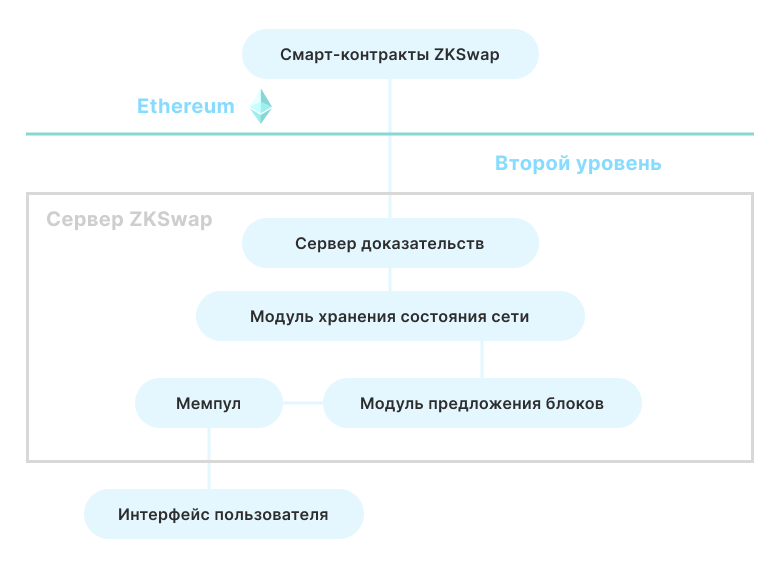
ZKSwap smart contracts are the key link between Ethereum and the exchange server. They hold tokens and update user balances.
The ZKSwap server processes transactions independently of Ethereum. It works as follows:
- user transactions enter the mempool;
- the block proposer groups user transactions;
- the state keeper receives transaction data and updates Layer-2 token states;
- the prover server takes the updated state and confirms validity. It generates a non-interactive zero-knowledge proof (zk-SNARK) using PLONK [Permutations over Lagrange-bases for Oecumenical Noninteractive arguments of Knowledge];
- the prover server sends the zk-SNARK to the ZKSwap smart contract on Ethereum.
The ZKSwap smart contract receives the zk-SNARK and confirms user transactions. After that, users can withdraw tokens to Ethereum wallets.
How to obtain ZKS tokens?
The exchange credits ZKS to airdrop and community-mining participants. ZKS also trades on Huobi, Poloniex, Uniswap and other crypto exchanges.
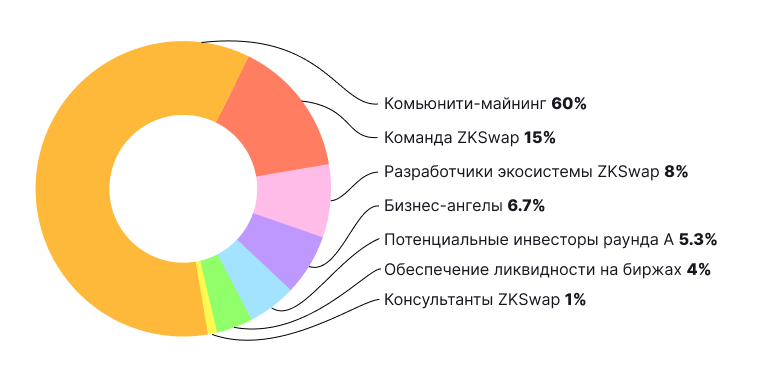
Total supply is 1bn ZKS. ZKSwap will distribute 60% of this amount (600m ZKS) to protocol users via community mining and airdrops.
The ZKSwap team will receive 15% of the supply (150m ZKS) one year after mainnet launch. Another 25% of tokens will go to ZKSwap ecosystem developers, investors, project advisers, and to the Uniswap and Gate.io exchanges for providing ZKS liquidity.


How is ZKSwap developing?
The exchange began operating on 15 February 2021. A month after launch, the value locked on ZKSwap surpassed $1bn.
In March, the exchange distributed 9m ZKS under Proof-of-Liquidity and Proof-of-TransFee.
In the second quarter, ZKSwap V2 is slated to launch. The new version will support user listings and non-fungible tokens (NFT).
In the third quarter of 2021, the exchange will release an SDK for payment applications and services built on ZKSwap.
Follow ForkLog news on Telegram: ForkLog Feed — the full newswire, ForkLog — the most important news, infographics and opinions.