



Willy Woo suggests SegWit as a shield against bitcoin’s quantum risk
Willy Woo urges parking coins on SegWit to buy time against a quantum attack.
Analyst Willy Woo has proposed a way to shield the first cryptocurrency from the quantum threat. He argues that funds should be moved to SegWit addresses and kept there for about seven years.
DUMMIES GUIDE TO BEING QUANTUM SAFE.
In the past it was about protecting your PRIVATE KEY (your seed phrase). In the age of big scary quantum computers (BSQC) that are coming, you need to protect your PUBLIC KEY also.
Basically a BSQC can figure out your private key from a…
— Willy Woo (@woonomic) November 11, 2025
In his view, quantum computers will be able to derive a private key from a public key. Woo claims the current Taproot format is vulnerable because it embeds the public key directly. SegWit, by contrast, keeps it hidden until the first outgoing transaction.
For the protection to hold, users should not spend from such a wallet until a complete fix is in place.
He acknowledged that, by consensus, the threat is unlikely to materialise before 2030. By then, developers may adopt post-quantum cryptographic standards.
Charles Edwards, founder of Capriole, disagreed. He called SegWit “not a protection model” and said that waiting seven years could lead to a collapse of the network.
Willy you know this isn’t a solution. Segwit is no protection model. We need to upgrade the network ASAP, and these kind of posts suggesting we have 7 years would mean the network collapses first. Bitcoin can adapt, but we need to see a lot more traction on that now and really…
— Charles Edwards (@caprioleio) November 11, 2025
He said the community must start working now on a protocol upgrade to protect against quantum computers. Edwards called the first cryptocurrency “the most vulnerable network in the world”.
Two years left
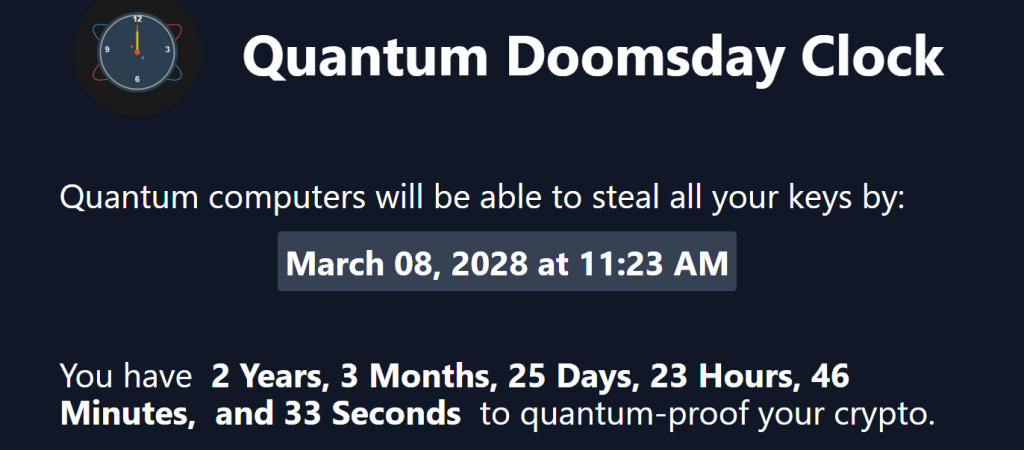
Quantum computers could crack the encryption of bitcoin and other cryptocurrencies within two years, according to the Quantum Doomsday Clock project.
The researchers estimate it would take 1,673 qubits to compromise ECC-256, 2,314 for RSA-2048 and 3,971 for RSA-4096.
The calculations assume a surface-code error-correction scheme with error rates between 10^-3 and 10^-5. Improvements here could accelerate timelines.
The authors noted that recent work has focused on controlling and reducing errors rather than increasing qubit counts. If the focus shifts to scaling, quantum advantage could arrive earlier than widely forecast. Once sufficient power is reached, an attack would take from hours to days.
The analysis showed that P2PKH bitcoin wallets get a brief reprieve. They use new public keys for each transaction. However, over the long run, systems based on current cryptographic standards will have to migrate to post-quantum protocols to remain secure.
Edwards said the project is useful, while disagreeing with the calculation methodology.
While I don’t necessarily agree with how this is calculated. I think a target is good as it gives a visual we must work towards. If we haven’t solved quantum by this point for Bitcoin… we’re going down that creek without a paddle. https://t.co/o7rAX8xWdG
— Charles Edwards (@caprioleio) November 6, 2025
“The idea of the Quantum Doomsday Clock is good, as it gives us a visual target to work towards. If we haven’t solved quantum for bitcoin by that point… we’ll be in very bad shape,” he said.
Panic is worse than the quantum threat
Panic in crypto spreads faster than common sense. Code runs the market, but prices are driven by emotion. An unfounded claim that bitcoin has been cracked by a quantum computer could set off a chain reaction and crash the market, Yun Au, founder of BOLTS Technologies, told Decrypt. He cited a recent sudden plunge.
“There was a small flash crash in the crypto market. A $50–100m sell-off—nothing for traditional markets—triggered huge losses in blockchain assets. This shows how fragile the system still is,” Au explained.
He said the same scenario is possible with panic around quantum computing. If someone claims elliptic-curve cryptography has been broken, “everyone will rush for the exits and the system will collapse”.
The threat is real but distant
Edward Parker, a physicist at RAND Corporation, says the quantum threat to cryptography is serious and should be prepared for in advance.
Researcher Ian McCormack argues that fear is outpacing the technology.
“Quantum computers are nowhere near powerful enough to crack RSA-2048 or any other meaningful cryptography. Reducing error rates and combining thousands of qubits to solve practical problems will take time, money and many attempts,” he noted.
McCormack added that the “mystique” around quantum computing amplifies fear. In his view, cryptography resilient to such machines will almost certainly arrive faster than a computer capable of breaking today’s standards.
Coin Metrics co-founder Nic Carter called quantum computing “the biggest risk to bitcoin”. He estimates that around 4m BTC already sit at addresses with exposed public keys. In theory, they are vulnerable to a quantum attack.
Experts concur that action is needed now. Rebecca Krauthamer, co-founder of QuSecure, said elliptic-curve cryptography should be abandoned in favour of post-quantum standards such as ML-DSA.
The governance problem
Upgrading bitcoin is a fraught political process. The network’s security model requires consensus among miners, developers and node operators. Any cryptographic change would require a fork, and debate could take years.
Computer science professor Scott Aaronson noted that the first cryptocurrency’s decentralisation complicates upgrades.
“In Ethereum and most other networks, someone can make the decision to move to quantum-resistant cryptography. In bitcoin, a fork would require agreement by a majority of miners,” he said.
The lack of a central authority may slow deployment. Rushing or splitting risks harming the network. Still, many bitcoin developers are confident that, given a working solution, consensus will be reached.
When will ‘Q Day’ arrive?
No quantum computer capable of breaking the digital gold’s encryption exists yet. Current prototypes count in the thousands of qubits, but a stable attack would require millions with error correction.
Christopher Peikert, a professor at the University of Michigan, believes there is no real threat in the next few years. In the short term, the best protection is behavioural.
“Public keys should not be revealed on-chain until it is absolutely necessary, and they should be given a short lifetime,” Peikert advised.
Most experts favour a gradual transition. That would avoid chaos that could damage trust in the system more than any real quantum attack.
In July, a group of developers found a way to protect the first cryptocurrency’s network from potential threats posed by quantum computers.
Рассылки ForkLog: держите руку на пульсе биткоин-индустрии!