



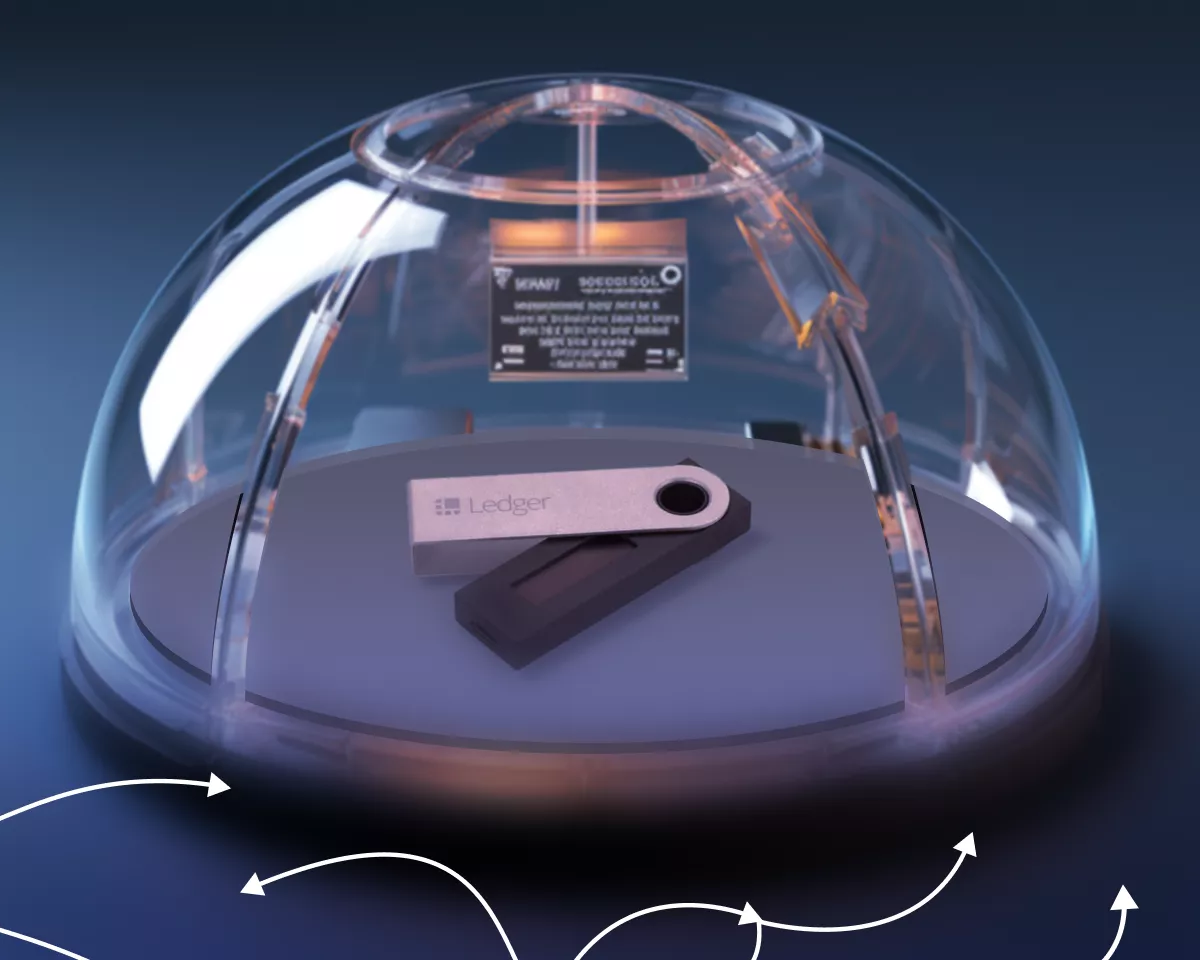
Crypto enthusiasts regard hardware wallets as among the best ways to safeguard digital assets from theft. Yet such devices have drawbacks.
In a joint piece with Mixer.money, we examine the security model of the most popular hardware wallets — Trezor and Ledger. We also explain what to do in case of a compromise or attack on the device.
Why the community regards hardware wallets as secure
Trezor and Ledger are essentially USB sticks with specialized software and microcontrollers for encrypting information. The mechanism of their operation can be described as follows:
- The user sets a PIN.
- The device creates a seed phrase for generating private keys and encrypts them using the PIN as the password to decrypt them.
- The wallet stores keys in non-volatile memory.
- The software reads and decrypts the data only after a code is entered.
Hardware wallets are protected against the most common hacker attacks:
- dump — the chip does not allow copying the information required for decryption to the computer;
- brute-forcing the PIN — after 3-10 unsuccessful PIN attempts the wallet erases all data;
- controller reflashing — the device erases all information when attempting to install a custom firmware;
- side-channel — the wallet software encrypts the data stream to the PC, so that the hacker cannot connect to the USB cable, read the transmitted bits and extract the private key.
Despite these measures, attackers still find ways to access the private key.
Vulnerabilities in Trezor controllers
The maker of the Trezor wallets, SatoshiLabs opened the source code of the devices so that white-hat hackers could help in hunting for wallet vulnerabilities.
In 2020, Joe Grand took advantage of a bug in the Trezor Model One controller and regained access for a user who had forgotten their PIN. To do this, he repeatedly rebooted the wallet and fed the controller a carefully calculated voltage to fool the security system.
In May 2023, Unciphered, a company specializing in wallet recovery, announced a breach of the Trezor Model T. Its staff turned to a hardware vulnerability in the STM32 controller to copy data to a computer and extract the seed phrase.
SatoshiLabs said that exploiting these vulnerabilities requires physical access to the device, specialized knowledge and expensive equipment. Partly true: breaking into the Trezor One took Joe Grand three months.
Potential vulnerability of Ledger wallets
The Ledger manufacturer does not disclose the firmware source code. The wallets run on the BOLOS operating system, which does not permit a memory dump even when directly connected to the chips. Since the company’s founding in 2014 there has been no publicly confirmed Ledger wallet breach.
In May 2023, the company announced the Ledger Recover wallet-recovery service: the user goes through Know Your Customer (KYC), and Ledger splits the seed phrase into three encrypted fragments and sends them to trusted custodians in France, the United Kingdom and the United States. If the device is lost, the owner can verify their identity, obtain the fragments and restore access to the wallet.
The feature drew criticism in the community: the existence of such a function suggests Ledger could extract the seed phrase without the wallet owner’s knowledge.
Other hardware-wallet vulnerabilities
In 2020, the network leaked Ledger’s customer database, and a year later, information about Trezor users appeared for sale.
Attackers used names, addresses and contacts of customers to hunt whales — sending personalized phishing emails on behalf of Ledger or Trezor support.
In both cases the leaks occurred due to third-party online retailers. Purchases through intermediaries pose another risk: resellers could sell backdoored devices to obtain private keys.
How to protect funds on hardware wallets
Despite the potential threats, hardware wallets remain among the safest solutions for storing cryptocurrency.
To reduce the risks of theft and losing access to digital assets, follow a few rules:
- buy wallets only from manufacturers or official representatives;
- do not use simple PINs such as birth dates, 0000 or 1234;
- set an additional password for the seed phrase to make it harder to extract the key if the wallet is stolen.
If the device is lost, recover access with the seed phrase, and then send the cryptocurrency to new addresses.
In case of phishing, transfer assets to another wallet using Bitcoin mixers such as Mixer.money. This will sever the on-chain link between the cryptocurrency and the owner’s identity.
Remember: any device can be hacked in theory. Do not keep all your funds on a single wallet, no matter how secure it seems.