
Key takeaways
- Bitcoin price hit a new all-time high. Ethereum and XRP hit two-year highs.
- The launch of Ethereum 2.0 with staking functionality took place.
- Spot-market trading volume entered the top three on record, approaching 2017-2018 levels.
- Derivative market activity was sky-high. A record level of liquidations pushed open interest down by 20%.
- Dex Uniswap and SushiSwap battled on, and DeFi project yEarn.Finance began aggressively absorbing competitors.
- Ethereum hash rate reached an all-time high.
- The number of whales rose as balances on centralized exchanges declined.
- The number of active Bitcoin addresses approached December 2017 levels.
- The “Greed Index” reached maximum levels.
Leading asset dynamics


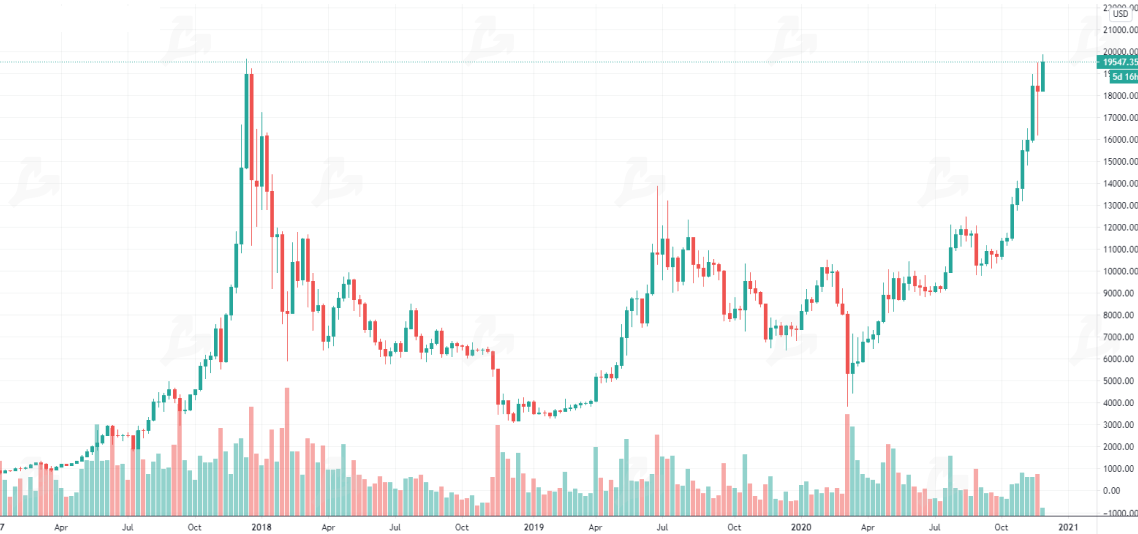
Weekly BTC/USD chart on Bitstamp. Data: TradingView.


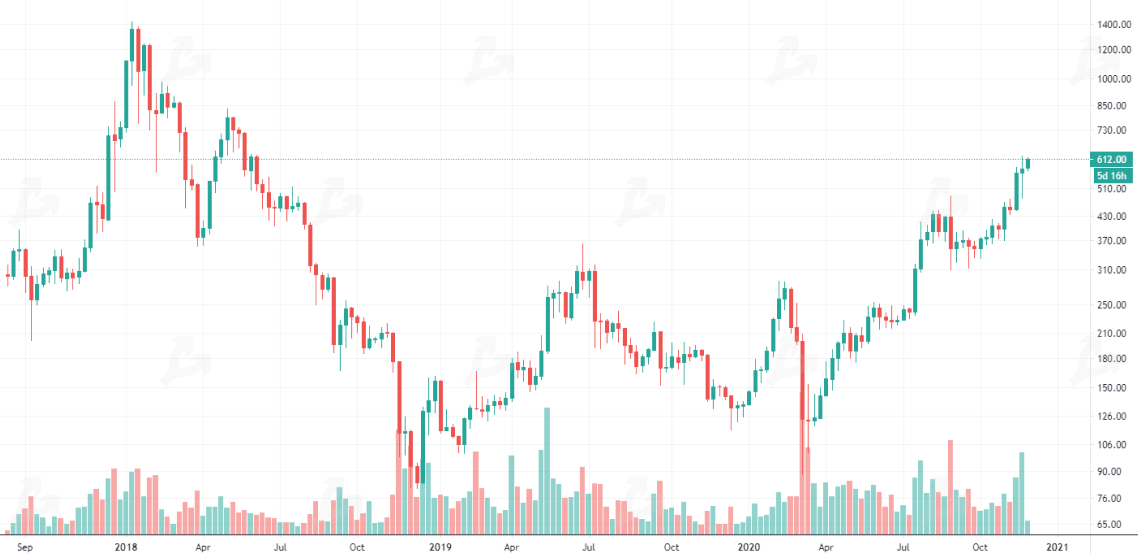
Weekly ETH/USD chart on Bitstamp. Data: TradingView.
- 30 November Bitcoin price updated a historic high on many exchanges, surpassing the December 2017 peaks. On Bitstamp it reached $19,870, and on 1 December it climbed to $19,918. On Binance a new high was recorded at $19,863. The average high on CoinGecko also updated to $19,799.
- 1 December the market capitalisation of the first cryptocurrency also peaked at $369.6 billion.
- Ethereum hit a two-year high, reaching levels seen in early 2018 — the price peaked around $636. The rise was accompanied by heightened on-chain activity ahead of the launch of the protocol’s second version with staking.
However the second-largest cryptocurrency by market cap remains about 58% below its all-time high recorded on 13 January 2018.
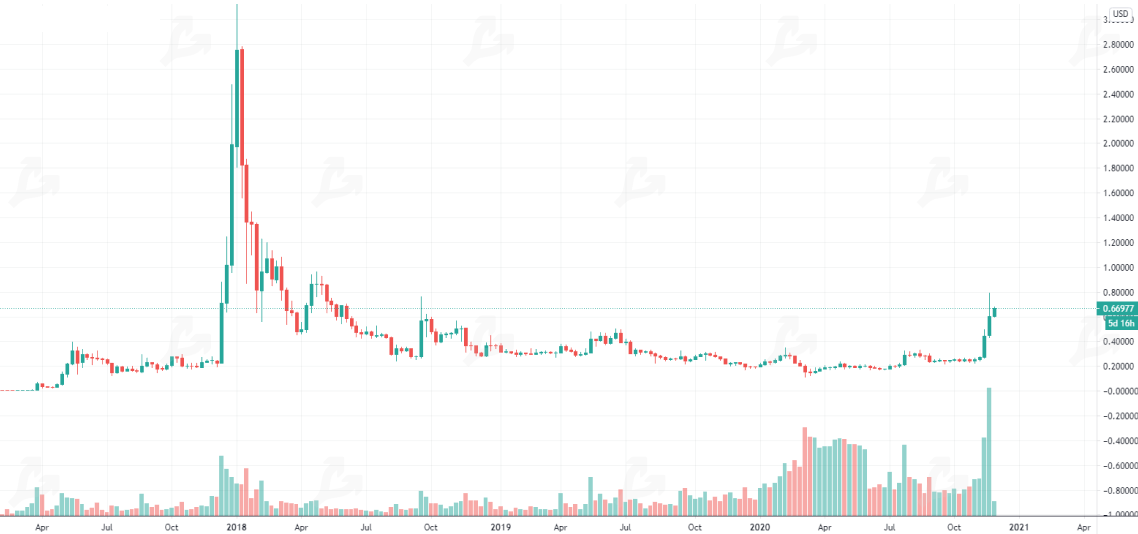
XRP/USD weekly chart on Bitstamp. Data: TradingView.
Market activity positively reflected in many altcoins, especially XRP — in November the token rose 175%. On 24 November XRP price updated a two-year high, peaking at $0.79 (on Coinbase even $0.90). As a result XRP’s market capitalisation rose from $10.8B to $32.2B. The asset returned to third place in the rankings of the most capitalised coins. Nevertheless XRP trades about 83% below its January 4, 2018 all-time high.
Litecoin (LTC), Cardano (ADA) and Stellar (XLM) also posted impressive price moves in November — 60%, 85% and 160% respectively.
Market moods and correlations
The Crypto Fear and Greed Index continued its ascent into the extreme greed zone. Throughout November the indicator stayed above 80, signalling heightened market activity. By 1 December the index reached an all-time high of 95 amid a failed attempt to push Bitcoin through $20,000. The monthly average was 86.5 (in October it stood at 57.1).


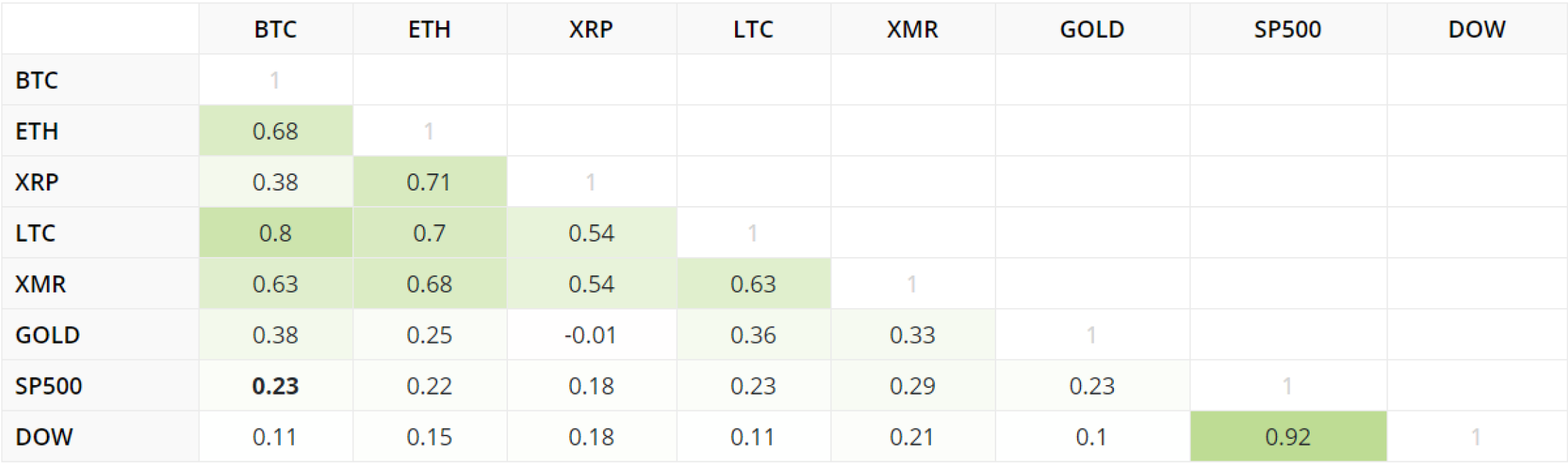
90-day asset correlations. Data: BlockchainCenter.
Trading volumes


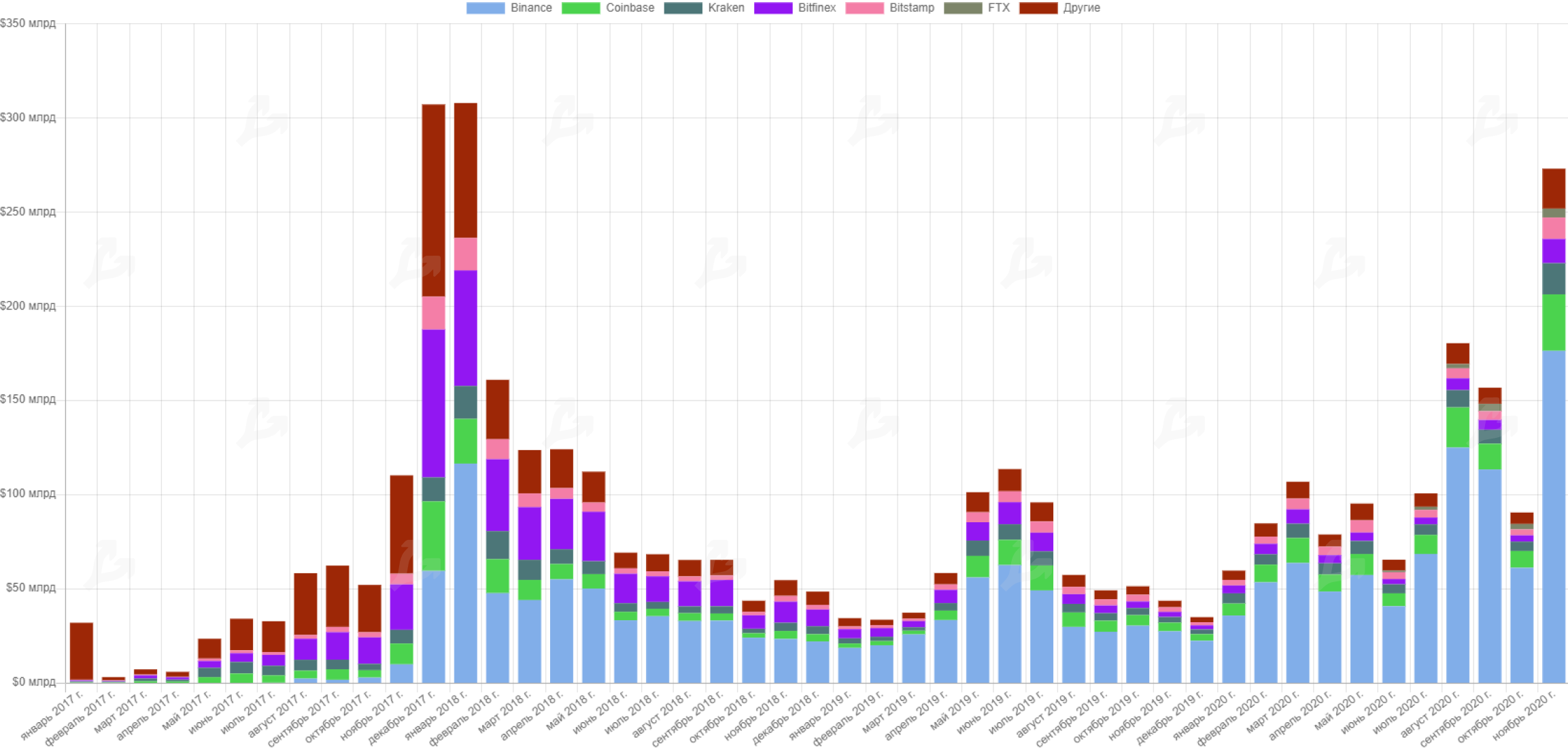
Spot trading volumes, $bn. Data: CryptoCompare.
Spot trading volumes in November posted the third-largest tally in history ($272B). The figure trails only December 2017 and January 2018 — when turnover over two months stood at $307B.
By exchange, Binance led with $176B in November, the highest figure in the platform’s history. In the top three also ranked Coinbase ($29B) and Kraken ($16B). This signals substantial crypto interest among United States investors.
Futures and options


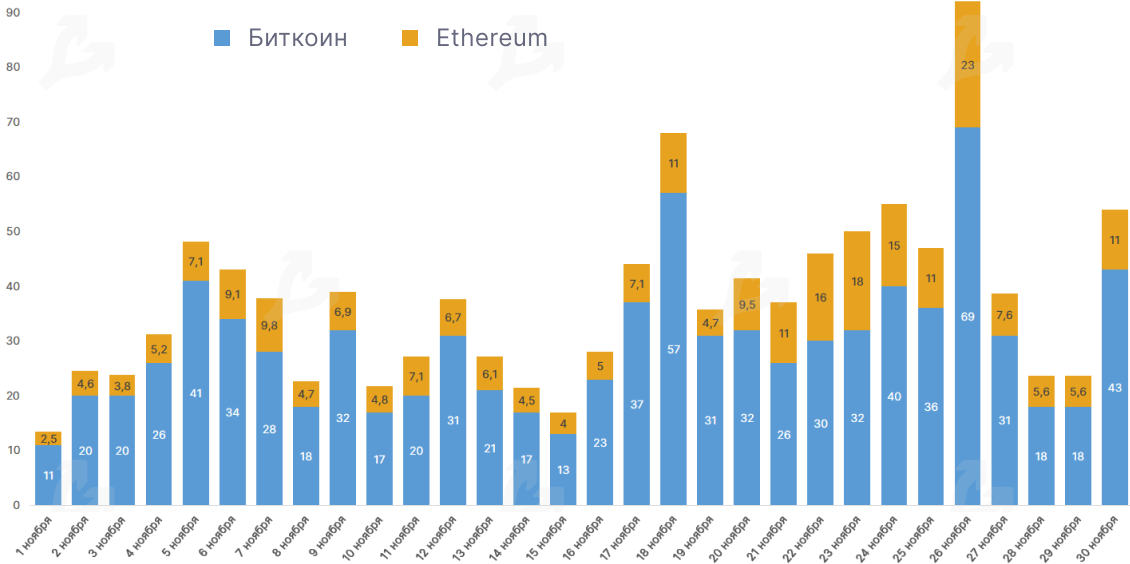
Futures volumes for Bitcoin and Ethereum, $bn. Data: skew.


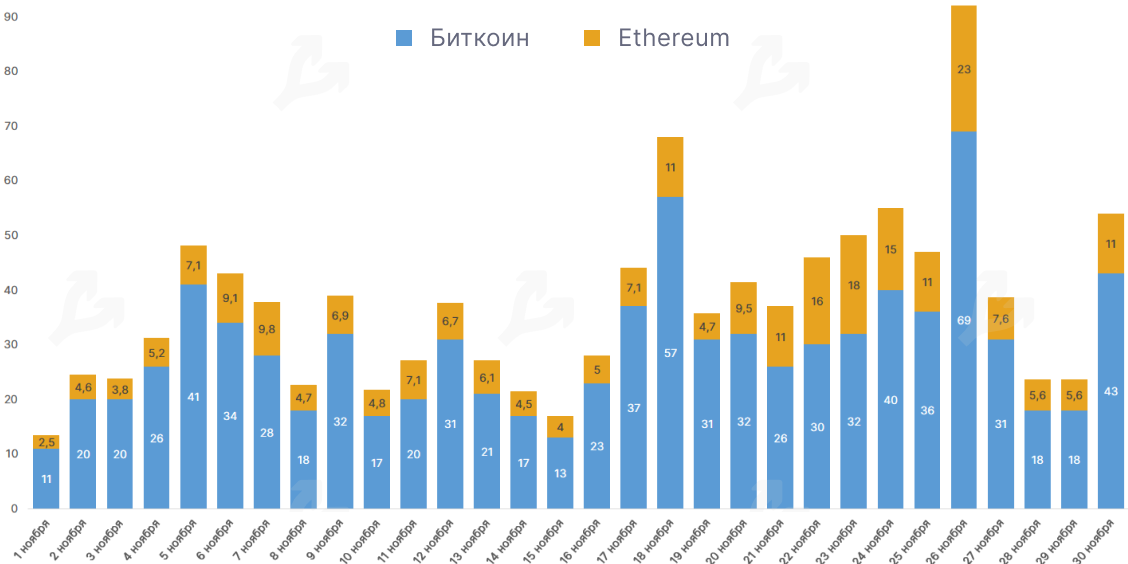
Options volumes for Bitcoin and Ethereum, $mm. Data: skew.
The surge in Bitcoin and Ethereum was accompanied by record activity in the derivatives market. Futures volumes reached new highs — $69B for Bitcoin-based contracts and $23B for Ethereum, surpassing daily turnover during the March market crash.
Open interest in Bitcoin futures climbed to a record $7.1B in November. On 26 November the figure fell by about 20% after a $3,000 correction in Bitcoin, during which liquidations across all assets reached a record $1.5B.
Activity also rose in the options market. By the end of the month Ethereum option contracts traded more than $100M, and Bitcoin options more than $800M, rising roughly threefold on average.
Open interest in Bitcoin options in November updated its historic maximum above $5B, while Ethereum contracts approached $1B.


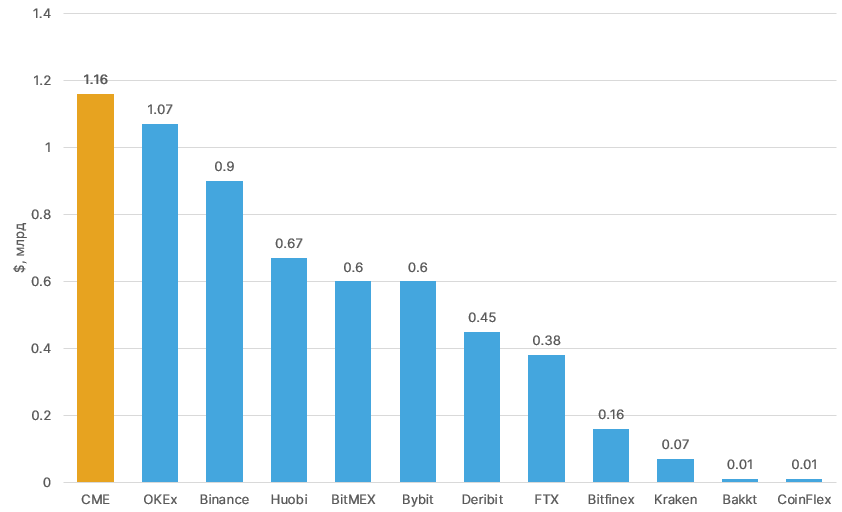
Open interest in Bitcoin futures across exchanges. Data: skew as of 28.11.2020.
Thanks to the activity of large players, CME for the first time ranked first in the number of open Bitcoin futures positions. But soon OKEx reclaimed the top spot after resuming withdrawals.
DeFi


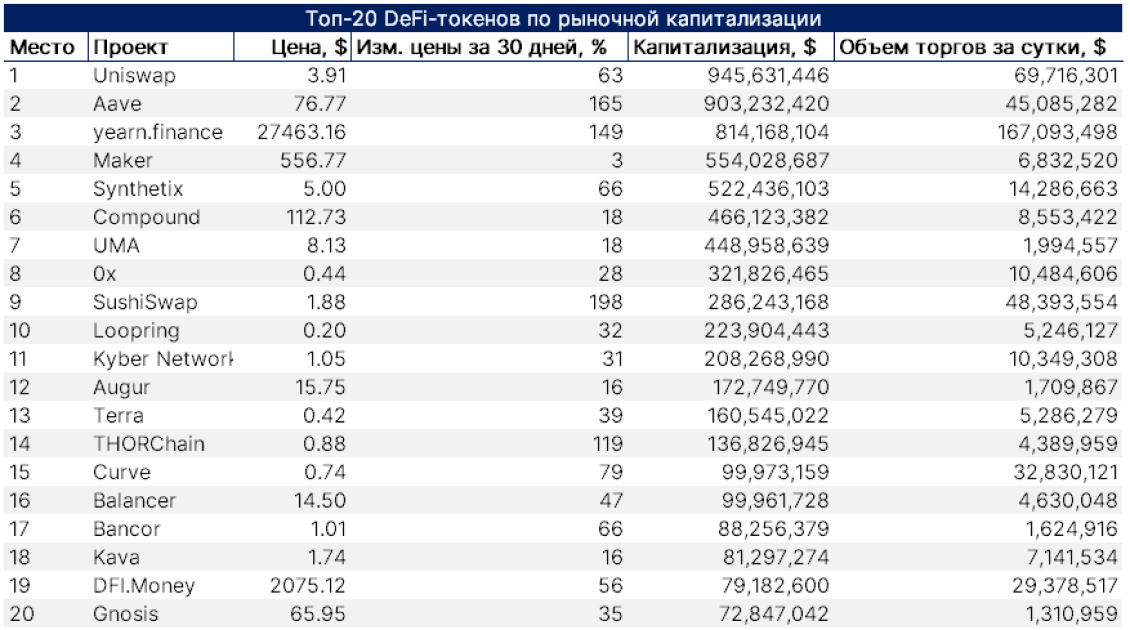
Messari data as of 1.12.2020.


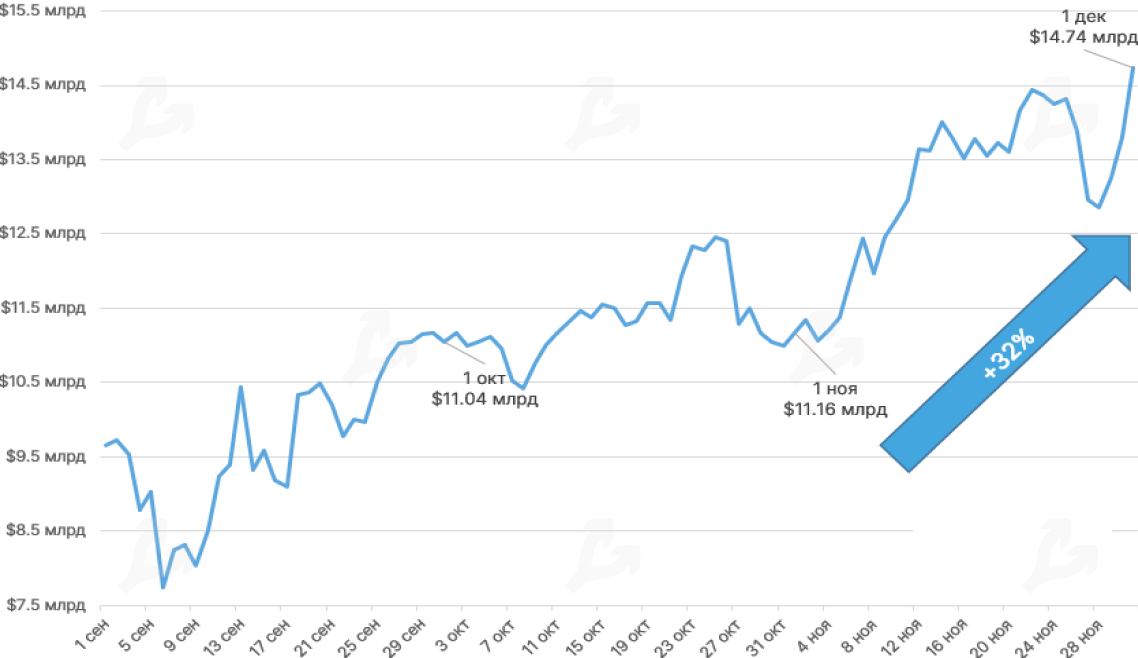
DeFi market-capitalisation by project. Data: DeFi Pulse.
In November DeFi project tokens rose sharply after a bearish October. Among popular coins, Aave, SushiSwap and yEarn.Finance led the gains, the latter known for aggressive acquisitions and a high token price.
Thanks to the renewed market activity, the value of assets locked in the sector rose by 32%, approaching $15 billion.


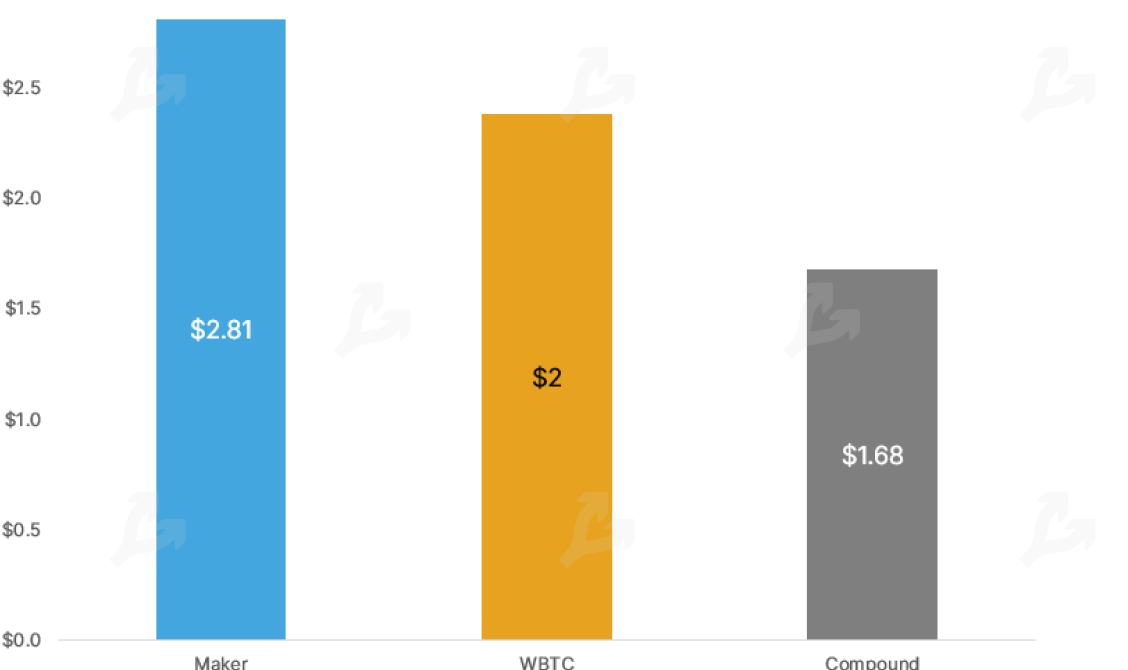
Top-3 DeFi-projects by locked value, $bln as of 1.12.2020. Data: DeFi Pulse.


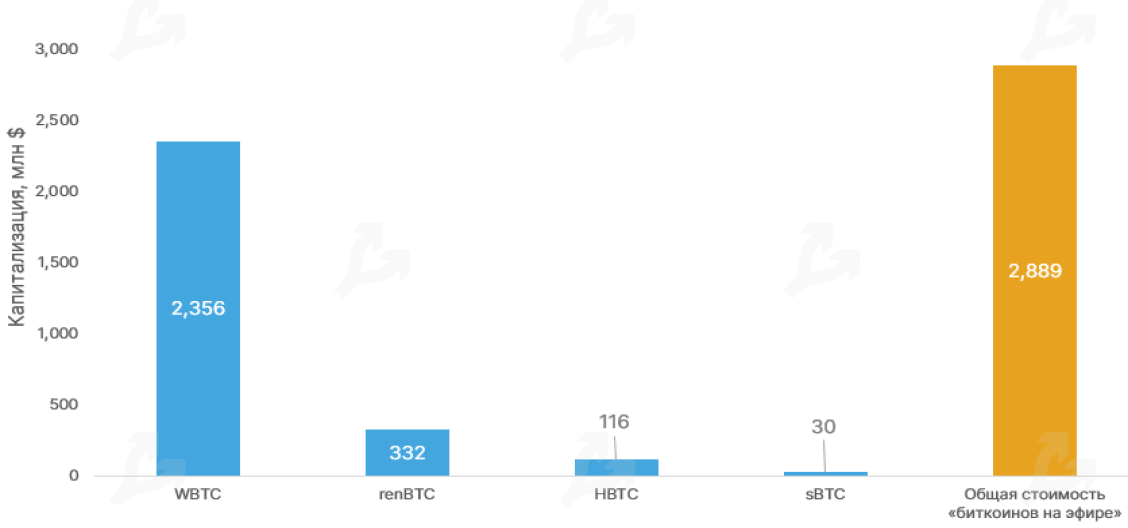
Market capitalisation of tokenised Bitcoin on Ethereum. Data: Dune Analytics.
Maker led the way in terms of value locked, with Uniswap losing its top spot. The WBTC token backed by Bitcoin rose from third to second place. Compound took third, while Uniswap dropped out of the top three.
The market capitalisation of Ethereum-based Bitcoin tokens rose 39% during the month to $2.8B. The market capitalisation of the most popular “Bitcoin on Ethereum” — WBTC — rose 44% to $2.3B. Such protocols offer holders of digital gold access to a DeFi-rich ecosystem. Demand for Bitcoin-backed Ethereum assets tightens the supply of the underlying Bitcoin, supporting its price.
DeFi protocol yEarn.Finance creates an ecosystem by absorbing other projects
1On 24 November Pickle Finance announced a merger with yEarn.Finance after losing $20 million in a hack. YFI’s creator Andre Cronje said the partnership was driven by project similarities.
2The next day Cronje presented details of integration with the Cream Finance lending protocol as work began on launching its second version. Cream will also host StableCredit — a protocol involving stablecoins and an automated market maker mechanism.
328 November Yearn Finance acquired Cover Protocol, a firm specialising in insurance. Goals remain the same — to optimise, expand and strengthen, based on a common vision.
430 November the project absorbed Akropolis, a DeFi protocol oriented to institutional investors and also hacked.
5Weekly acquisition marathon culminated with a major announcement — on 1 December Andre Cronje announced a merger with the decentralised platform SushiSwap. Together the projects will focus on developing automated market making technology.
DEX


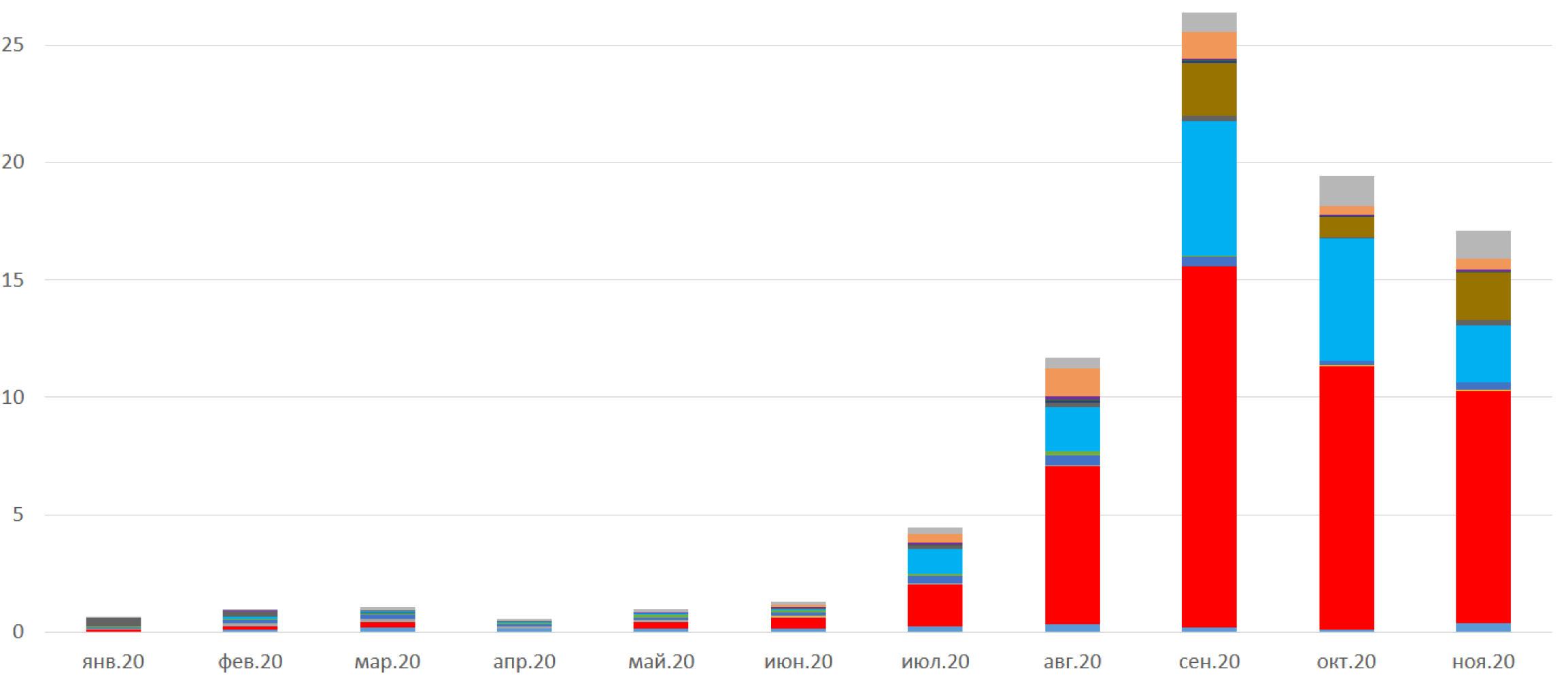
Volume traded on decentralised exchanges, $bn. Data: Dune Analytics.
Trading volume on decentralised exchanges (DEX) in November continued to decline, falling to $17.07B. Uniswap accounted for 54.8% of the market share. SushiSwap ranked second, helped by the [end of] UNI mining program through liquidity provision on Uniswap, largely due to its competing liquidity pools. Subsequently Uniswap lost half of its liquidity, dropping to sixth place in the overall locked assets ranking. Meanwhile SushiSwap’s value locked rose from $260m to $1.1B (finishing the month around $730m).
Stablecoins


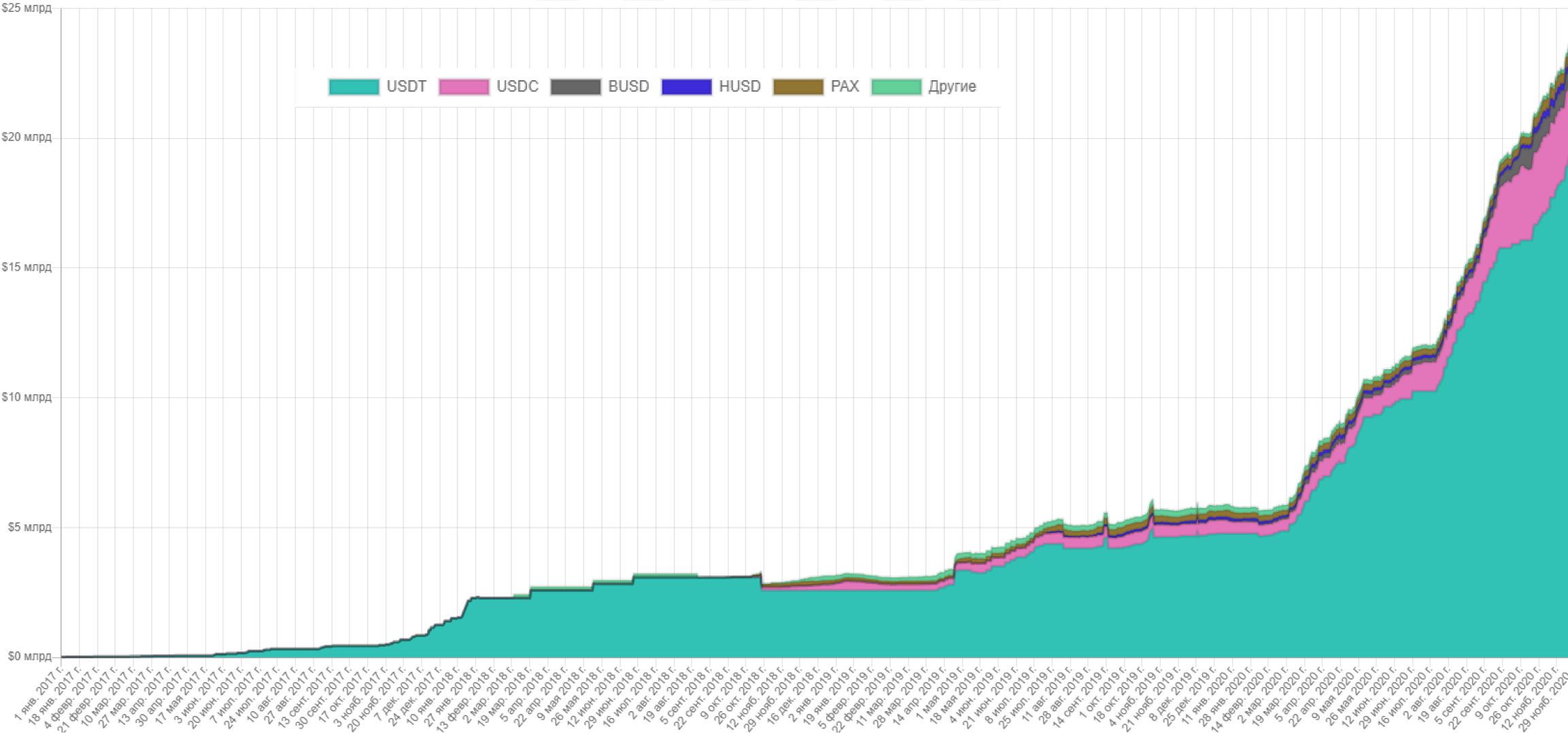
Market capitalisation of stablecoins. Data: Messari.
Stablecoin capitalisation in November reached $24 billion. During the month Tether issued $2.4 billion USDT — its share in the segment exceeded 80%. The closest competitor, Circle, issued $31 million USDC in the same period, bringing stablecoin market-cap close to $3 billion.
P2P trading


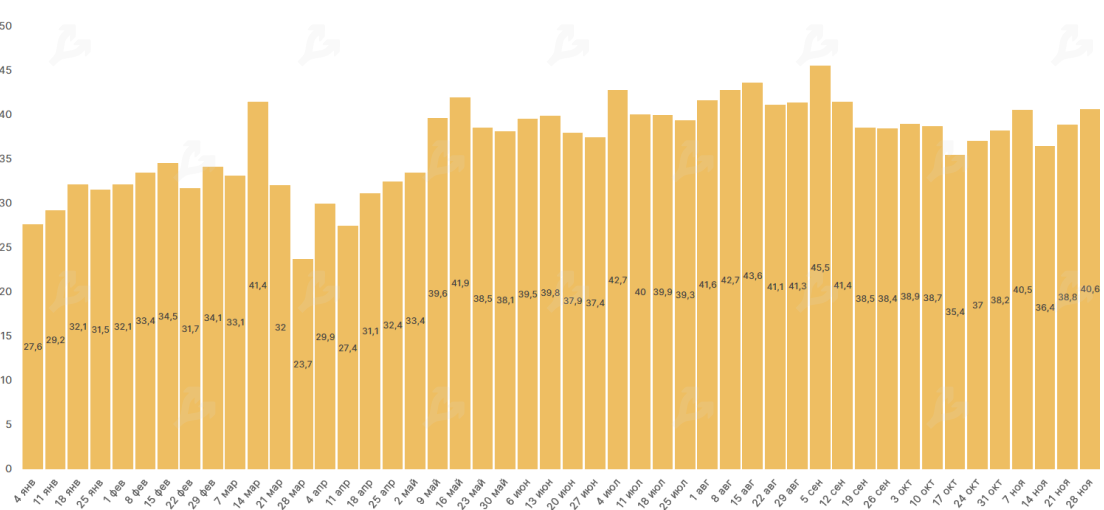
Volume of LocalBitcoins trading on the LocalBitcoins platform in 2020, $mm. Data: coin.dance.


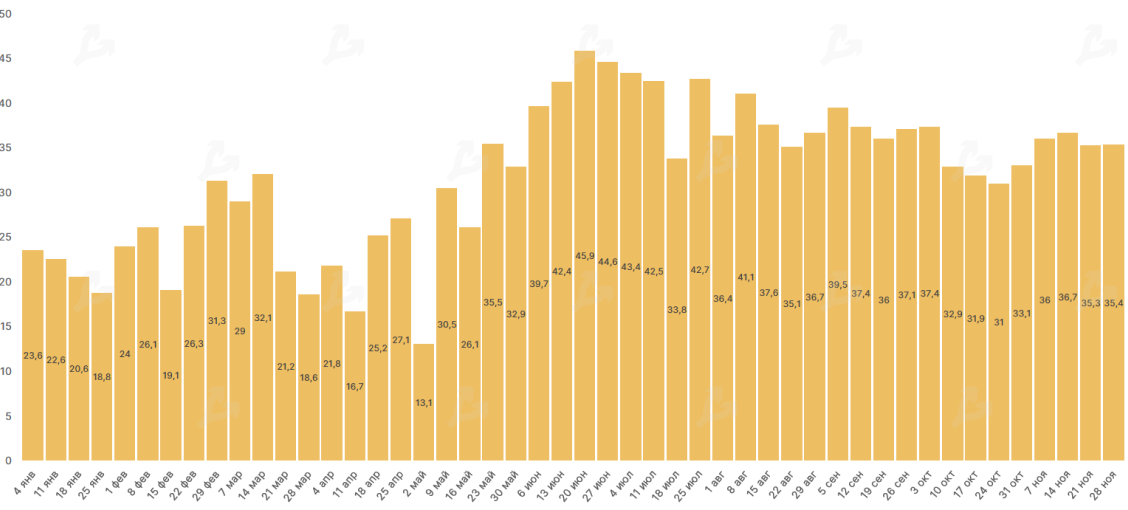
P2P trading volumes on Paxful platform in 2020, $mm. Data: coin.dance.
On P2P platforms, activity rose only modestly, with no pronounced spikes. LocalBitcoins showed a similar trend to October, rising from $36.4m in the first week of November to $40.6m by month-end.
On Paxful, trading volumes averaged about 10% higher than the prior month, reaching $36m.
Mining, hash rate, fees


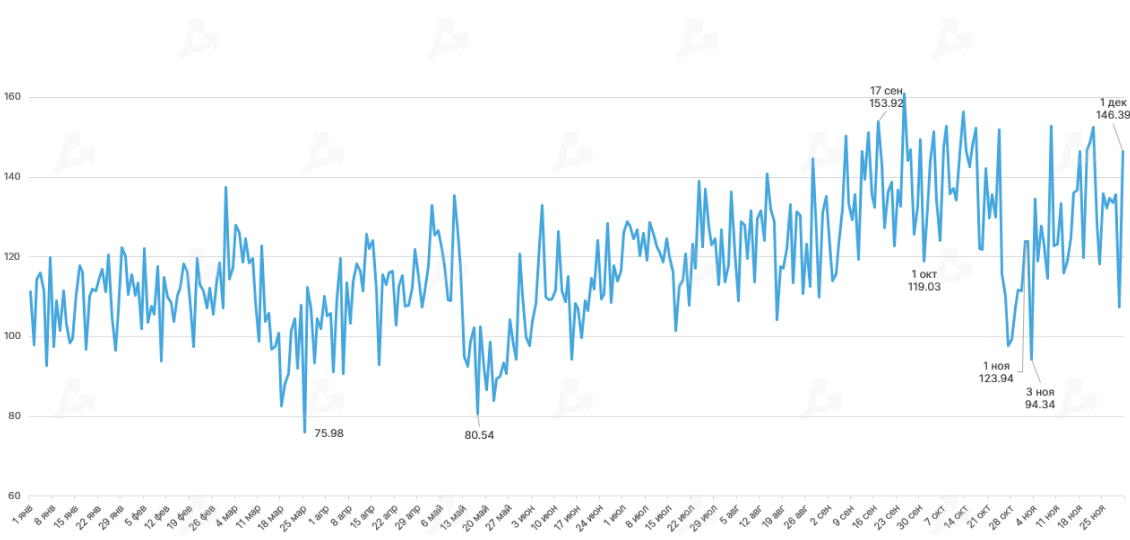
Bitcoin hash rate dynamics since start of year, EH/s. Data: Glassnode.


Share of the largest Bitcoin mining pools in hash rate. Data: Glassnode.
Bitcoin hash rate recovered after a fall at the end of October to November. The month’s rise stood at 18%, and from the local low on 3 November it was up 55%. The positive hash rate dynamic may be linked to a wave of ASIC miners joining the network after Sichuan’s migration. The metric historically correlates closely with Bitcoin’s price.
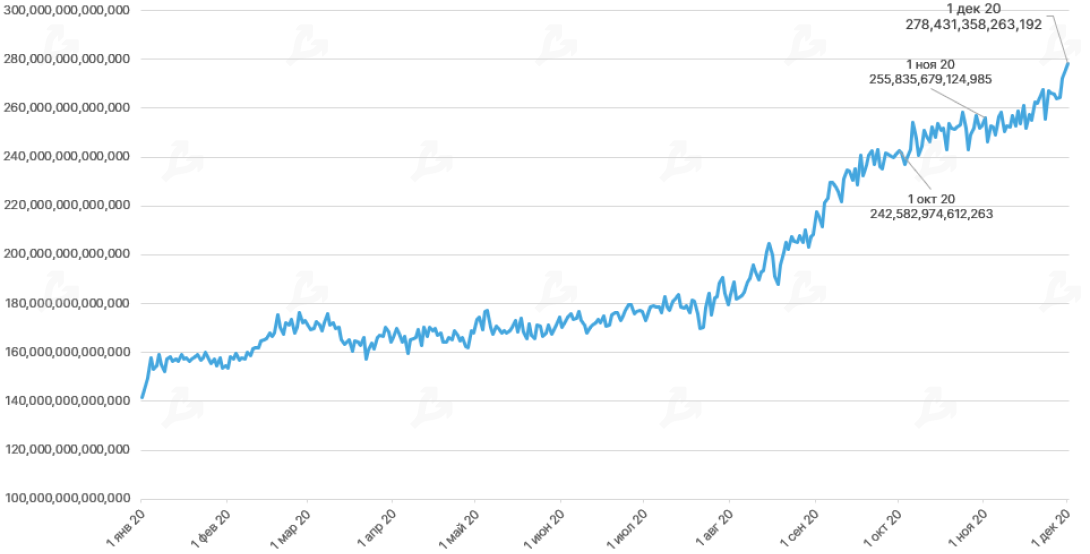
Over the same period Ethereum hash rate reached a fresh all-time high, rising 9% in November.


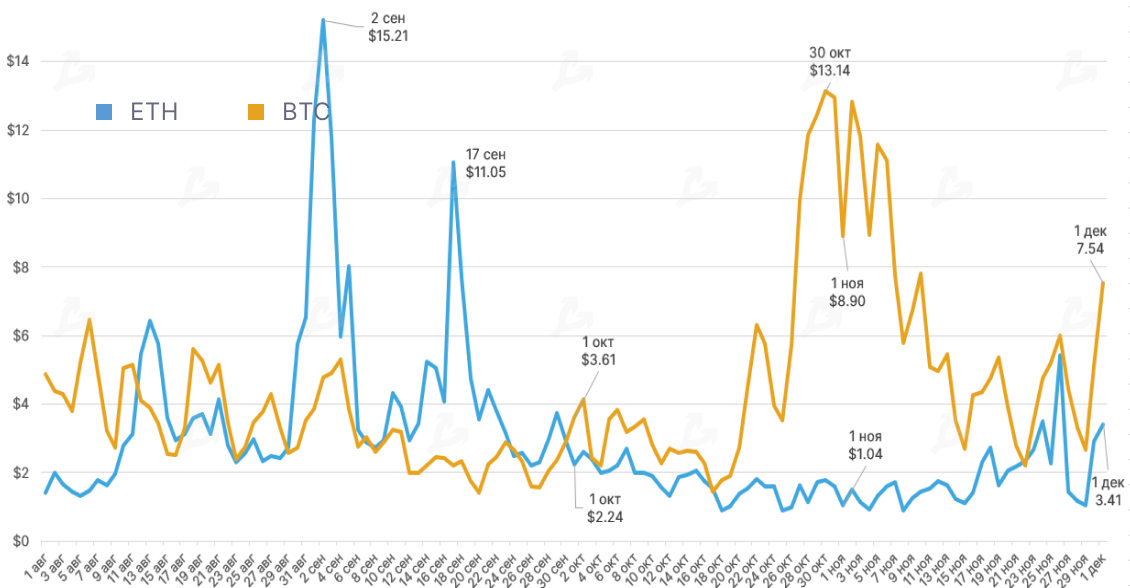
Average BTC- and ETH-transaction fees. Data: Blockchair.


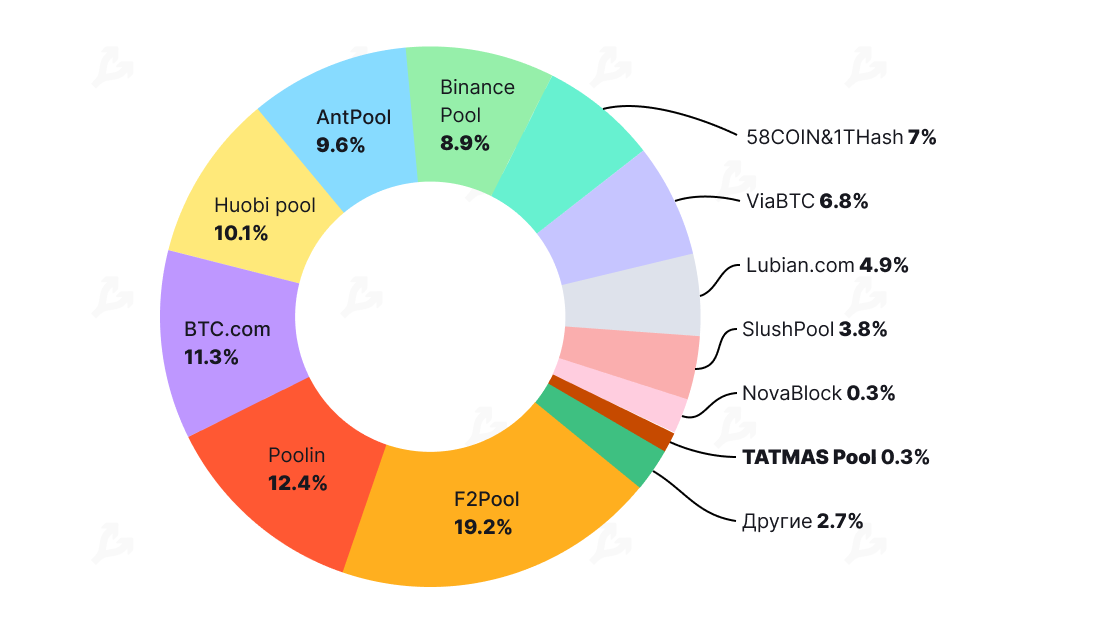
Share of the largest pools in Bitcoin hash rate. Data: btc.com as of 1.12.2020
During November, the average fee for Ethereum transactions rose modestly amid renewed on-chain activity, while Bitcoin transaction fees declined most of November but rebounded on the back of new price highs in BTC/USD pairs.
As before, the Bitcoin hash rate remains driven by Chinese mining pools. The largest are F2Pool, Poolin, and BTC.com, with shares of 19.2%, 12.4% and 11.3% respectively. The balance of power in the sector changed little over the month.


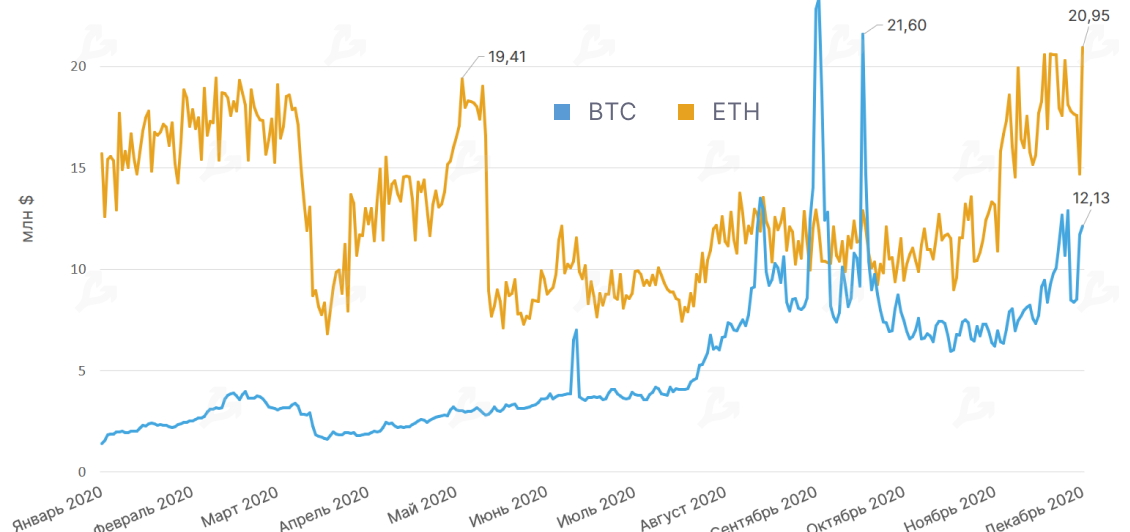
Bitcoin and Ethereum miners’ revenues in November. Data: Glassnode.
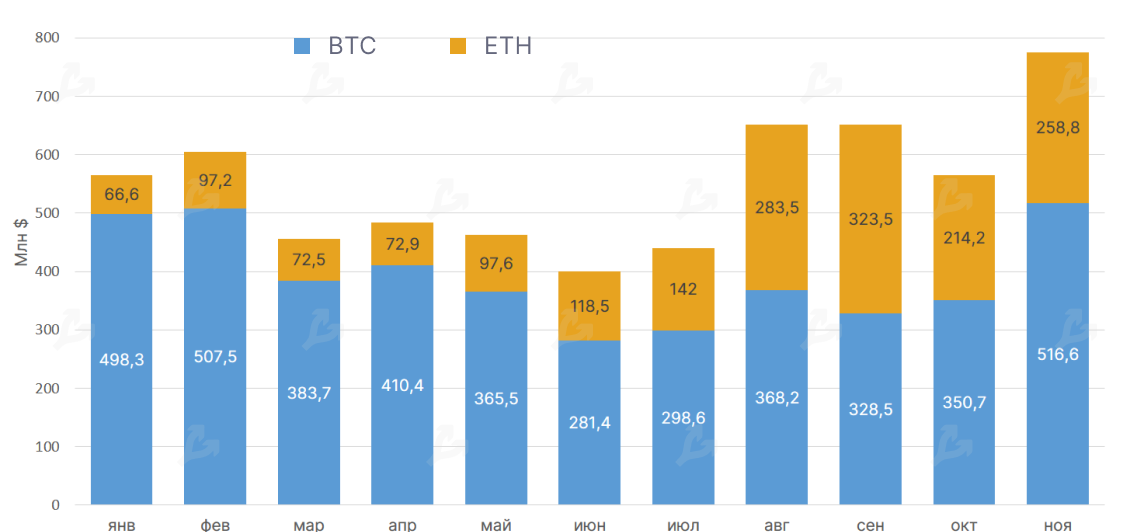
Bitcoin and Ethereum miners’ revenues in 2020. Data: Glassnode
Thanks to the rise in Bitcoin price, miner revenues returned to levels seen before the May halving. In November miners earned $516.6 million from Bitcoin and $258.8 million from Ethereum, lower than in September and August when commissions surged amid DeFi activity.
On‑chain data


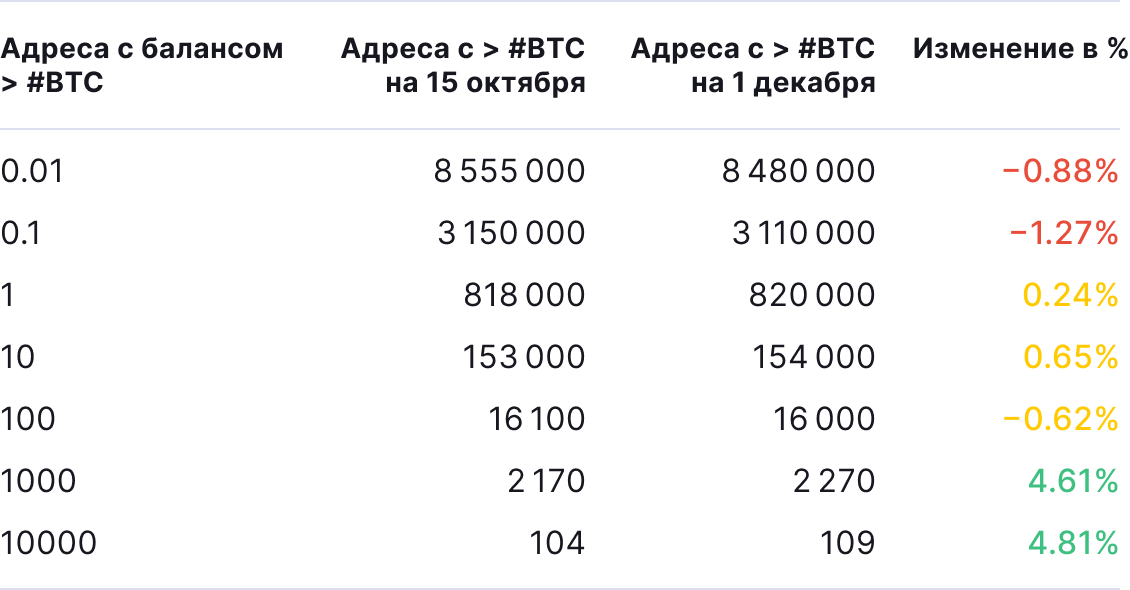
Balance changes of various Bitcoin address categories from 15 October to 1 December. Data: Glassnode.
From mid-October to 1 December 2020 there were shifts in the balance-sheet structure of Bitcoin holders — the number of players with ≥1000 BTC and ≥10,000 BTC rose by 4.61% and 4.81% respectively. The number of “mid-sized” wallets remained largely unchanged. The number of retail holders with assets from 0.01 BTC and 0.1 BTC fell by 0.88% and 1.27% respectively.


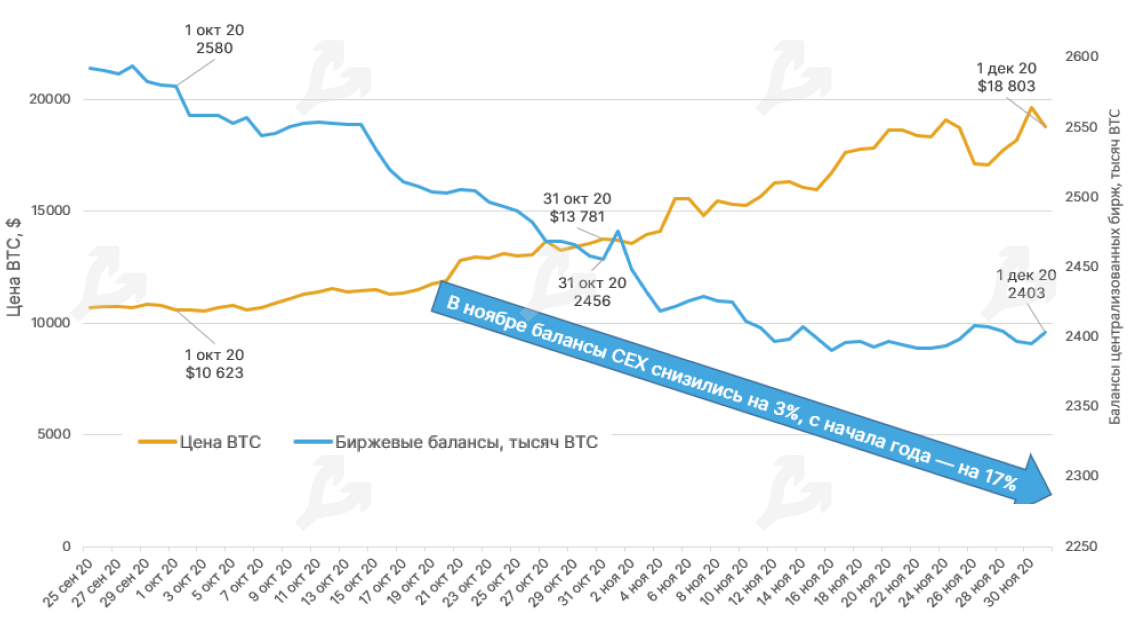
Bitcoin price and balance trends of custodial exchanges, thousand BTC. Data: Glassnode, Yahoo Finance.


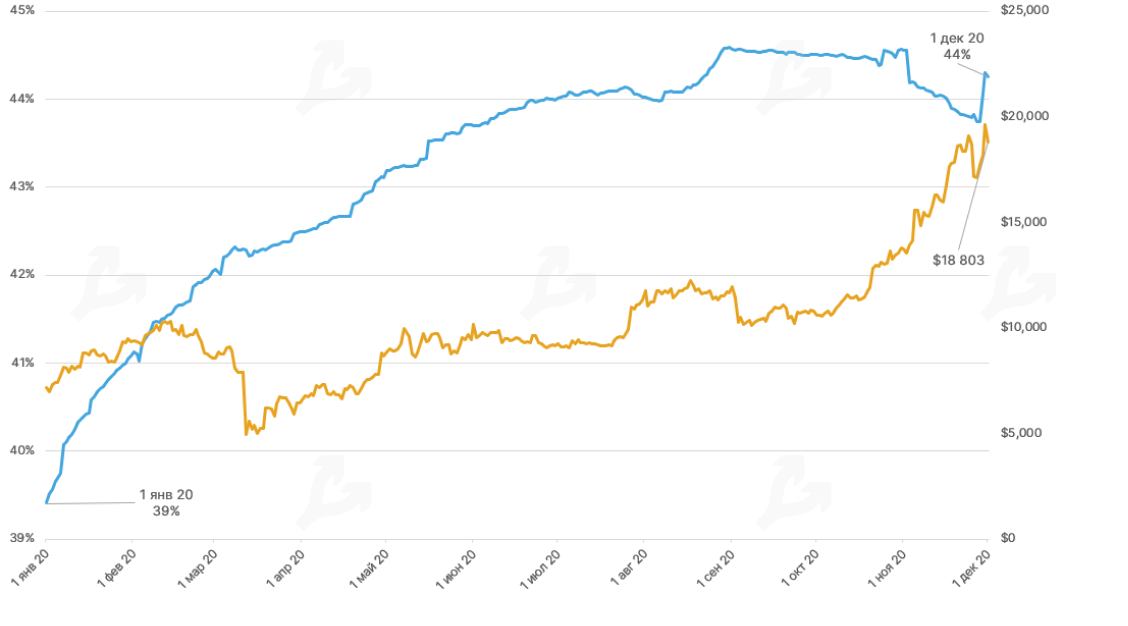
Share of Bitcoin supply not moved for more than two years. Data: Glassnode, Yahoo Finance.
- Balances on centralized exchanges continued to trend lower. In November, balances on CEX declined by 3%; since the start of the year the fall has been 17%. By 1 December, centralized exchanges held 12.94% of the total Bitcoin supply.
- The trend may reflect rising DeFi platform popularity, including WBTC, and market participants’ desire to retain control of funds. Clearly Bitcoin’s ascent is not sufficiently prompting active selling on centralized exchanges. Beyond reducing potential price pressure, it may signal institutional participation and a rising number of Buy & Hold proponents.
- The share of Bitcoin supply that hasn’t moved for over two years ticked down slightly in November. This could indicate profit-taking by some holders. Yet the overall trend remains upward — the indicator has risen from 39% to 44% since the start of the year. This points to a shift in market participants’ time preference toward longer horizons.


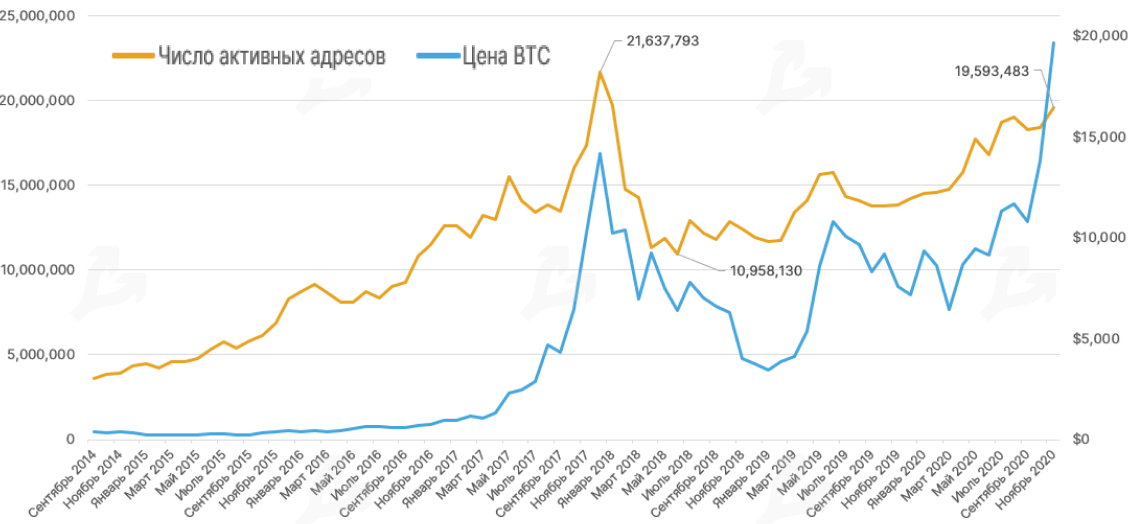
Dynamics of the number of active Bitcoin addresses. Data: Glassnode.
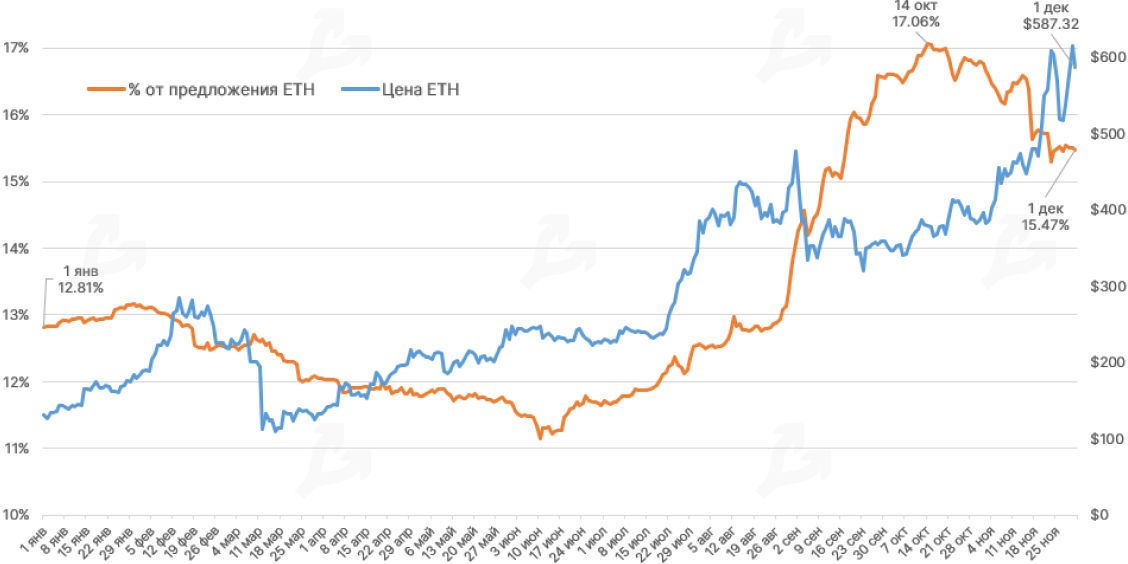
Share of Ethereum supply used in smart contracts. Data: Glassnode.
Against the backdrop of investor engagement, mass adoption of Bitcoin among a broad set of market participants grew — evidenced by the rising number of active addresses, approaching late-2017 levels.
Since mid-October there has been a noticeable reduction in Ethereum’s share of activity in DeFi smart contracts. This may reflect a cooling in the hype surrounding the sector, as investors take profits ahead of ETH’s annual high.
Institutional participation


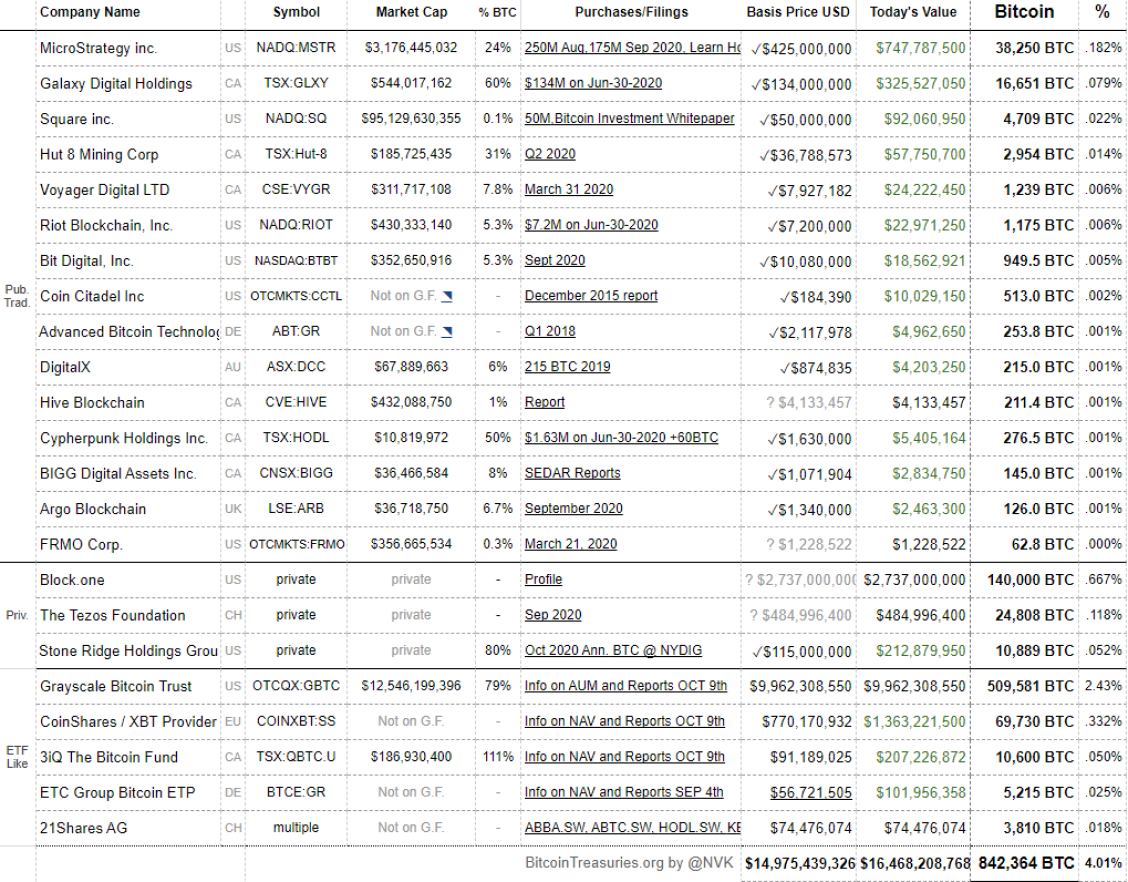
Investments in Bitcoin by public companies as of 1 December 2020. Data: bitcointreasuries.
Public companies significantly increased unrealised gains from Bitcoin, for example MicroStrategy generated $34.35 million of such gains in the last year. By contrast, profits from Bitcoin holdings reached $322.7 million in under four months.
Another example is Square — Jack Dorsey’s company. In October it invested 1% of its capital in Bitcoin, purchasing 4709 BTC. An initial $50 million investment has since grown to about $92 million.


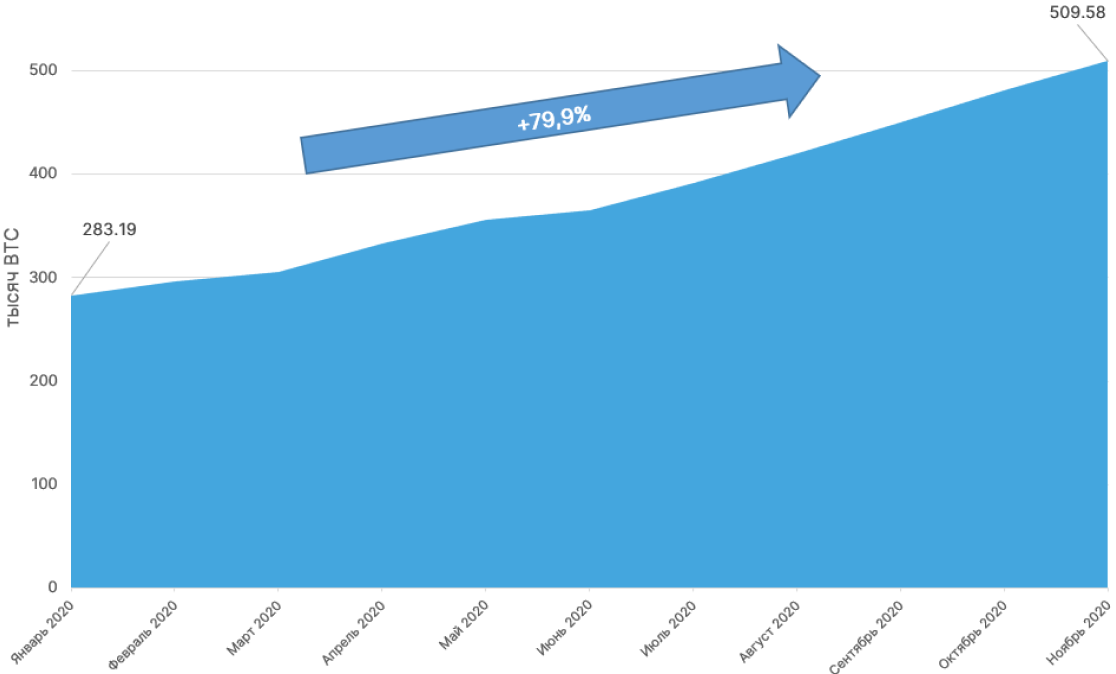
Grayscale Bitcoin Trust assets (thousand BTC). Data: grayscale.co.
Grayscale Investments posted a fresh record — assets under management exceeded $10 billion on 18 November; by 1 December the figure stood at $12.3 billion. The abrupt rise points to institutional interest. JPMorgan notes that inflows into Grayscale trusts outpaced gold-backed exchange-traded funds.
Galaxy Digital, Mike Novogratz’s firm, attracted $58.7 million from 33 investors over the year, with average investments of $1.6 million.
Amidst institutional activity, Coinbase reported record custody volumes — assets held in its custody service rose from $6 billion in April to $20 billion by December.
What else is happening with institutional players?
- Swiss subsidiary Gazprombank (Switzerland) Ltd launched test Bitcoin trading.
- BlackRock’s Chief Investment Officer Rick Rieder stated that Bitcoin could replace gold.
- SkyBridge Capital, with $9.2 billion assets under management, filed with the SEC for approval to invest in digital currencies.
- VanEck added a Bitcoin ETN to its list of traded products. Trading began on Deutsche Boerse’s Xetra.
Billionaires take a look at Bitcoin
- Former George Soros associate Stanley Druckenmiller said he invested in Bitcoin, highlighting its advantages over gold and suggesting he expects greater returns from the first cryptocurrency.
- Meanwhile, Ray Dalio argued that governments will “choke” Bitcoin before it fulfils its potential, so he prefers gold. Dalio later acknowledged he may have been mistaken.
- Mexican billionaire Ricardo Salinas Pliego invested 10% of his portfolio in Bitcoin, accompanying the decision with a video showing bags of Venezuelan bolivars for emphasis.
What about central bank digital currencies (CBDCs)?

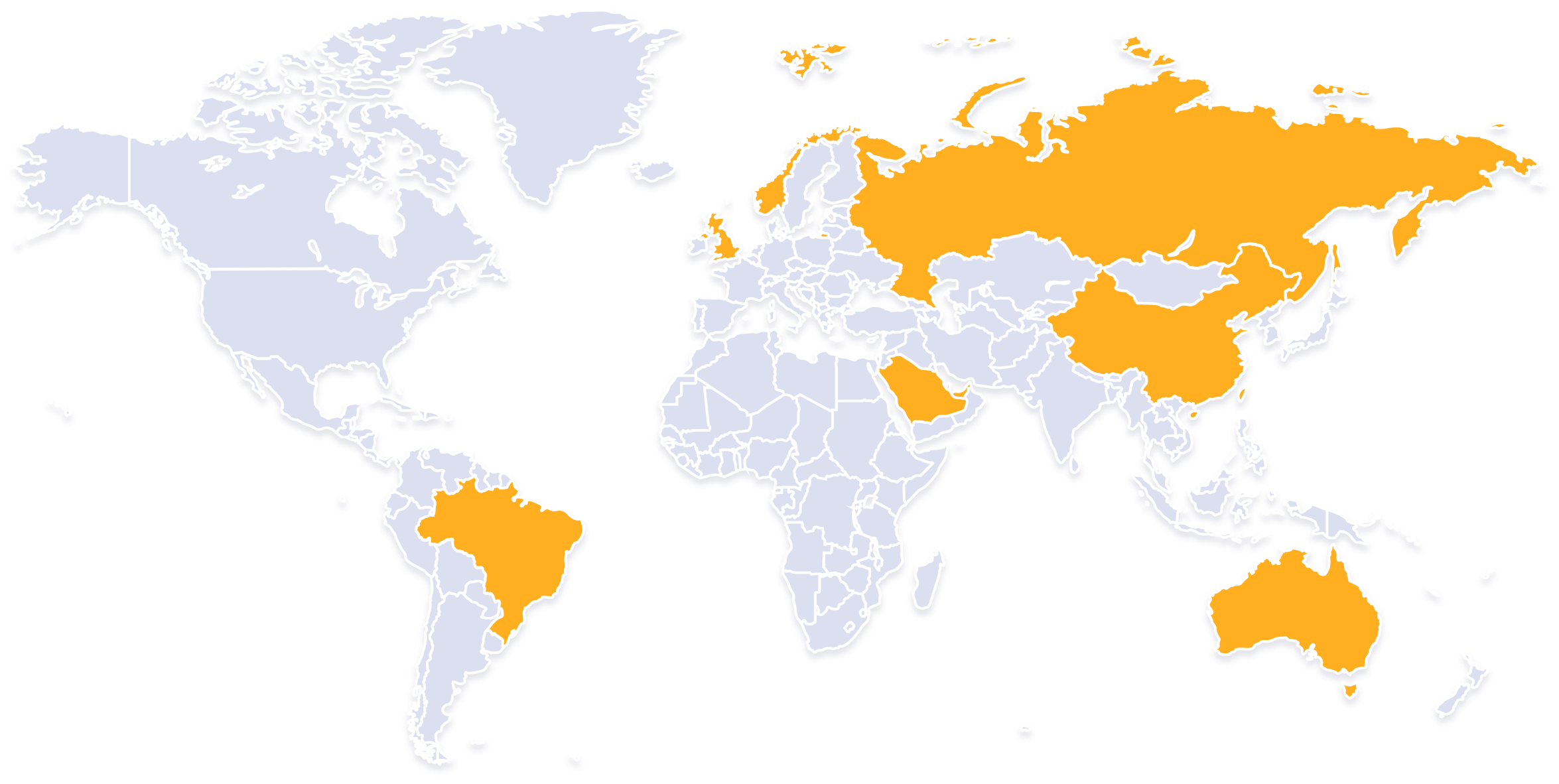

Key regional events



- En+ Group and BitRiver created a venture for cryptocurrency mining.
- Demand for mining equipment in Russia rose 45%, according to Avito data.
- Sberbank will launch a blockchain platform to buy digital assets. The bank’s head, Herman Gref, also suggested the possibility of its own stablecoin in 2021.



- In November, a draft law on stimulating the development of the digital economy in Ukraine was introduced in the Verkhovna Rada as part of the Diiya City project. It provides for establishing legal foundations to stimulate IT business in the country.
- Binance and Ukraine’s Digital Transformation Ministry released an educational series about Bitcoin to acquaint users with the history of digital assets, terminology, mining, exchanges and buying/selling crypto.
Key regulatory events
- On 2 December Ukraine’s Verkhovna Rada approved in first reading a base bill; virtual assets were equated to intangible assets.

- Central Bank of Kyrgyzstan proposed regulating crypto exchanges operating in the country.



- In Argentina a bill to regulate cryptocurrencies was proposed for consideration in parliament.



- Nigeria’s Finance Ministry will develop a regulatory base for cryptocurrency and blockchain tech.
- Russian Prime Minister Mikhail Mishustin said authorities would defend holders’ rights to crypto and propose legislative changes. Later, the Ministry of Finance proposed amendments criminalising non-declaration of cryptocurrency assets, and on 26 November the government approved the bill.



- South Korea will introduce a ban on anonymous crypto, while authorities pushed back crypto taxation to 2022.

- South Africa will classify cryptocurrencies as financial products.
Запуск Ethereum 2.0 с функцией стейкинга
1On 4 November Ethereum developers presented the Ethereum 2.0 deposit contract, enabling transfers from the existing network to ETH2. The genesis block date was announced for 1 December 2020. The main condition was 16,384 validators holding a total of 524,288 ETH (minimum 32 ETH each). Deposits began the same day.
2The co-founder Vitalik Buterin sent 3,200 ETH to the deposit contract within a day to bolster confidence.
3About a week later, on 11 November, users deposited 52,993 ETH, or 10% of the required total.
4Buterin later described the advantages of early ETH2 staking for validators, noting penalties enshrined in the protocol.
5Some users worried that deposits would be irreversible; Buterin reassured that deposits could be undone with a hard fork if the network did not launch on 1 December.
6Despite a slow start, users ensured ETH 2.0 launched on schedule — the required threshold of 524,288 ETH and 16,384 validators was surpassed on 24 November. Investors included Dubai-based IBC Group, which transferred the equivalent of $10 million. The last 25,000 ETH were deposited by Celsius Network.
7On 1 December the zero-th phase of Ethereum 2.0 launched successfully. The user-deposited amount exceeded the threshold by 66.5%.
Other notable November events
26 November Chinese crypto exchange OKEx resumed withdrawals. The feature had been unavailable since 16 October. CryptoQuant data show that on the first day 24,631 BTC left the platform, while more than 21,000 BTC were sent to other exchanges. Users largely moved funds to rival platforms — Huobi, Binance and others.
American PayPal customers were enabled to buy and sell Bitcoin, Bitcoin Cash, Ethereum and Litecoin. The weekly buying limit was $20,000. The head of PayPal later said Bitcoin will be used more for everyday payments than as a store of value, and he also announced the possibility of accepting Bitcoin by merchants in PayPal in the next year.
3 November the US Department of Justice confiscated 69,370 BTC worth over $1 billion, plus an equivalent amount in Bitcoin Cash, Bitcoin SV and Bitcoin Gold from hard forks. It emerged that the wallet had been targeted by hackers for years and is linked to the Silk Road dark‑net marketplace, whose founder is serving a life sentence.
The initiative started with the Poolin mining pool, which launched a portal to coordinate the Taproot upgrade in Bitcoin. Two weeks later pools controlling about 82% of the hash rate announced readiness to support its activation.
Read more on Taproot and Schnorr signatures in the educational card.
On 18 November the Bitcoin Cash network held its first halving. Block rewards dropped from 6.25 BCH to 3.125 BCH. The Canopy upgrade also activated, including the plan to create a development fund funded by 20% of miner rewards.
Quotes of the month