




From July to September, 48 new companies joined the ranks of those accumulating the first cryptocurrency. The total number of corporate holders of digital gold reached 172, noted Bitwise.
There are almost 40% more public companies holding bitcoin today than there were 3 months ago.
Companies Are Buying Bitcoin, Q3 2025 Edition: pic.twitter.com/R6m1kyaP0H
— Bitwise (@BitwiseInvest) October 14, 2025
Hunter Horsley, CEO of the asset management firm, described the figures as “remarkable.” He emphasized that interest in Bitcoin is shown not only by private investors but also by public companies.
The combined reserves of companies exceeded 1 million BTC, valued at $117 billion—4.87% of the total supply of digital gold. The largest holder remains Strategy Michael Saylor, which owns 640,250 BTC worth $71.9 billion. It is followed by MARA Holdings with 53,250 BTC valued at $5.9 billion.


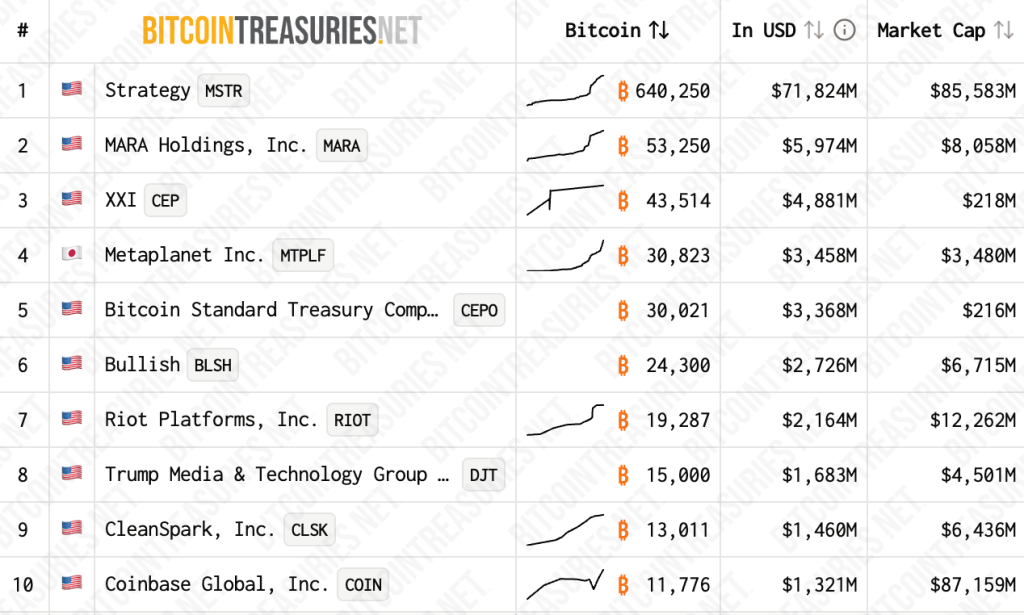
According to BTC Markets analyst Rachel Lucas, the increase in crypto-focused firms indicates that “major players are doubling down rather than retreating.” In early September, CryptoQuant specialists noted a sharp slowdown in the growth rate of corporate Bitcoin reserves.
Lucas believes the trend will continue. In a comment to Cointelegraph, she emphasized that companies purchasing digital assets are making a strategic decision for the long term rather than seeking short-term gains.
Market Paradox
Corporate treasuries continue to accumulate Bitcoin, yet its price remains volatile. Lucas highlighted several factors contributing to this reaction.
The first is the method of accumulation. Companies typically acquire cryptocurrency through OTC. This tactic avoids slippage, but does not immediately impact the asset’s spot prices.
The second reason is the opposing market forces. While public companies are buying the asset, other participants exert downward pressure, for instance, by taking profits at local highs or amplifying price swings through derivative instruments.
General sell-offs are also triggered by macroeconomic events, including the recent trade tensions between the US and China. This led to crypto market liquidations exceeding $19 billion, causing Bitcoin’s price to fall below $110,000.
Edward Carroll, head of markets at MHC Digital Group, noted that despite the lack of noticeable price reaction, the fundamental market imbalance is intensifying. He stated that this will have a “positive impact on the price of digital gold in the medium to long term.”
Demand for Bitcoin will be “orderly and continue to grow in the coming years.” An important consequence of this process will be the gradual weakening of the asset’s correlation with general market sentiment, the expert emphasized.
According to Bitbo, miners produce approximately 900 BTC daily, while companies purchase an average of 1,755 BTC.
Earlier, CryptoQuant analyst Axel Adler Jr. stated that Bitcoin has passed the maturity test.