




Nvidia published fourth-quarter results that comfortably beat analysts’ forecasts. Revenue in its core data‑centre segment rose 75%.
Key figures:
- earnings per share: $1.62 versus a $1.53 forecast;
- revenue: $68.13bn against an expected $66.21bn.
Total revenue increased 73% from $39.3bn a year earlier. More than 91% of sales come from the data‑centre unit, home to its flagship AI chips.
Net income almost doubled—to $43bn from $22.1bn in the prior period.
Guidance was stronger than expected. The company plans to generate $78bn of revenue in the first fiscal quarter—analysts had pencilled in $72.6bn. The outlook excludes data‑centre sales to China.
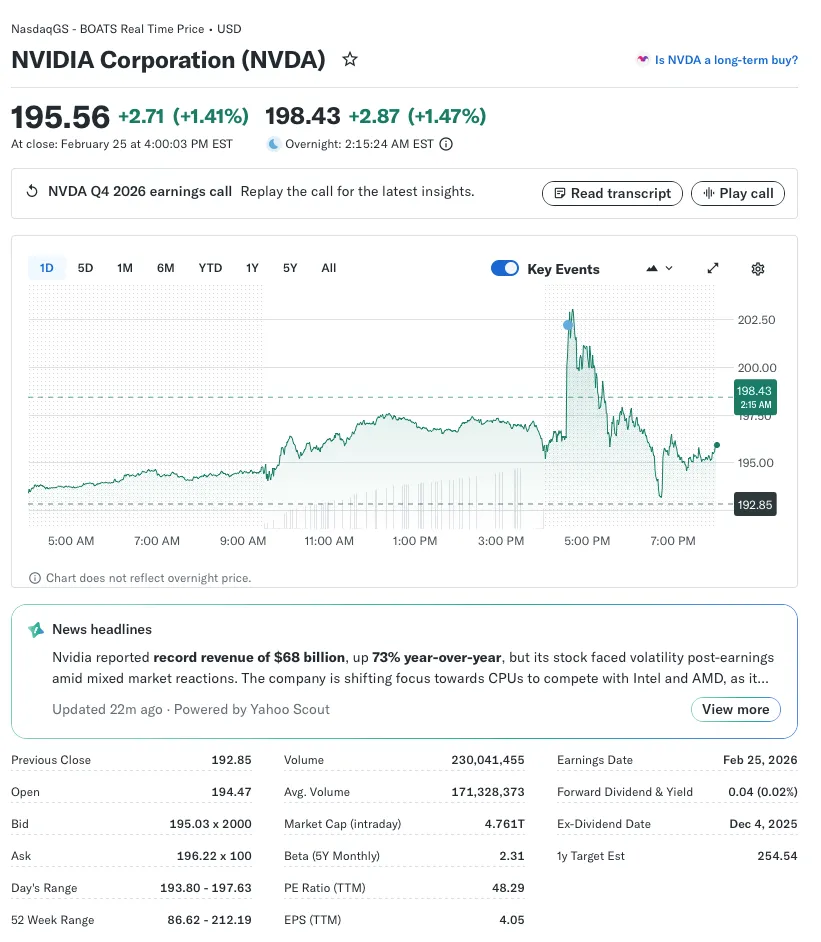
Nvidia’s shares have outpaced the broader market: year to date they are up 5%, while the Nasdaq is down 0.4%.


Expectations for Nvidia’s print were set weeks earlier, after results from Alphabet, Amazon, Meta and Microsoft. Based on their guidance and analysts’ estimates, combined capital spending over the year could approach $700bn as the tech giants build out their own AI infrastructure.
Nvidia’s CFO, Colette Kress, said hyperscalers remain the company’s biggest customers, accounting for over 50% of data‑centre revenue.
Potential risks
A persistent headache for Nvidia is memory supply. Kress noted that constraints will weigh on the gaming business “in the first quarter of fiscal 2027 and beyond”.
Interest is building in next‑generation computing systems, Vera Rubin. Early samples have already gone to customers, with volume shipments expected in the second half of the year.
Performance per watt is expected to be ten times higher—particularly important given data‑centre power constraints.
Nvidia also said it is extending supply chains beyond Asia—to the United States and Latin America. It is producing Blackwell at TSMC’s plants in Arizona, with part of the systems assembled at Foxconn’s new large facility in Mexico.
Anthropic’s dispute with the U.S. military
Nvidia’s CEO, Jensen Huang, commented on the disagreements between the U.S. Department of Defense and Anthropic. In his words, “it’s not the end of the world”.
He noted that the Pentagon has every right to use the technologies it buys. Anthropic, however, can set policies governing the use of its products.
“Both sides have a reasonable position,” Huang said.
He stressed that even if talks fail there would be no critical consequences: “Anthropic is not the only AI company in the world, and the Department of Defense is not the only client.”
A doomsday‑economy scenario
Huang also commented on a report by Citrini Research in which analysts sketched a scenario of economic collapse triggered by artificial intelligence.
The paper partly sparked a sell-off in software and payments stocks.
“I think the markets got it wrong,” he said.
In his view, companies will use AI agents to create new products and boost efficiency. Virtual assistants will not replace software; they will use it.
“All these tools we use today—Cadence, Synopsys, ServiceNow or SAP—exist for fundamentally sound reasons. AI agents will become intelligent software that uses these services on our behalf and helps us be more productive,” Huang said.
In January, the administration of U.S. president Donald Trump officially authorised the export to China of Nvidia’s H200 AI chips—the second most powerful products in the company’s line‑up.