


OP Labs Reduces Workforce by 20% Following Base’s Transition to Its Own Stack
OP Labs cuts 20% of staff to streamline processes and cut costs.
OP Labs, the developer of Optimism, has laid off 20 employees to streamline internal processes and reduce costs, according to CEO Jing Wang.
Today we shared difficult news with the OP Labs team.
Our priority was to communicate with the impacted people & give the team time to process the news before sharing publicly. This decision reflects a narrowing of our focus, not our runway.
I’m sharing the note I sent to the… pic.twitter.com/rJThhlcFaw
— Optimist Prime (@jinglejamOP) March 12, 2026
A screenshot of the general chat, now with 102 participants, suggests that 19.6% of the staff were affected.
“This is not about finances. OP Labs is well-capitalized, with a runway for years to come. It’s about doing fewer things well, making decisions faster, and reducing coordination costs,” Wang wrote.
She did not specify which positions were affected but encouraged recruiters to consider the former employees, describing them as “talented engineers, operators, and developers who helped build Optimism into what it is today.”
A Transition Period
Optimism is a key layer-two solution for Ethereum. At the time of writing, its TVL exceeds $1.5 billion. The project has also reached the first stage of decentralization (Stage 1).

The OP Stack technology stack serves as an open foundation for creating customizable blockchains, and it underpins the L2 network Base by Coinbase. In mid-February, developers of the solution announced a transition to their own architecture for independent development, adding pressure on Optimism.
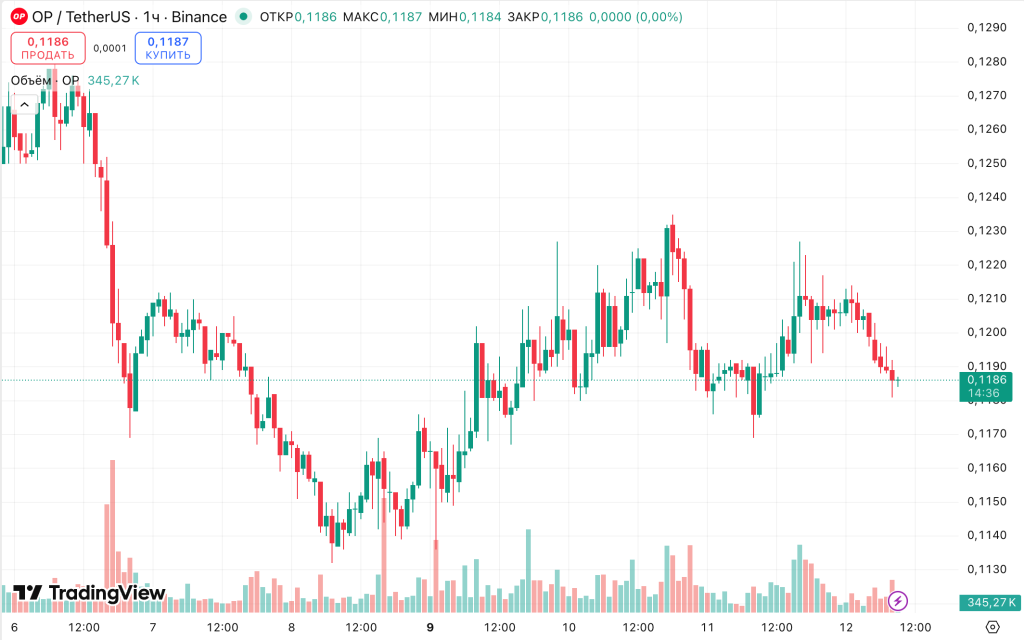
Over the past month, the price of the native OP token has fallen by 36.7%. At the time of writing, the coin is trading around $0.11.
A Shift in Narrative
Ethereum co-founder Vitalik Buterin believes that as the main network scales, the relevance of L2 diminishes. He noted that rollups are decentralizing more slowly than expected.
The programmer advised developers not to replicate L1 but to seek unique niches: privacy, specialized applications, non-financial scenarios, and ultra-high speed.
As a technical base, he proposed a “native rollup precompile”—a protocol-integrated mechanism for verifying ZK-proofs.
Representatives of L2 networks acknowledge the need for evolution. However, players like Offchain Labs insist that the Ethereum mainnet still cannot match layer-two solutions in terms of throughput.
Optimism’s Plans
Despite challenges, Optimism has a clear roadmap for 2026. One of the main goals is to accelerate block formation times.
What Optimism is shipping in 2026:
→ Even faster blocks
→ More economic parameters
→ Continuous upgrades
→ Native interoperability
→ Custom compliance controls
→ Actions SDK
→ ZK proof systems pic.twitter.com/XNm99PDWVq— Optimism (@Optimism) February 25, 2026
Developers also plan to:
- implement native interoperability between networks;
- develop compliance control mechanisms for different jurisdictions;
- launch ZK-proof systems compatible with Ethereum’s quantum-resistant roadmap.
In March, the Ethrex team, in collaboration with the Ethereum Foundation and L2BEAT, introduced the code and documentation for a ready-to-use environment for native rollups.
Рассылки ForkLog: держите руку на пульсе биткоин-индустрии!