




OpenAI is “on track” to unveil its first device in the latter half of 2026, according to Chris Lehane, the company’s global affairs director, in a conversation with Axios.
In May 2025, OpenAI announced the acquisition of a startup led by former Apple design chief Jony Ive, which focuses on creating AI devices. At the same time, Sam Altman gave employees a preliminary overview of the gadget he is developing with Ive, sharing plans to release 100 million “AI companions.” These are expected to become part of daily life, the entrepreneur hopes.
The new product is designed to fully understand the user’s environment and life. It is unobtrusive, can fit in a pocket or sit on a desk, and “will become the third primary device after the MacBook Pro and iPhone.”
This will not be a phone, glasses, or wearable device—both Ive and Altman aim to wean people off screens. They refer to it as a “new design movement.”
The CEO of OpenAI emphasized that a whole “line of devices” is planned, comparing the concept to Apple’s ecosystem.
Lehane described the device as one of the company’s major innovations for 2026. It remains unclear whether it will be available for purchase that year.
In January, an insider known as Smart Pikachu revealed that OpenAI plans to release an “AirPods replacement.”
Hearing fresh detail on Openai “To-go” hardware project from last report. Now confirmed it is a special audio product to replace Airpod, internal code name is “Sweetpea”
On manufacturing, Foxconn has been told to prepare for total 5 devices by Q4 2028. All not known but a home… https://t.co/svOCBuyapI pic.twitter.com/SFumFfRIeF
— 智慧皮卡丘 Smart Pikachu (Weibo) (@zhihuipikachu) January 12, 2026
The internal code name is Sweetpea. The case will be egg-shaped with two “capsules” to be placed behind the ear. The main processor is a smartphone chip. While the cost of materials and components will be high, the gadget itself will be powerful.
According to the blogger, the presentation is scheduled for September 2026, with projected sales of 40-50 million units in the first year.
Foxconn is expected to “prepare for the release of five devices” by the fourth quarter of 2028, added Smart Pikachu.
In October 2025, FT reported that OpenAI was working on a screenless device the size of a palm, which “receives audio and visual signals and responds to user requests.” This might refer to a “smart” speaker.
Other Plans for 2026
OpenAI’s CFO Sarah Friar shared in a blog post that 2026 will be a year of “practical implementation.”
“The priority is to bridge the gap between what is currently possible with artificial intelligence and how people, companies, and countries use it in everyday life,” she stated.
The opportunities are vast and already available, especially in healthcare, science, and entrepreneurship, Friar added.
The top executive outlined how OpenAI envisions monetizing its services while ensuring computational capacity. According to her, the lab’s revenues are directly tied to the availability of technical infrastructure.


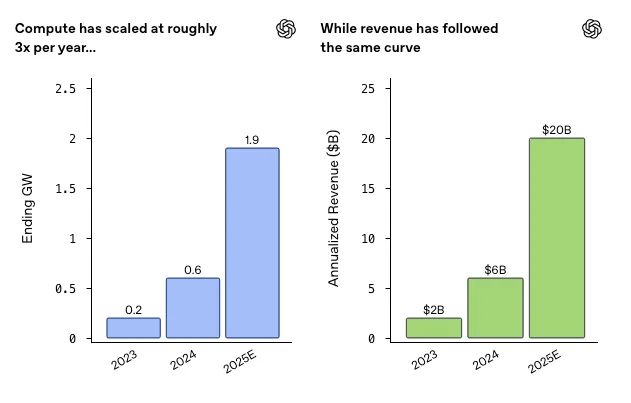
The AI startup’s computational capacity grew from 0.2 GW in 2023 to 1.9 GW in 2025. Annual revenue over the same period increased from $2 billion to over $20 billion.
“This is unprecedented growth. We firmly believe that more computational capacity would lead to faster adoption and monetization,” Friar emphasized.
The tech industry and OpenAI are under scrutiny due to the massive investments directed towards data centers and their power supply. Skeptics argue that a bubble is forming, as despite high revenues, Altman’s startup remains unprofitable.
“Ensuring computational capacity requires commitments made years in advance, and growth does not occur in a perfectly straight line,” Friar added.
She stated that OpenAI’s business model must scale alongside its products.
On the Subject of Scaling
On January 16, OpenAI announced that it would begin testing ads in the free ChatGPT tier and the low-cost Go tier in the coming weeks.
In the coming weeks, we plan to start testing ads in ChatGPT free and Go tiers.
We’re sharing our principles early on how we’ll approach ads–guided by putting user trust and transparency first as we work to make AI accessible to everyone.
What matters most:
— Responses in… pic.twitter.com/3UQJsdriYR— OpenAI (@OpenAI) January 16, 2026
The company assured:
- responses will not be influenced by commercial content;
- ads will always be placed separately and clearly labeled;
- conversations will not be accessible to advertisers.
There will be no ads in the Plus, Pro, Business, and Enterprise plans.
Altman noted that he would strive to make paid messages useful.
Back in January, billionaire Elon Musk demanded that OpenAI and Microsoft pay $134 billion in “unlawful profits” that the AI startup gained thanks to his early support.