



The AI startup OpenAI has introduced a new large language model, o1, trained using reinforcement methods to perform complex reasoning tasks.
We’re releasing a preview of OpenAI o1—a new series of AI models designed to spend more time thinking before they respond.
These models can reason through complex tasks and solve harder problems than previous models in science, coding, and math. https://t.co/peKzzKX1bu
— OpenAI (@OpenAI) September 12, 2024
The neural network is said to be capable of “thinking”—creating a long internal chain of thoughts during question analysis, according to the company.
o1 avoids some “reasoning traps” by effectively self-checking and spending more time analyzing parts of a question. The model can approach task analysis holistically, planning and executing a series of actions over an extended period.
The new OpenAI tool is suitable for tasks involving multiple subtasks, such as identifying privileged documents or brainstorming marketing strategies.
@OpenAI‘s o1 thinks for seconds, but we aim for future versions to think for hours, days, even weeks. Inference costs will be higher, but what cost would you pay for a new cancer drug? For breakthrough batteries? For a proof of the Riemann Hypothesis? AI can be more than chatbots pic.twitter.com/AtqjRTzNMN
— Noam Brown (@polynoamial) September 12, 2024
“The thinking process of o1 lasts seconds, but we aim for future versions to think for hours, days, or even weeks. The cost of inference will be higher, but what price would you pay for a new cancer drug? For revolutionary batteries? For a proof of the Riemann Hypothesis? AI can be more than chatbots,” noted OpenAI researcher Noam Brown.
According to OpenAI, in the qualifying exam of the International Mathematical Olympiad, o1 solved 83% of the tasks, while GPT-4o managed 13%. In competitive programming on the Codeforces platform, it outperforms 89% of participants.


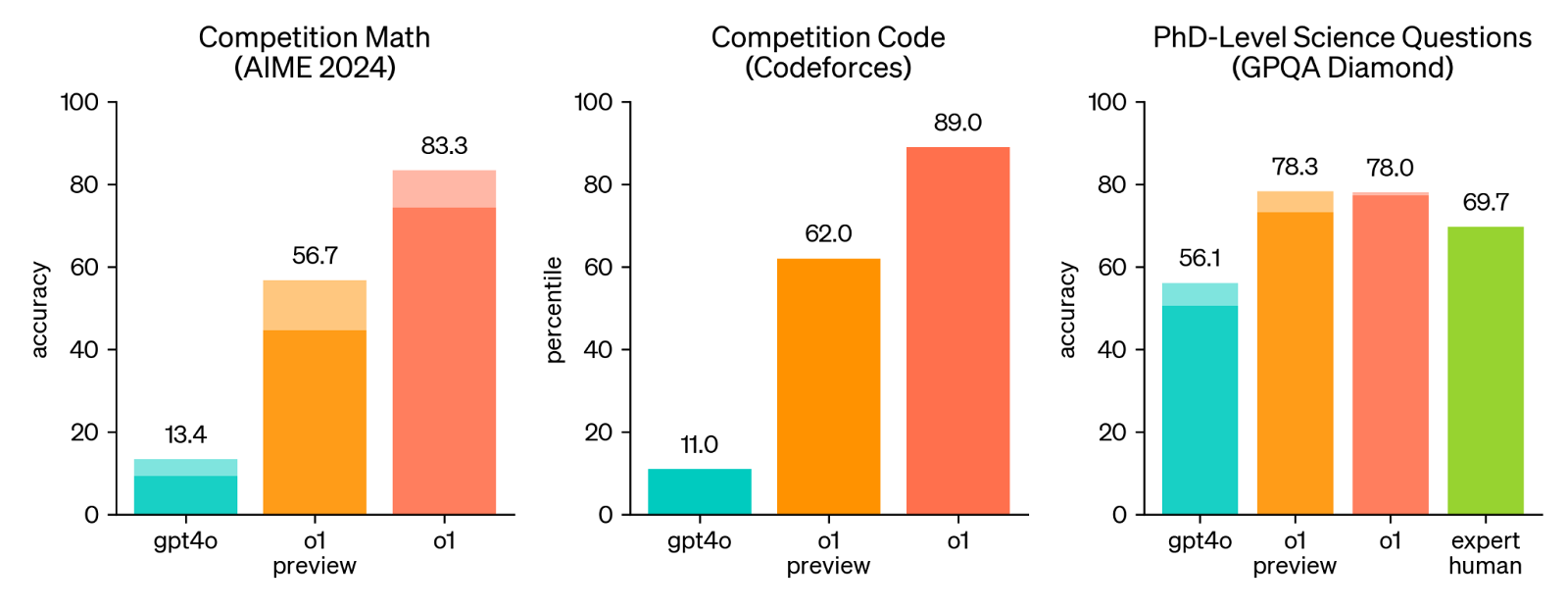
The neural network combines a family of models. On September 12, an early version, o1-preview, was released, with others planned for the future.
The capabilities of the new language model are currently limited: it cannot analyze web pages, files, or images.
The new OpenAI tool is more expensive than its predecessor—the o1-preview API costs $15 per 1 million input tokens (three times more than GPT-4o) and $60 per 1 million output tokens (four times more than GPT-4o). It is available in ChatGPT for corporate Plus or Team users.
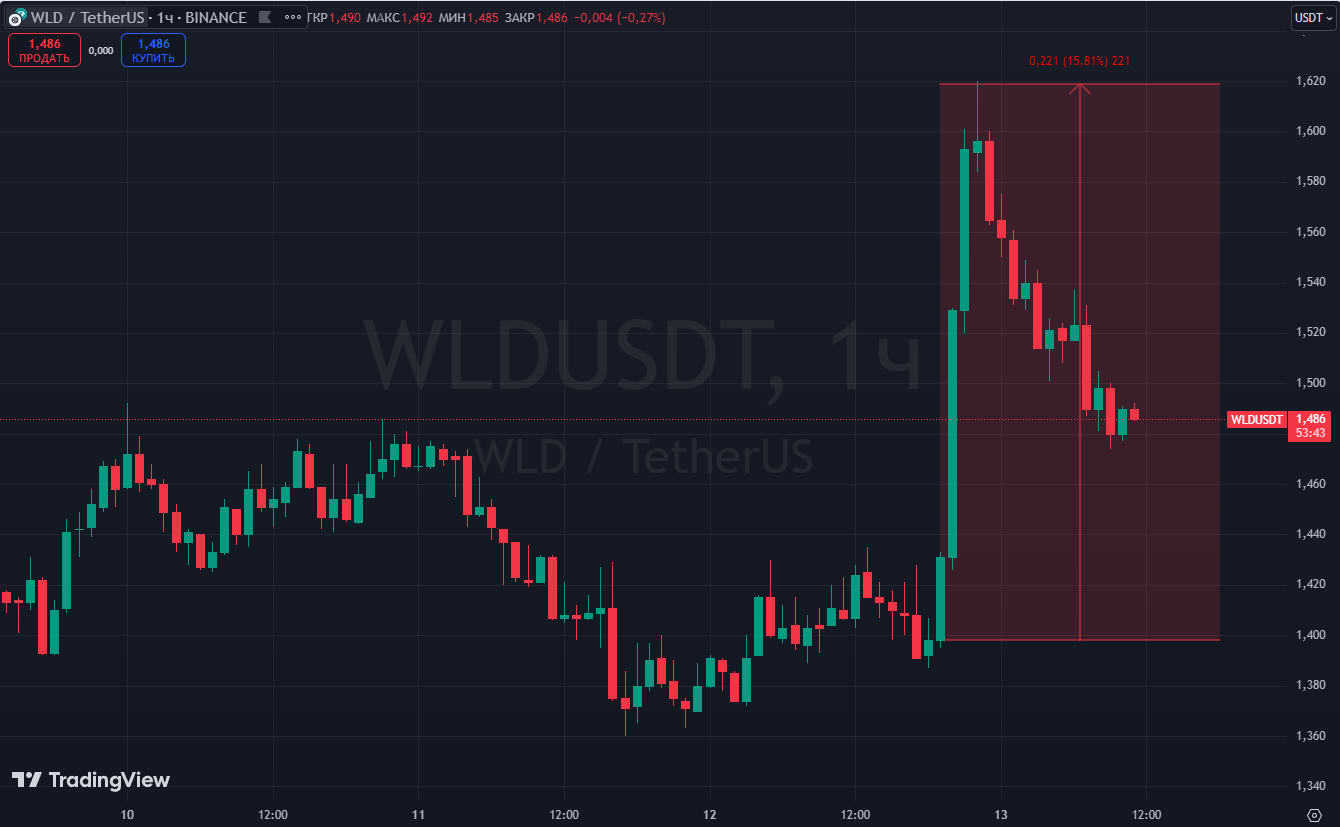
Following the release of the new AI model by Sam Altman’s company, the token of his other project, Worldcoin (WLD), saw a 16% increase. The price then slightly retracted.

The new model was previously codenamed Strawberry. Before this, the project was called Q* and was considered a breakthrough for creating general artificial intelligence that “could threaten humanity.”
It was earlier reported that OpenAI is in talks to raise $6.5 billion at a valuation of $150 billion.
CEO Sam Altman plans to implement a large-scale project to create AI hardware and systems worth tens of billions of dollars.