


A crypto blogger known as The Smart Ape has published a detailed analysis of the economic consequences of widespread AI automation. The starting point was a forecast by Microsoft AI chief Mustafa Suleyman, who stated to the Financial Times back in February that AI will automate most office professions within 12–18 months.
According to The Smart Ape, the mass displacement of “white-collar” workers could trigger a cascading economic collapse comparable in scale to the 2008 crisis.
Office Workers as the Foundation of the Credit System
The blogger argues that banks lend not to individuals, but to “income trajectories.” A lawyer earning $200,000, a consultant with $180,000, an engineer with $160,000 — for banks, these are borrowers of the highest reliability. If AI replaces their jobs, an entire class that underpins the credit system will vanish.


The author describes a chain of consequences: job loss — depletion of savings — selling stocks to pay off mortgages. If millions of former high-paid professionals start doing this simultaneously, the stock market will slump, and within 6–12 months, mass mortgage defaults will begin.
Housing Market More Vulnerable Than in 2008
The Smart Ape points out a key difference from the 2008 crisis: then, the blow was to the periphery of the credit system — subprime borrowers. Now, the most reliable categories are at risk.
“U.S. mortgage debt has risen to $12.5 trillion from $10.5 trillion in 2008 — only a 20% nominal increase, although housing prices have nearly tripled in that time. The main capital is concentrated among boomers, while young homeowners remain heavily indebted.
The ‘lock-in’ effect creates additional pressure: millions of Americans took out mortgages at 3% during the pandemic and are unwilling to sell homes at current rates of around 7%. This reduces market liquidity. If forced sales begin, prices may fall faster than fundamentally justified,” claims The Smart Ape.
The Fed’s Dilemma and Redistribution Failure
The author believes that the Fed has no good options. Two scenarios are possible:
- Turn on the printing press again and save banks, as during the 2008 crisis. However, the consequences of the recent inflation spike are still felt: prices for food, rent, and fuel remain high, and global central banks are increasingly betting on gold instead of the dollar.
- Do not intervene and let banks handle defaults on their own. But this risks a repeat of September 2008, when the financial system began to rapidly lose stability.
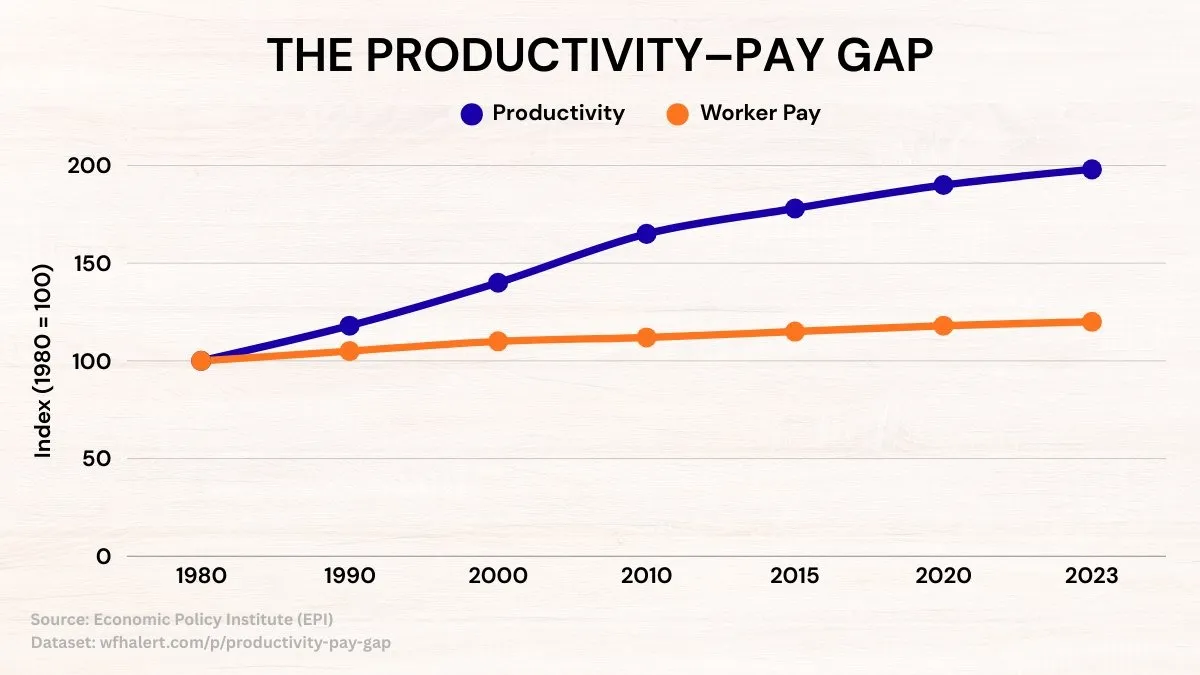
The blogger emphasizes that since the 1980s, productivity growth has not led to wage increases — the benefits were captured by capital. AI, he says, launches the same dynamic “without brakes.” Value will concentrate among a few companies — NVIDIA, Microsoft, Google, Anthropic, OpenAI — and a thin layer of engineers around them.

Why UBI Won’t Save Us
The most popular response — universal basic income (UBI) — is deemed unrealistic by the author. A modest $1,000 per month for adult Americans would cost the budget $3–4 trillion annually — about two-thirds of all tax revenues. The program would have to be funded by taxing the very companies with “the best lobbyists and the most aggressive offshore schemes.”
According to The Smart Ape, the real political program will boil down to unemployment insurance and retraining programs for professions that will also disappear.
K-shaped Finale
The outcome, according to the author, will be a K-shaped economy. At the top — capital owners and AI engineers, at the bottom — former “white-collar” workers who join the ranks of manual laborers and the gig economy. The middle class, as previously understood, will no longer exist.
“Suleyman may be wrong about the 18 months. Even if he missed by five years, the direction is set. Those who move forward are those who create the AI that replaces the rest. Learn the tools, get close to those who create them, understand how it works. Waiting will not save you,” concludes The Smart Ape.
Earlier, Gartner forecasted AI spending to grow to $2.59 trillion.