



Developing L2 solutions startup StarkWare unveiled the StarkNet roadmap with a focus on performance and UX in 2023, and, in the next phase, on decentralisation of operations and governance.
Starknet’s goals for the upcoming months: performance and UX! ?️
The milestones will focus on boosting performance to new heights, and delivering a seamless UX
By year’s end, we’ll achieve a robust network, transitioning to seamless governance in 2024!https://t.co/AaiKjrscWR
— StarkWare (@StarkWareLtd) April 24, 2023
Analyst Colin Wu saw in the document signs of preparation for the release of a utility token and for an airdrop.
L2 network StarkWare announced the 2023 roadmap. The current development focus is on performance and UX. In 2024, the focus will be on the decentralisation of operations and decision-making. This may mean that the Token and airdrop will be in 2024. https://t.co/7bB6bIU7Fb
— Wu Blockchain (@WuBlockchain) April 25, 2023
In Cairo 1.0 update marked the stabilization of the L2 solution’s capabilities — developers gained the ability to create dapps using STARKs, the document says.
The Regenesis phase remains unreleased, which will be seamless and will not affect smart contracts. It will become possible after the overwhelming majority of those versions transition from Cairo 0 to Cairo 1.0.
It is expected that, going forward, major upgrade decisions for the project will be taken by the community. The following steps are planned:


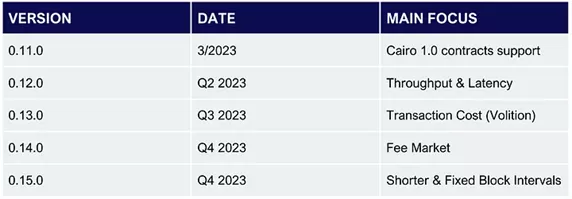
In the second quarter, version 0.12.0 is anticipated, aiming to improve throughput and reduce delays in processing transactions. This will be achieved by moving to a Rust-based sequencer and the new Rust-Cairo VM. Work on open-source projects has been underway for the past six months.
In the planned third-quarter version 0.13.0, transaction fees will be significantly reduced by cutting data-transfer costs to Ethereum (this component accounts for about 95% of costs).
The team will offer the Volition solution, allowing developers to build StarkNet applications with a hybrid data-availability mode — both inside and outside the network. Details will be announced later.
In the fourth quarter, StarkWare plans to adapt to the Ethereum-imminent EIP-4844 implementation as part of the Cancun upgrade. This will be implemented in version 0.14.0.
EIP-4844 will add a new fee market for short-lived data. Rollups will use it to provide data availability instead of consuming regular gas.
0.14.0 envisages introducing a fee market in StarkNet. It will enable efficient allocation of scarce resources, based on users’ willingness to pay for a transaction, rather than simply its place in the queue.
“We expect a substantial reduction in data costs thanks to EIP-4844 and Volition”, the developers promised.
Version 0.15.0 (Q4) is expected to switch to fixed and shorter block intervals and, accordingly, faster finalization of transactions. Like 0.14.0, it will promote “smooth and predictable operation of StarkNet regardless of network load”.
Currently, each block is confirmed by its own proof, and the intervals between blocks are variable—the stored amount determines the cost of the block.
To achieve a fixed cost, the network is expected to accumulate a sufficient number of transactions. This leads to variable block intervals. To address this, the team plans to establish a 1:1 relation between a StarkNet block and its proof.
Starting with version 0.15.0, the proof will attest to the integrity of one or more StarkNet blocks. The step will fix the block interval and improve the user experience.
The team did not disclose details of further steps regarding decentralisation of operations and governance.
As a reminder, in February 2023 StarkWare expanded cooperation with the Chainlink decentralized oracle network to accelerate the deployment of its L2 solution StarkNet.