




What is parallelization?
Parallelization, or parallelism, is the concurrent processing of data across many compute nodes, followed by combining the results.
The approach is used to boost the performance of blockchain systems. In this context it means executing transactions in parallel—many operations are processed at once instead of sequentially.
Developers at Sei offered a simple analogy:
Consider this simple scenario to understand the power of parallelization:
It’s a hot day, you want a Pepsi but you need to queue with these Fanta guys ?
Normally, you’d have to wait in the same long line to quench your thirst. But, if there were multiple machines serving one… pic.twitter.com/IHj0FzXD9J
— Sei ?? (@SeiNetwork) January 30, 2024
“It’s a hot day. You want a Pepsi, but you have to stand in line with these Fanta lovers. To quench your thirst, you would normally have to wait in such a long queue. But if there were several vending machines each serving one of the drinks, the process would be parallel!”
According to them, at present all EVM networks work “according to the first scenario”.
“With sequential execution, every transaction has to be confirmed by the entire network, which results in significant energy consumption and high effort from miners or validators,” the Suipiens blog says.
Parallelization, then, removes the “queue” and allows transactions to be distributed to network nodes and validated simultaneously.
Once this process completes, the network converges to a “uniform” state by reaching consensus across nodes.
The parallel approach optimises the use of network resources. Transaction processing accelerates by distributing work across nodes and their sub-groups.
“This has been proven to significantly improve a system’s overall throughput. Projects implementing parallelisation claim up to a 100x increase in TPS compared with networks that process transactions sequentially,” noted CoinGecko analyst Joel Agbo.
What approaches to parallelization are there?
Two main models exist:
- optimistic parallelization;
- state-access parallelization.
Briefly on each.
Optimistic parallelization
Here, the network skips sorting and starts processing data concurrently. The method assumes transactions are unrelated.
If execution proves incorrect, the network “rolls back” to make adjustments. Where dependencies exist, the affected transactions are re-executed with the correct data.
State-access parallelization
With this model, transactions are first sorted. They are grouped by the impact they have on network state—for instance, into related and unrelated.
Related transactions touch the same contract or the same account in the network.
Unrelated ones may include one-way transactions that interact with different contracts.
The network processes unrelated transactions simultaneously, saving users time and cost. Related transactions are re-coordinated before processing.
Sorting may also consider gas price. Higher-fee transactions can be executed in parallel, improving user-perceived speed.


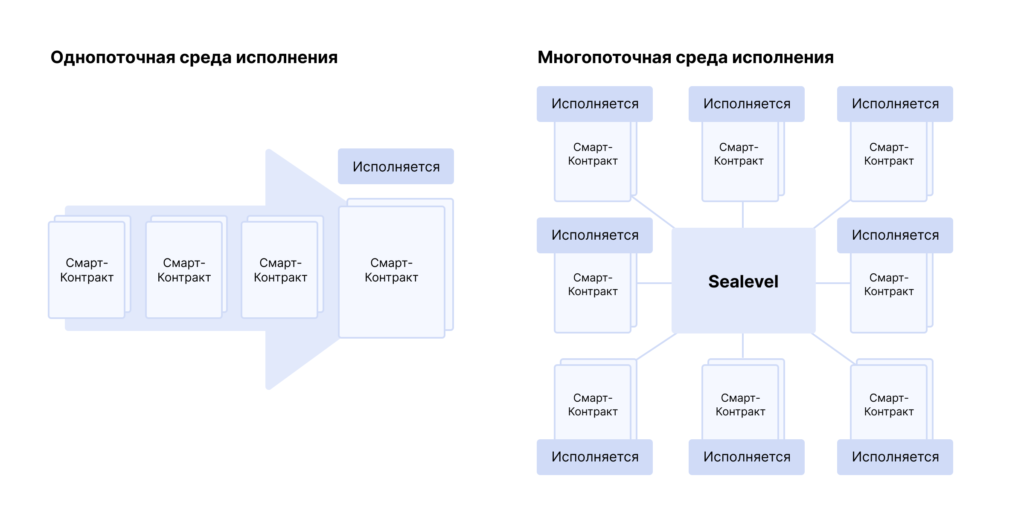
How does parallel transaction execution work?
As noted, parallel execution processes multiple transactions at once. It differs markedly from the traditional sequential approach, delivering greater efficiency and scalability.
A simplified algorithm looks like this:
- identifying independent transactions. The system finds unrelated operations—those that do not touch the same data or state. For example, transactions on Solana that affect different smart contracts can be processed in parallel;
- simultaneous execution. Once independent transactions are identified, nodes execute them concurrently. This parallel processing dramatically reduces confirmation times (as seen, for instance, with Solana’s Sealevel technology);
- handling dependencies and conflicts. The system must cope with complexities in transaction flows while preserving data integrity and blockchain reliability.
What are the advantages of a “parallel” approach to scaling?
Key benefits include:
Higher performance. Splitting tasks and distributing them across many nodes not only speeds up processing but also enables horizontal scaling.
The network can add resources by bringing in more nodes during bursts of on-chain activity, and scale back during quieter periods. Such flexibility keeps the network “fit” when transactional demand whipsaws.
Lower gas costs. Parallelization saves both time and the funds users spend on network operations.
Transactions are spread across sub-groups of nodes. Each operation thus incurs a smaller fee than under sequential processing.
Faster throughput also means shorter queues and less competition for inclusion, so each transaction can clear with a lower fee.
Transaction speed. By distributing work across multiple nodes, the network saves considerable time on execution. Blockchains that support parallelization achieve multiples of TPS compared with systems that process transactions sequentially.
What are the pitfalls of parallelization?
While parallel processing lifts performance, implementing it efficiently is hard. The chief difficulties stem from the need to sort transactions and continuously reconcile multiple states.
With optimistic parallelization, a network can stumble on related transactions. For example, many transfers might target the same account from different addresses. The network must settle all such transactions while ensuring balances are correct on each wallet involved.
“Identifying these dependencies is a colossal task, given today’s interconnected applications,” Suipiens experts noted.
To address this, networks using parallel execution may deploy schedulers. These ensure that dependent transactions run only after the rest complete.
State-access models tackle the issue from the start. But nodes must cope with a rapid flow of information and the need to synchronise frequently with the rest of the network.
“The complexity of managing and coordinating multiple transactions at the same time can drain network resources. This is especially true for nodes tasked with quickly updating and verifying transaction state. The complexity increases the risk of errors and potential security vulnerabilities,” said Datawallet head of research Anthony Bianco.
A team of experts led by journalist Colin Wu concluded that Solana’s periodic outages stem from the network’s inability to handle rising transaction volumes.
Which EVM-compatible blockchain projects use parallelization?
Ethereum Virtual Machine is the virtual machine that executes code on the network of the second-largest cryptocurrency. It is part of the protocol and runs smart contracts written in Solidity or other languages compatible with Ethereum. EVM also enables token operations and other functions for decentralised applications (dapps).
With the most popular virtual machine, developers can easily port dapps without rewriting code from scratch. Accordingly, EVMs that support parallelization let teams deploy applications on high-performance blockchains without major changes.
Here are some such projects.
Sei Network
Sei is a blockchain built for decentralised finance, notably exchanges and trading platforms. It relies on Tendermint Core and the Cosmos SDK.
The system supports parallelization—orders from independent markets can be executed simultaneously.
In November, the team announced the second version of the network, billed as the “first parallelized blockchain” with EVM support. The upgrade modernises a system using the “optimistic” model. It enables porting Ethereum smart contracts to Sei and using them alongside Cosmwasm protocols.


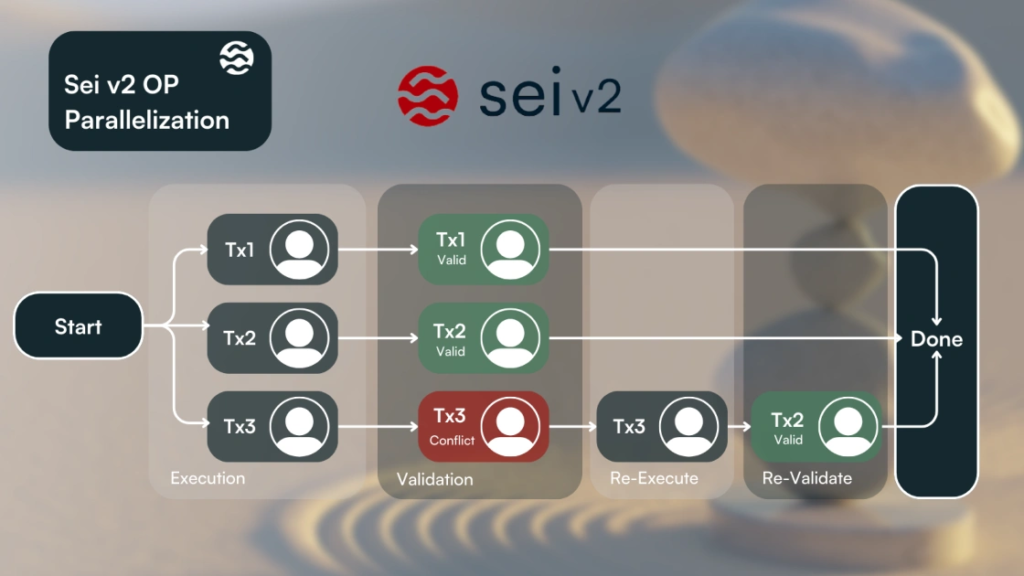
To deliver EVM compatibility, the team uses Geth—the most widely used client of the second-largest cryptocurrency—for transaction processing.
On performance, Sei V2 is set to provide throughput of 28,300 transactions per second, with 390 ms block times.
Sei V2 will introduce a SeiDB data structure to improve the platform’s data storage. According to the developers, it will prevent “state bloat” and simplify node synchronisation.
Monad
An EVM-compatible layer-1 blockchain with support for 10,000 TPS.
Monad uses the “optimistic” parallelization model. To prevent incorrect execution, the system employs static code analysis.
The platform runs a MonadBFT consensus algorithm.
According to its developers, Monad bridges the gap between decentralised and traditional platforms thanks to “superscalar pipelined execution and an optimised architecture”.
Neon EVM
The first “parallel” EVM on the Solana blockchain, combining high compatibility with considerable throughput.
According to the project website, sending or swapping tokens costs just $0.003. The blockchain can process more than 2,000 transactions per second.


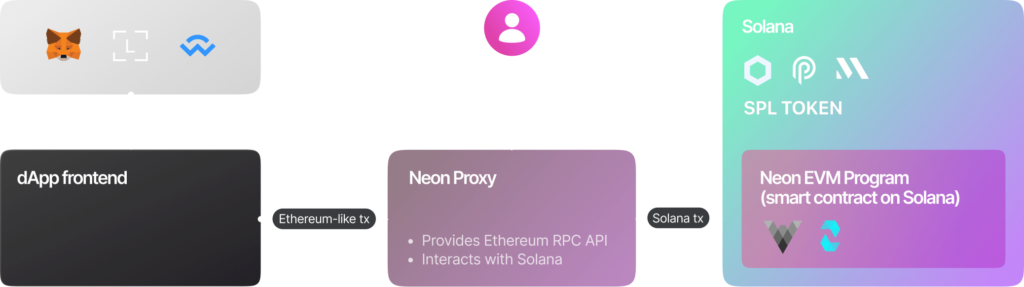
Which other projects support parallelization?
Beyond EVM-compatible efforts, other platforms also support parallelization.
Solana
The project is a pioneer of parallel transaction execution. The Solana team is building a scalable blockchain protocol for decentralised applications and smart contracts.
Co-founder Anatoly Yakovenko named parallelization as one of eight key features driving the chain’s high throughput.
At Solana’s core is the Sealevel virtual machine. It processes transactions in parallel, scaling horizontally across GPUs and SSDs.
Transactions declare in advance which state they will read and write during execution. Sealevel finds non-overlapping transactions in a block and schedules them.
“A parallel execution environment can process tens of thousands of smart contracts using all cores available to a validator. This saves significant time because each transaction is verified as quickly as possible,” Joel Agbo noted.
Sui
Sui is a high-performance layer-1 blockchain developed by Mysten Labs for latency-sensitive decentralised applications.
The Sui team leverages work from Diem, Meta’s abandoned blockchain project. A modified version of the Move language was used for coding.
Consensus employs the Narwhal and Bullshark protocols, which enable parallel computation and bring significant scalability.
Transaction handling depends on whether it touches a single-owner object (any type of asset) or a “shared object” (for example, public smart contracts).
The first type includes coin transfers, NFT issuance and voting. Such transactions are handled by a simplified Fast Pay procedure, based on Byzantine Consistent Broadcast.
This process does not seek consensus among validators, which greatly shortens processing time.
The developers claim the system can handle 10,000–290,000 TPS.
Aptos
The project pitches itself as a flexible platform, easily upgraded to meet a rapidly changing Web3 landscape. As stated in its white paper, Aptos brings a unique combination of consensus, a new smart-contract design, security, performance and decentralisation.
The developers say the platform can deliver 160,000 TPS. Latency from submission to execution is under one second. Much of this comes from its particular structure for parallel transaction execution.
Aptos uses an “optimistic” model in which unrelated operations are processed in parallel. The system can automatically detect related transactions after execution.
User, application and smart-contract interactions are handled by the Move VM, a challenger to the Ethereum Virtual Machine’s “monopoly”. According to the Pontem team developing Move, the Aptos VM could become a standard for integrating applications from Cosmos, Solana, Polkadot and even Ethereum.
The blockchain runs the AptosBFT consensus algorithm. Smart contracts are written in Move.