



Partisia Blockchain: what it is and how it works
In February 2024 the developers of Partisia Blockchain (PBC) launched an airdrop programme for 25m MPC tokens. Participation requires making transactions within the network’s ecosystem.
Here is what PBC is, which problems it aims to solve, and why the MPC token matters.
What is Partisia Blockchain?
PBC is a blockchain focused on user privacy. It combines zero-knowledge (ZK) proofs, multiparty computation (MPC) and zero-knowledge smart contracts (ZKSC).
MPC is the project’s token, which can be staked. Supply is capped at 1bn. The tokens are allocated as follows:
- 60% for private (35%) and public (25%) sales;
- 20% to the ecosystem pool: 10% to support node operations and 10% to incentivise strategic partners, developers and community growth;
- 15% to the PBC team with a four-year vesting;
- 5% as a ten-year reserve.
Users pay transaction fees in Ethereum, USDC and other assets by bridging them through the Bring Your Own Coin (BYOC) mechanism.
Who created Partisia Blockchain and when?
The blockchain is developed by the Partisia Blockchain Foundation, established in 2020 by Ivan Damgård, Jesper Buus Nielsen, Claudio Orlandi, Kurt Nielsen, Peter Frands Frandsen and Brian Gallagher.
All co-founders hail from Danish firms Sepior and Partisia. In 2008 the latter built the first commercial data-exchange platform for enterprises using ZK computation.
Sepior, a Partisia subsidiary, develops MPC crypto wallets. In July 2022 it was acquired by Blockdaemon.
PBC’s beta mainnet went live in December 2021. At the time of publication the network is in its fifth phase (delta mainnet). According to the roadmap, the sixth phase (epsilon mainnet) is slated for June 2025.
How does Partisia Blockchain work?
MPC underpins PBC to secure and privatise data storage and transmission.
The technology splits transaction processing across multiple parties. Individual nodes see only fragments of data and exchange computation results without revealing sensitive information.
This allows, for instance, patients to share health data anonymously and rival firms to exchange best practices while preserving trade secrets.
Partisia Blockchain uses the Eager FastTrack consensus algorithm.
“This is a new approach that eliminates the inefficiencies and limitations of the Byzantine Fault Tolerance (BFT) model. The latter waits for confirmation from ⅔ of nodes to reach consensus. This is a slow process that significantly affects scalability,” the team claims.
Under Eager FastTrack, transactions execute once they are signed. When nodes collect signatures from ⅔ of all validators, they record a Proof-of-Justification (PoJ) and move to the next block. PBC’s developers call this instant finality.
If the blockchain cannot reach consensus, the protocol falls back to full BFT and then restarts Eager FastTrack.
PBC implements sharding—splitting network load across multiple segments (shards). A coordinator shard delegates transaction verification to groups of nodes, which return computation results.
“A blockchain with three shards can process three times as many transactions as a network without this technology. Each shard in PBC has a throughput of 1,000 TPS, and new shards are created as needed,” the PBC developers note.
The blockchain provides privacy on demand via zero-knowledge proofs: ZK computations are added to the primary (transparent) chain as separate transactions to ensure full anonymity. This lets developers balance transparency and privacy.
“ZK computations are served by verified nodes in known jurisdictions and comply with data-protection rules such as the GDPR. Personal information never enters the transparent blockchain; it is stored only on ZK nodes in encrypted form,” project representatives say.
ZK is integrated into a special class of confidential smart contracts (ZKSC). These execute transactions under predefined conditions and return the results.
How to become a Partisia Blockchain validator
Token holders can earn staking rewards by running a PBC node. To do so, they must set up a dedicated server (VPS) and complete four steps:
- register as a candidate by filling out a special form;
- join the Discord channel and pass KYC/KYB procedures;
- request access to the validators’ channel and provide a Partisia Wallet address;
- configure the VPS.
There are three types of validators in Partisia Blockchain:
- Baker node — signs and produces blocks; minimum stake: 25,000 MPC;
- ZK node — performs ZK computations in addition to block production; minimum stake: 100,000 MPC;
- Cross-chain node (BYOC) — acts as an oracle, tracking deposits and withdrawals to and from other networks; minimum stake: 250,000 MPC.
Each network participant or organisation may run only one node.
What is BYOC?
Bring Your Own Coin (BYOC) is a bridge for moving assets from other blockchains into PBC. It requires a Partisia Wallet and an external wallet.
At the time of publication the bridge supports MetaMask as well as Ethereum (ETH), Polygon (MATIC), BNB (BNB), Tether (USDT) and USD Coin (USDC).
BYOC assets can be converted into gas to pay transaction fees. Network fees are fixed: the cost is pegged to the US dollar at 100,000 units of gas per $1. Prices for on-chain operations are defined in the yellow paper.
What is MOCCA?
MPC On-Chain Custody Advanced solution (MOCCA) is a cross-chain custody and asset-management system unveiled by the PBC team at the World Economic Forum in Davos in January 2024.
Its key features include configurable privacy, programmability via smart contracts and regulatory compliance. The solution secures BYOC assets on their native chains using MPC in Partisia Blockchain.
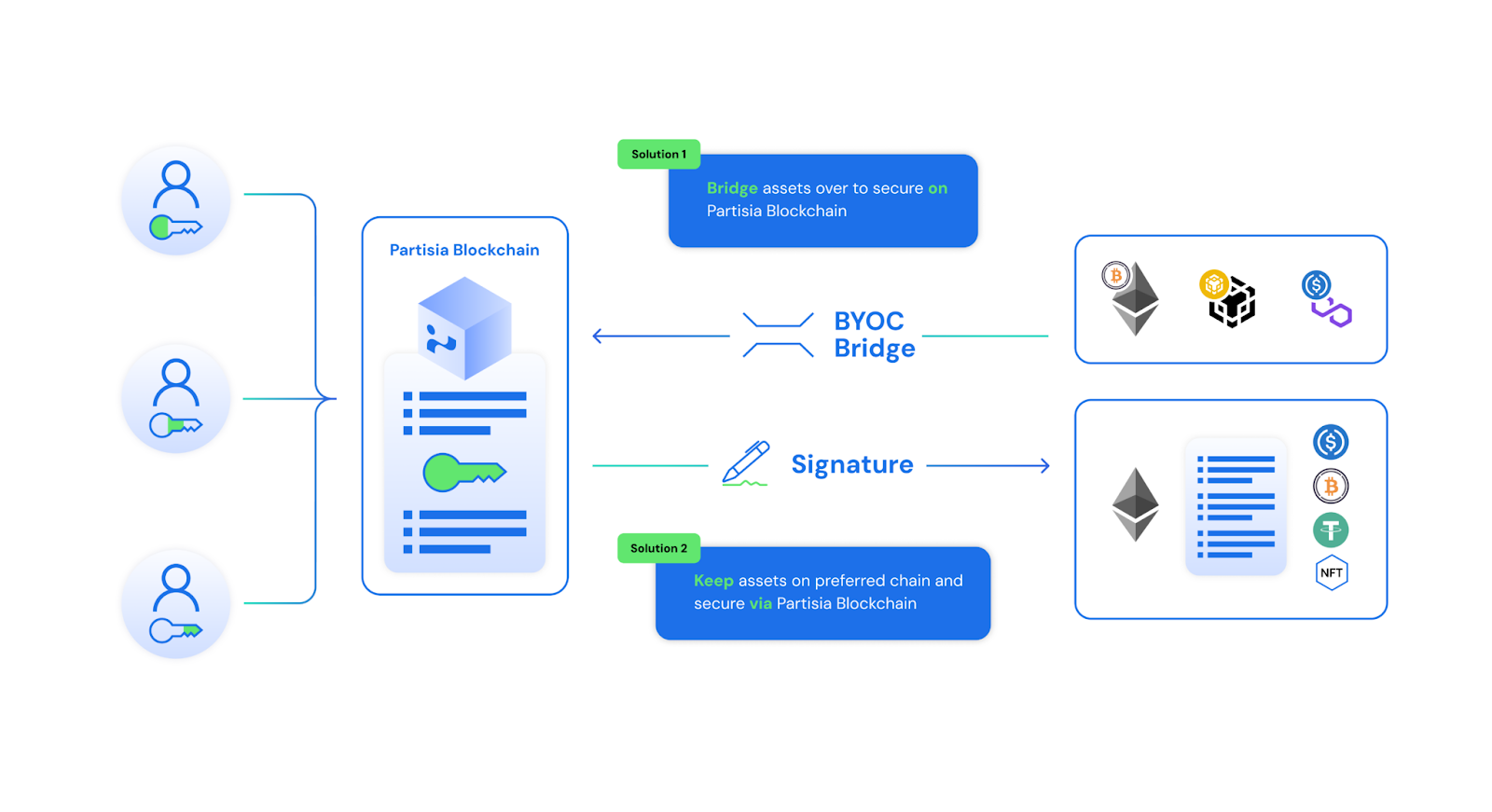
MOCCA smart contracts allow changes to threshold-signature schemes, integration of NFTs with special permissions, or setting conditions for specific transaction categories.
How to use Partisia Blockchain as an L2
PBC can serve as a second-layer solution for networks such as Ethereum and BNB Chain—for instance, to add privacy to voting via zero-knowledge proofs.
This involves deploying two smart contracts:
- a private contract on Partisia Blockchain that ensures only eligible users vote and tallies the results;
- a public contract on Ethereum that stores the participant list and performs final verification.
Users send votes directly to the ZKSC, which delegates computations to four ZK nodes and verifies participants.
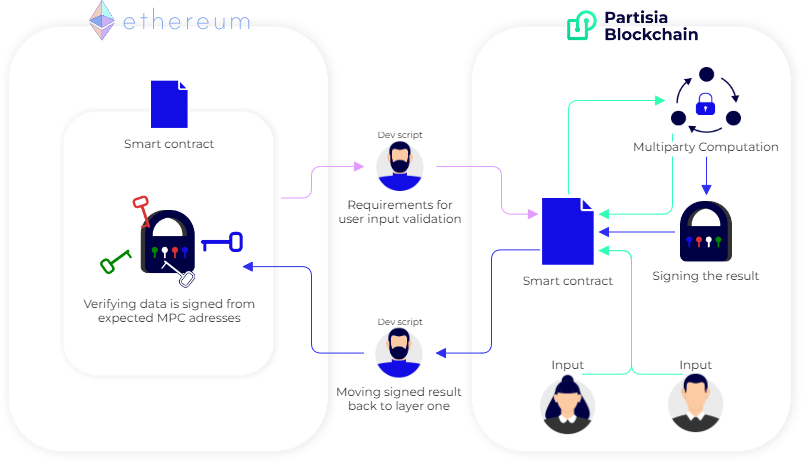
The ZK nodes produce a result that other nodes sign. It is relayed to Ethereum, where the contract verifies the signatures and publishes the final tally.
Рассылки ForkLog: держите руку на пульсе биткоин-индустрии!