



Ethereum’s scaling challenge has not gone away, but its developers are anything but idle.
Only recently the Dencun upgrade went live, dramatically cutting L2 fees. Now an equally ambitious update—Pectra—is in the works, aiming to make the system more flexible, efficient and user-friendly.
- Pectra combines the Prague and Electra upgrades, designed to expand wallet capabilities and make Ethereum more efficient.
- The major upgrade is pencilled in for the first quarter of 2025.
- Pectra will, among other things, bring smart-contract functionality to familiar wallets and let validators stake more than today’s 32 ETH limit—up to 2048 ETH.
What is Pectra?
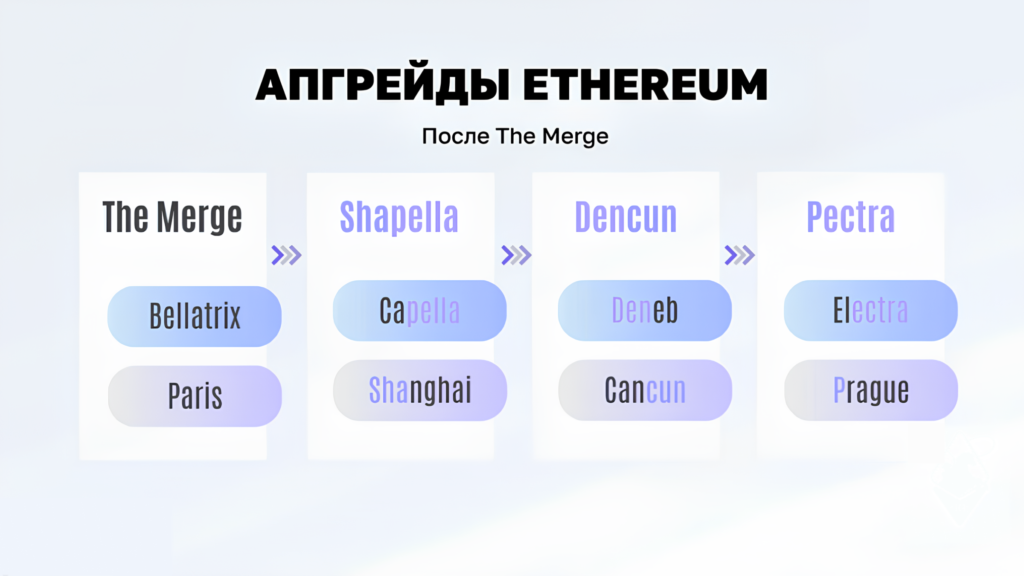
Pectra fuses two previously planned upgrades: Prague (for the execution layer) and Electra (for the consensus layer).


“The Pectra upgrade plays a key role in Ethereum’s evolution, and the developer community’s engagement raises the network’s capabilities to a higher level,” — noted CoinGecko analysts.
The scale of the effort is hinted at by a long list of EIPs slated for inclusion in the hard fork:


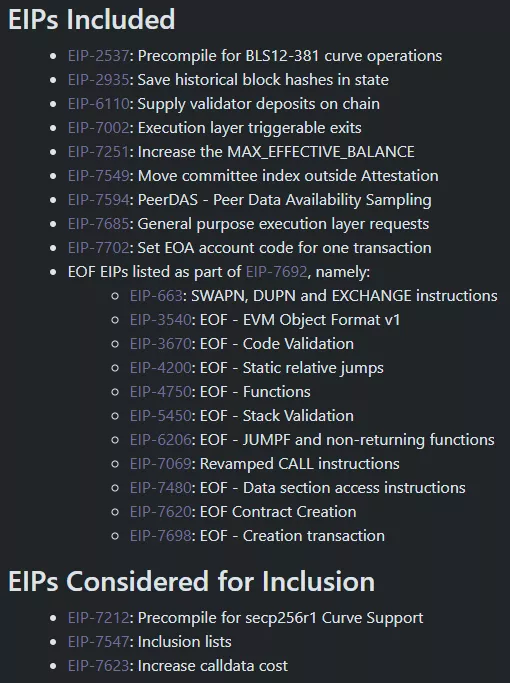
These EIPs include advances in account abstraction, significant changes to validator operations, and network-wide performance improvements.
Among the most notable proposals:
- EIP-2537 — introduces a precompile for operations on the BLS12-381 elliptic curve. This speeds up and cheapens BLS-signature operations, improving validator accessibility and performance and lowering gas costs;
- EIP-2935 — persists previous block hashes in dedicated storage slots to improve the efficiency and reliability of Ethereum data verification as the protocol moves toward statelessness;
- EIP-7002 — enables faster, more convenient withdrawal management for validators, widening the design space for staking and restaking;
- EIP-7251 — allows validators to stake more than the current 32 ETH cap—up to 2048 ETH. This lets node operators reduce the number of validators they run;
- EIP-7594 — introduces the PeerDAS (Peer Data Availability Sampling) protocol to optimise L2s, transaction processing and network scalability;
- EIP-7702 — adds a new transaction type that lets Ethereum account addresses act as smart-contract wallets for the duration of an operation, then revert to their original state;
- EIP-7692 — a bundle of 11 EIPs aimed at improving smart-contract deployment and execution, including gas-cost optimisations for specific operations.
“After the upgrade, Ethereum will be applied across a broader spectrum of use cases, meeting diverse user needs. Regular user accounts will become more programmable, L2s more accessible, smart contracts more efficient, and validators more flexible in management,” — said William M. Peaster of Bankless.
EIP-3074 vs EIP-7702
The benefits and pitfalls of EIP-3074
One of the central components of the forthcoming upgrade was initially expected to be EIP-3074, which would bring smart-contract functionality to standard crypto-wallets. In particular, it was envisaged that users could bundle transactions and sign them in a single step.
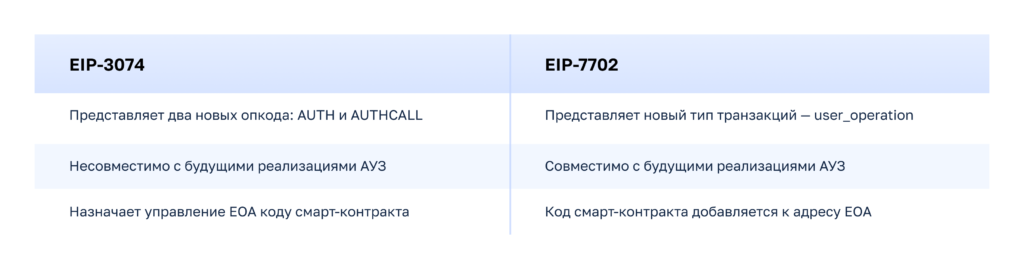
EIP-3074 presents the idea of “delegating control of EOAs to a smart contract”. Its main goals include:
- advancing the concept of sponsored transactions;
- improving user experience (UX) when using a regular Ethereum account (an address derived from a public/private key pair).
Sponsored transactions let the account that pays gas differ from the account that actually performs ERC-20 operations. For example, a DEX could fold the gas cost into its trading fee by paying on a user’s behalf. That would allow users to avoid holding ETH if they do not need it.
Put simply, the proposal would enable batching transfers to save time and money, and paying fees for other users.
EIP-3074 defines two new Ethereum opcodes:
- AUTH — specifies the address authorised to send a transaction on a user’s behalf;
- AUTHCALL — calls smart contracts at the specified address on a user’s behalf.
AUTH verifies the user’s signature and intended action, while AUTHCALL invokes the target contract with “the sender address as the caller”.
Ordinarily, users must manually sign a message each time they interact with a dapp (swapping or staking tokens). With EIP-3074, a single signature would suffice—AUTH and AUTHCALL would automatically handle subsequent steps.
Another innovation is recovery of lost keys. To use it, users grant ownership of their assets to an initiator contract via a digital signature; the contract then performs transactions and function calls on their behalf.
Despite advantages such as “social” recovery, advanced transactions and better UX, some community members criticised EIP-3074. For example, DeFi Llama developer 0xngmi called out the chief drawback: “now it’ll be possible to fully drain an address, all tokens, all NFTs, all DeFi positions with only one bad signature”.
downside of EIP 3074 is that now it’ll be possible to fully drain an address (all tokens, all nfts, all defi positions…) with only one bad signature
— 0xngmi (@0xngmi) April 11, 2024
Argent co-founder Itamar Lesuisse voiced a similar view.
It should allow a scammer to drain your entire wallet with a single offchain signature. I expect this will be a major use case…
— itamar.eth (@itamarl) April 11, 2024
Representatives of Safe voiced concern that the proposal lacks “a clear path to full account abstraction” and could hamper its adoption.
EIP-7702: Vitalik Buterin’s alternative
Seeking greater security, Ethereum co-founder Vitalik Buterin proposed a different tack. EIP-7702 introduces a new transaction type akin to EIP-2930, made compatible with EIP-3074’s mechanics by translating them into optimised code.
The improvement lets Ethereum account addresses act as smart-contract wallets for the duration of a transaction, after which they revert to their original state.
In Buterin’s design, AUTH and AUTHCALL are replaced with simpler EOA-linked verification and execution functions. This preserves operational integrity while streamlining authorisation.
According to the developer, this approach requires minimal changes to the network because EIP-3074 directly aligns with full account abstraction.
In addition, EIP-7702 allows EOAs to execute contract code temporarily, preserving compatibility with the current architecture.
The alternative was well received by the community, and it was soon decided to replace EIP-3074 with the new proposal. Polygon developer Jarrod Watts called it “one of the most impactful changes that is ever going to happen in Ethereum”.
Vitalik just proposed EIP-7702.
It’s one of the most impactful changes Ethereum is going to have… EVER.
So, here’s everything you need to know about how it works and how we got here:
— Jarrod Watts (@jarrodWattsDev) May 8, 2024
He added that once the new functionality is implemented, “your existing EOA will be able to execute any smart-contract code”.
The specialist also outlined the main drawbacks of EIP-3074, including the risk of an attacker gaining control over all of a user’s funds.
“EIP-7702 is a more sophisticated version of EIP-3074, more compatible with account abstraction (ERC-4337). Thus, it is a compromise between ERC-4337 and EIP-3074,” — explained CoinGecko analysts.
The table below shows the key differences between EIP-3074 and EIP-7702:


EIP-7251
The success of The Merge, rising prices and ecosystem growth have swelled the ranks of validators securing consensus. Their total count is nearing 1.5 million, and the combined value of staked ETH exceeds $140 billion.
While the abundance of validators has strengthened security, some researchers worry that such growth could affect network stability.


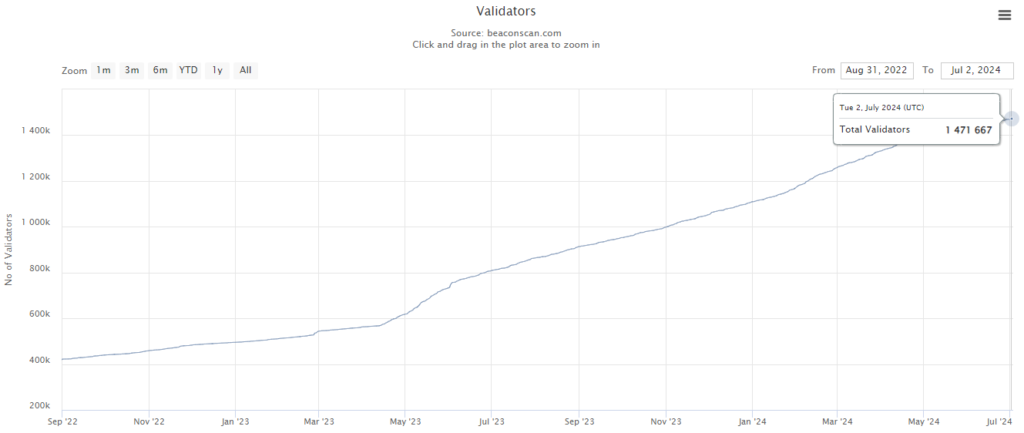
EIP-7251 (also MaxEB, MAX_EFFECTIVE_BALANCE) addresses “validator sprawl”. It proposes increasing the maximum stake from 32 ETH to 2048 ETH (with the 32 ETH minimum preserved).
“This allows large node operators to consolidate their validator sets to reduce overall validator count. It also enables solo stakers to earn more and provides flexibility for deposits,” — explains Ethereum.org.
For example, a large operator with 2048 ETH can combine 64 validator sets into one. An individual staker with 45 ETH could manage a single set, the Unchained project notes.
Thus, EIP-7251 aims to cut the number of validators while preserving Ethereum’s high economic security. Other features include:
- large operators can merge validator sets without exiting and re-entering the protocol;
- partial withdrawals at the execution layer—for instance, a validator with 200 ETH can withdraw 50 ETH without fully exiting;
- a configurable effective-balance cap: operators can set the maximum that triggers partial withdrawals.
Pros and cons
Advantages of the proposal:
- consensus-layer relief: fewer validators reduce network load and latency;
- prepares for future upgrades such as single-slot finality and PBS (proposer-builder separation), which limits validator powers in block formation and introduces specialised builders who order transactions;
- greater flexibility for solo staking;
- fewer validators, boosting efficiency and cutting operational costs.
Arguments against:
- raising the maximum stake increases the risk of slashing (which rises linearly with the amount staked);
- some in the community worry about centralisation risks and a potential “51% attack”.
In short, EIP-7251 would significantly reduce validator counts without radical changes to the network of the second-largest cryptocurrency. Even so, the community must weigh the trade-offs carefully to avoid unintended consequences.
What comes after Pectra?
Nothing is final yet, but the Ethereum community is considering introducing Verkle trees in the Osaka upgrade that will follow Pectra.
“I’m very excited about Verkle trees. They will allow validator clients to operate in a stateless mode. This will let staking nodes run while using almost no hard disk space and synchronise [with the blockchain] almost instantly,” — said Vitalik Buterin.

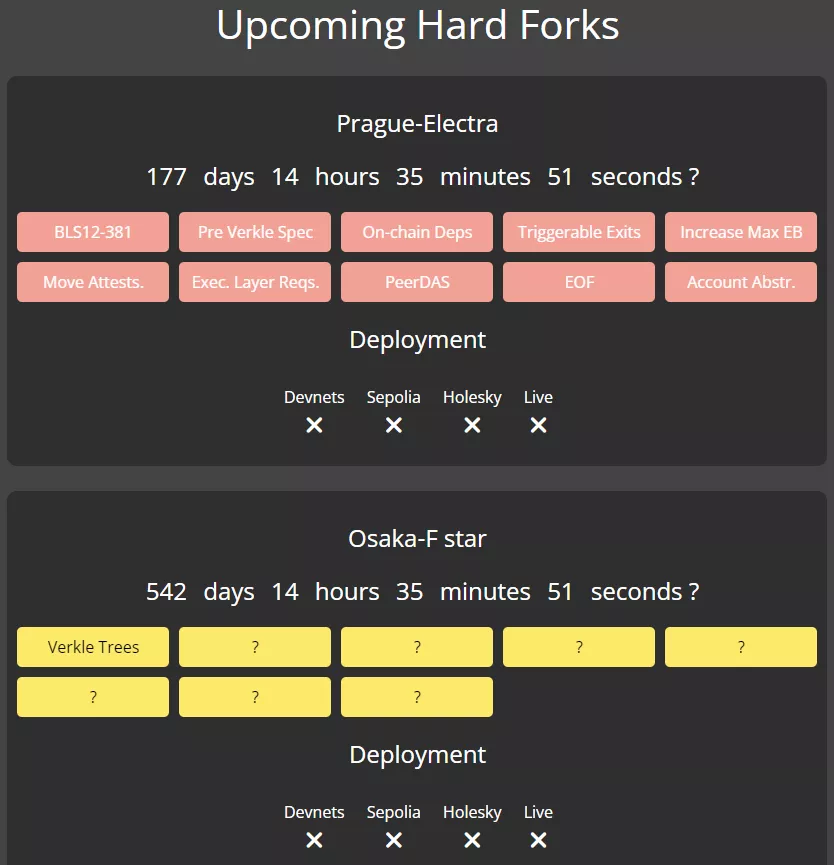
Verkle trees are a data-structuring algorithm akin to Merkle trees. The key difference is that each node uses a special hash type called a vector commitment to commit to its children.
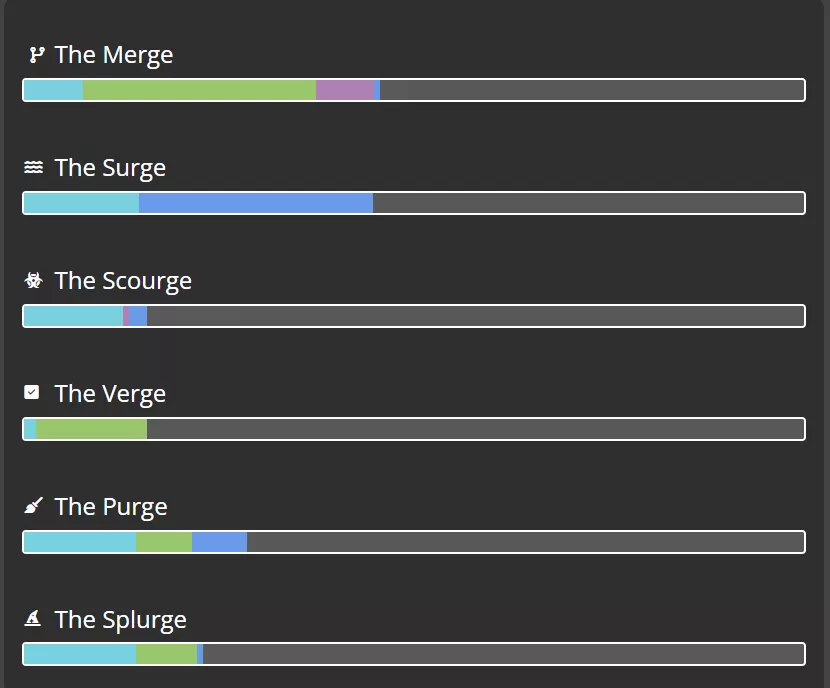
Integrating this data structure sits on Ethereum’s roadmap. Verkle trees are planned for the third phase, The Verge.


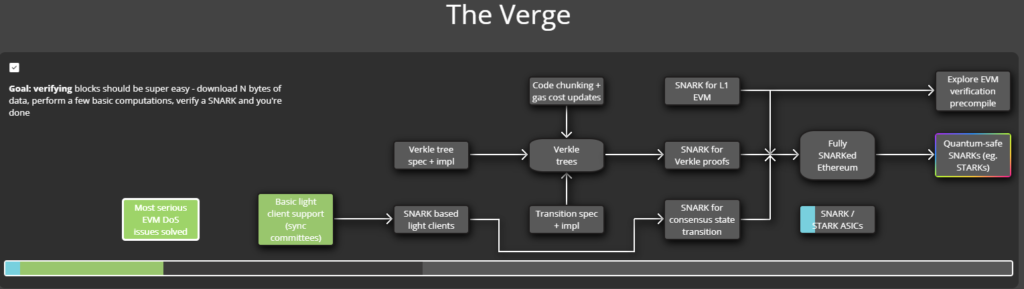
The scheme optimises on-chain storage and node size. Buterin calls its key property “much more size-efficient proofs”, as the mechanism allows verification of any block using only the data contained within it.
This verification model sharply lowers the technical requirements for validators, which should, over time, increase node diversity and deepen decentralisation.
The Ethereum co-founder added that the upgrade will also improve the experience for solo stakers by refining user interfaces and adding new client-side features.
The phase after The Verge is The Purge. It is intended to simplify the network and reduce node load.

At its core is EIP-6780, introduced during the Dencun hard fork. It streamlines the SELFDESTRUCT opcode, improving security and protocol implementation, and making it easier to build client applications.


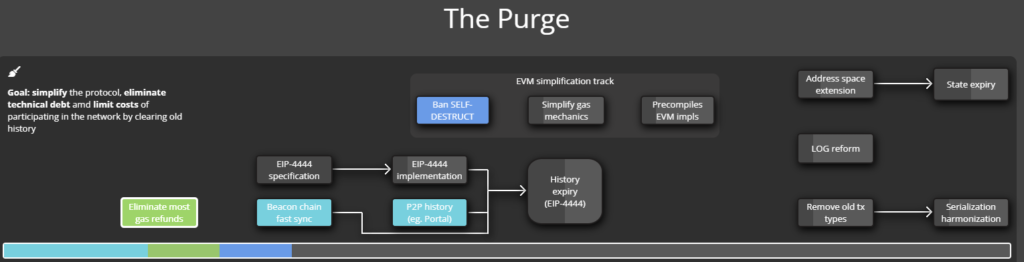
Buterin also pointed to other “cleanup” initiatives within The Purge, including removing code from the Geth client and eliminating “empty accounts” via EIP-7523.
He further suggested using precompiles for complex cryptographic functions that cannot be implemented efficiently in the EVM.
EIP-4444 aims to reduce storage footprint and node sync times. Buterin stressed that this change will significantly increase the number of people willing to run their own node.
There are also plans to migrate the execution layer to the more efficient SimpleSerialize (SSZ) format, simplifying application development and improving the blockchain’s overall structure.
Conclusions
The Ethereum ecosystem keeps evolving. It consistently leads by TVL, while its native cryptocurrency remains the second-largest by market capitalisation.
The next two Ethereum upgrades promise to make the network markedly easier to use for both users and developers. The platform will become more versatile, able to meet a wider range of needs.
Vitalik Buterin is convinced that the next five years will be “crucial” for ether’s mass adoption in the “real world”. The coming upgrades should help Ethereum meet growing demand, interoperate with other networks and roll out new features—keeping the platform at the cutting edge of blockchain innovation.