



Large crypto exchanges typically support around 30 financial products: OTC-trades, Polkadot parachain auctions, Ethereum staking and others. Yet most traders do not use them.
Pexpay — a platform with a basic toolkit that offers newcomers an easy entry into the crypto industry, and for professionals — Binance liquidity and low taker fees.
We explain how to start trading cryptocurrency using Pexpay as an example. At the end of the piece — a concise overview of features for professional traders.
Registration and KYC
To register on Pexpay you need to provide an email address and a password, and then enter the verification code from the received email.
The next step is to enable two-factor authentication (2FA) via Google Authenticator or SMS. After this you will have access to trading on the spot and futures markets.


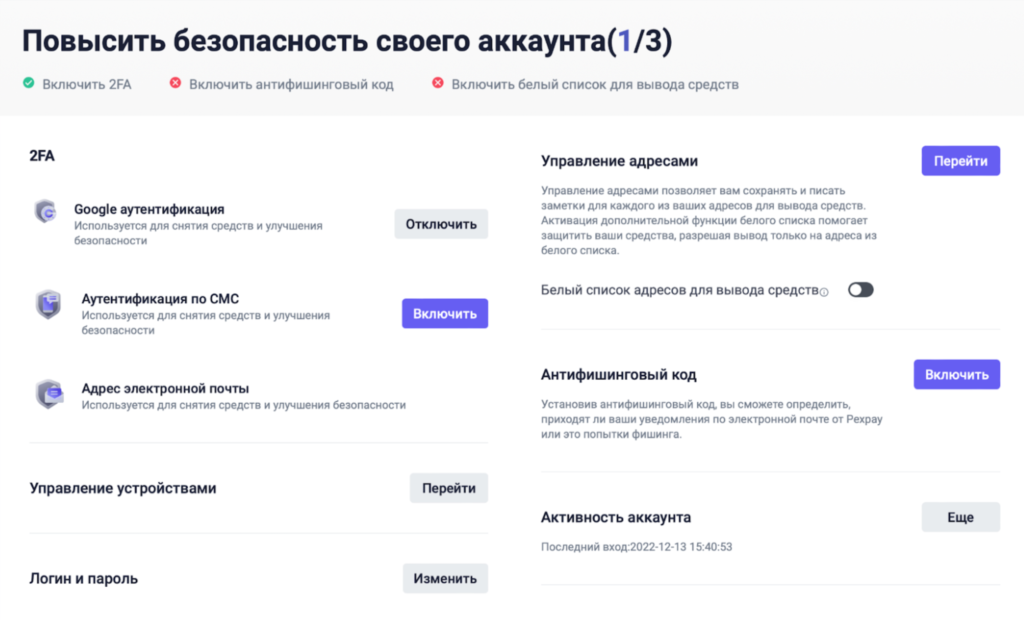
For better account protection you can create a whitelist of withdrawal addresses, add an anti-phishing code to all Pexpay emails, and specify devices from which login to the platform is allowed.
Buying USDT on the P2P Market
P2P market — a platform for peer-to-peer trading. Users post buy or sell orders for assets, and the platform monitors participants’ fairness.
Such trades are safer than dealing with exchangers and do not fall under the ban on cryptocurrency operations, introduced by the National Bank of Ukraine.
On the P2P market you can buy tokens for further trading, withdraw profits to a card, and earn from arbitrage — profit from price differences of a single asset across different venues. For example, if a user buys 1000 USDT at a rate of 37.98 hryvnias on Bybit, and then sells them at a rate of 39.6 on Pexpay, they would earn 1710 hryvnias.
To access the P2P market on Pexpay you need to pass KYC — identity verification designed to counter money laundering. The platform uses services from a specialised provider and does not store users’ personal data.
Pexpay charges no fees for P2P trades and supports cards from most local banks: SberBank, Tinkoff, monobank, PrivatBank, ForteBank, Ziraat and others.
Users can buy Bitcoin (BTC), Ethereum (ETH), Tether (USDT) and other popular assets for 50 national currencies, including US dollars (USD), euros (EUR), rubles (RUB), hryvnias (UAH), tenge (KZT) and Turkish lira (TRY).


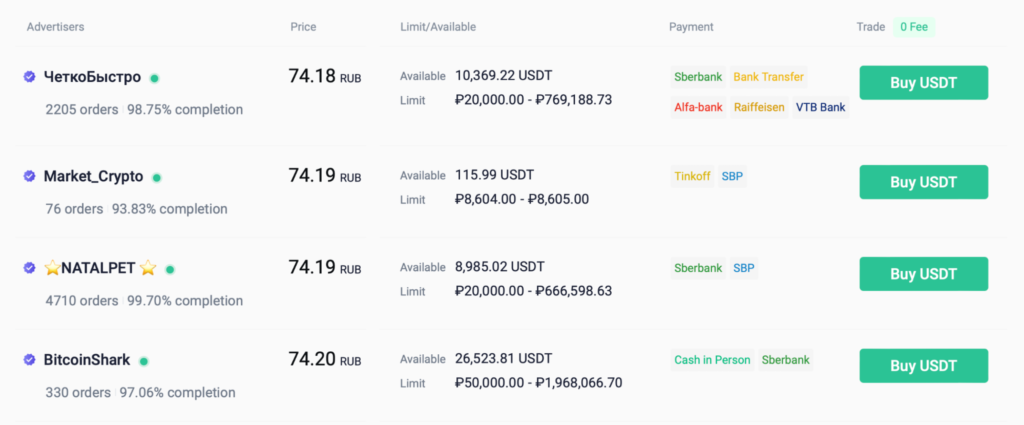
If the desired asset is not on the P2P market, you can buy Tether and then swap it on the spot market or via a conversion.
We bought Tether for hryvnias using a bank card: we selected the token and payment currency, chose a seller by their limit and payment method, and pressed the “Buy” button.


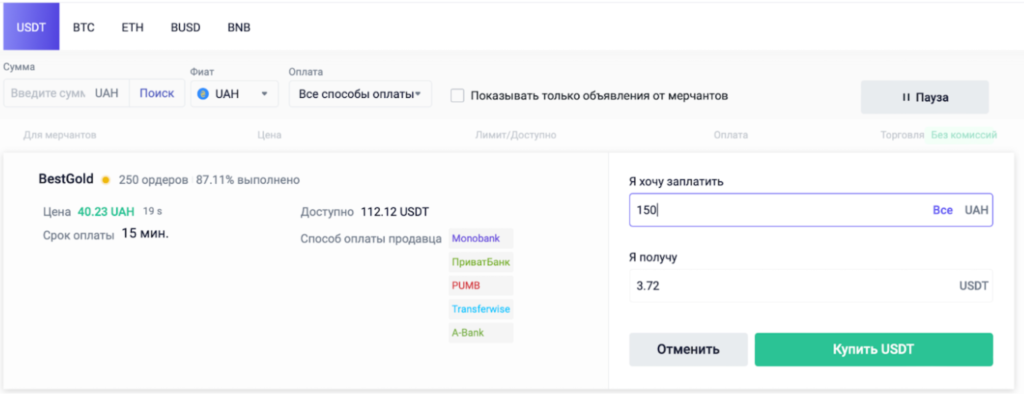
In the opening window we entered the amount and confirmed the creation of the order. We chose a payment method, sent the funds to the seller’s details and confirmed our actions.
Attention: the button “Pay for order” must be pressed after transferring funds to the seller.


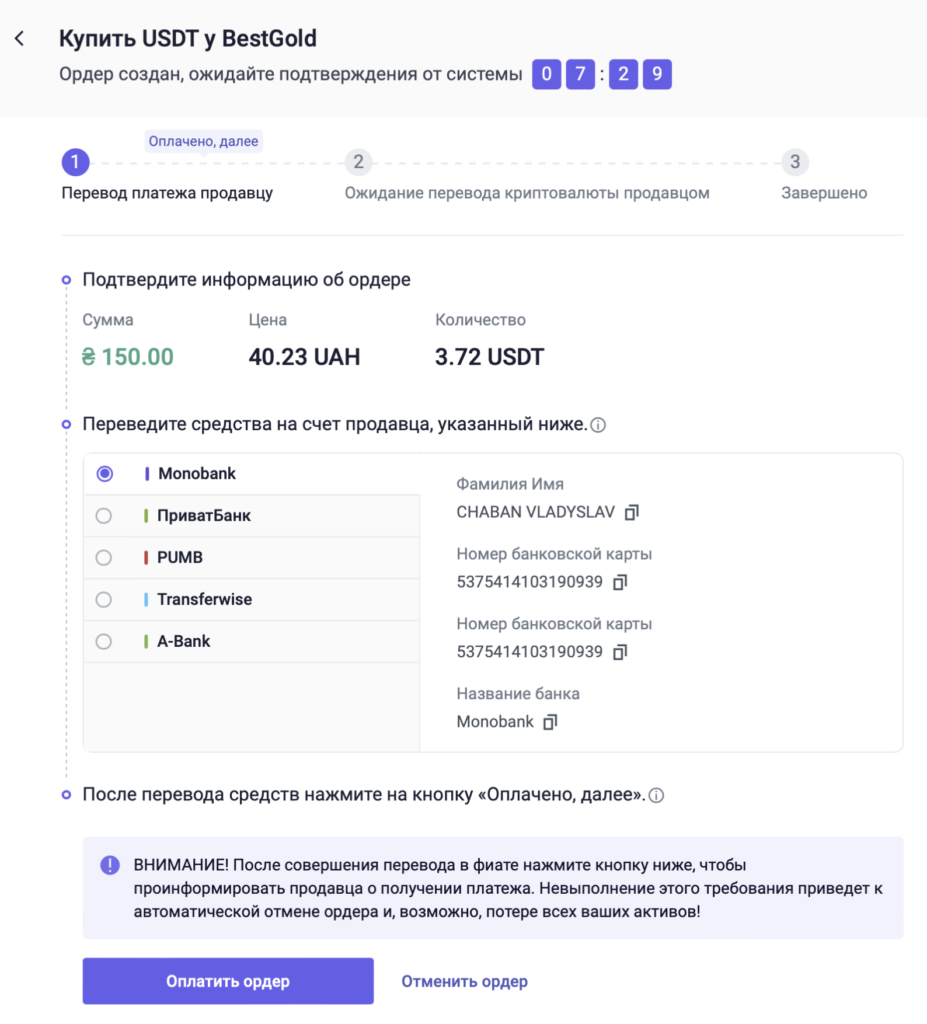
The seller has 30 minutes to send the cryptocurrency to the buyer’s account, but we received USDT in 10 minutes.
Asset Conversions and Deposits
Token conversion — swapping one asset for another at the market rate at the time of the deal. With this tool you can quickly obtain cryptocurrencies not listed on the P2P market.
We swapped part of Tether for ApeCoin (APE): we went to the conversion page, chose the assets and pressed the “Preview” button. When the platform calculated quotes, we confirmed the swap.


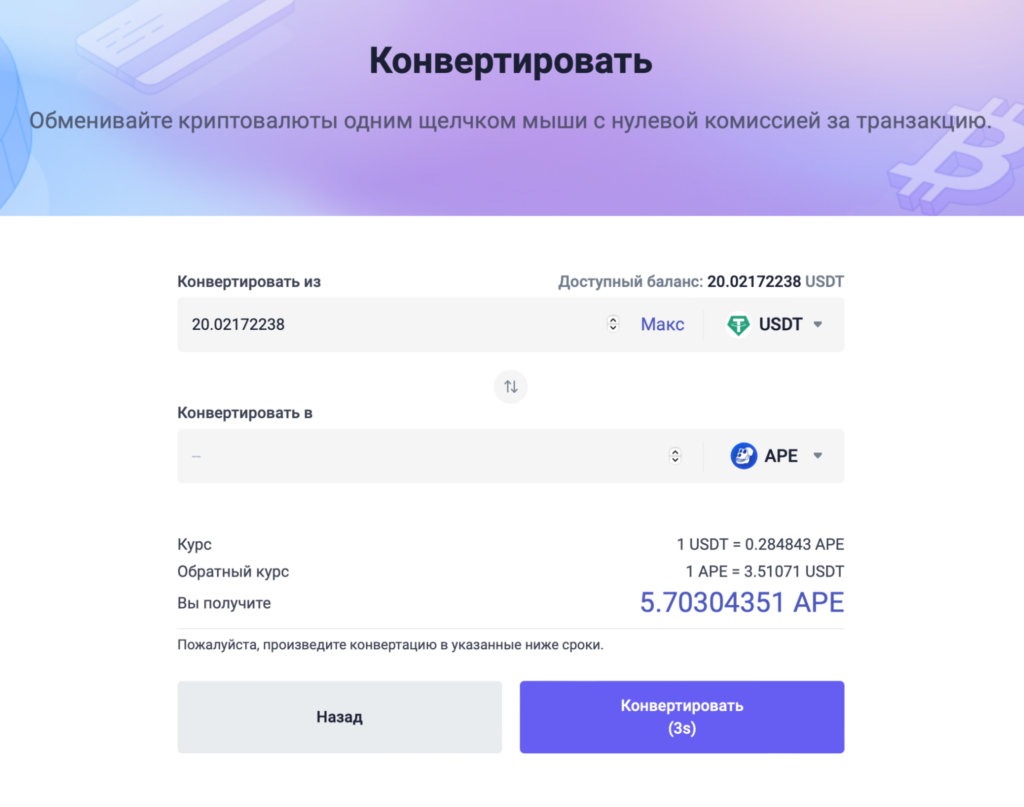
The received tokens can be deposited to a savings account. On Pexpay there are deposits with daily interest accrual for 140 digital assets:
- cryptocurrencies — native tokens of protocols needed to pay transaction fees and distributes rewards. Examples: Bitcoin (BTC), Solana (SOL), Kava (KAVA);
- stablecoins — tokens with stable value pegged to fiat currencies. Examples: Tether (USDT), Binance USD (BUSD), USD Coin (USDC);
- project tokens — assets issued by dapps or other blockchain-based solutions. Examples: Axie Infinity (AXS), PancakeSwap (CAKE), Santos FC Fan Token (SANTOS).


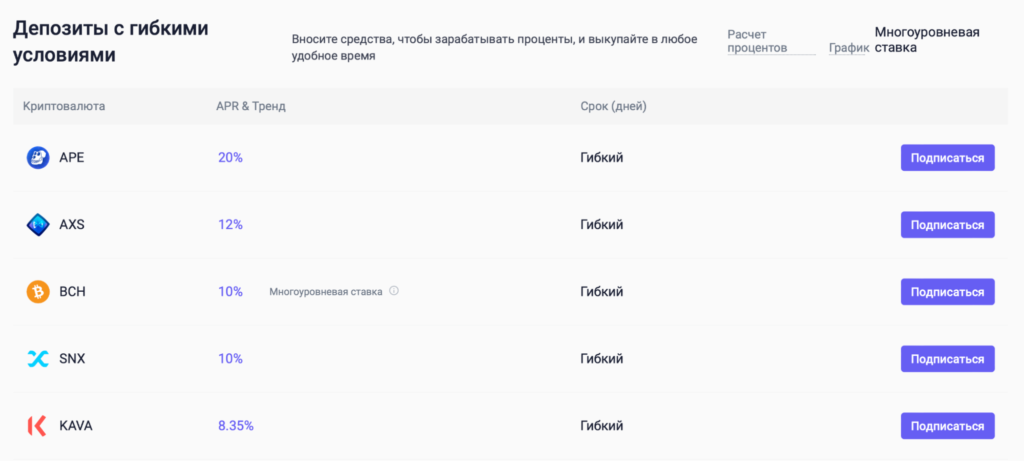
We deposited 5.7 APE ($20 at the time of writing) into a deposit at 20% APY: we found the token in the list, clicked “Subscribe”, entered the investment amount and confirmed the operation.


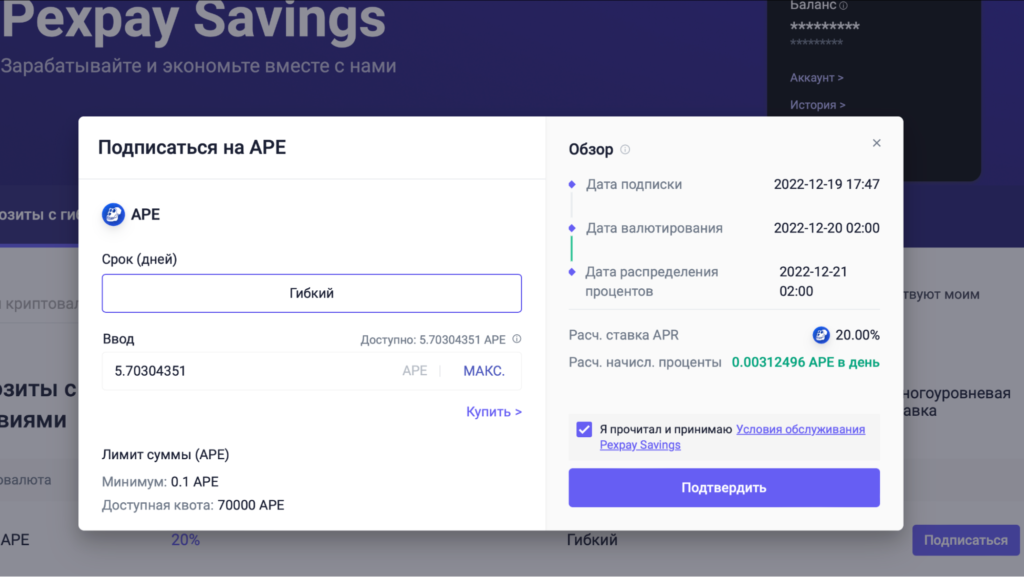
In two days we earned 0.003 APE ($0.012). After that we closed the deposit and swapped the tokens for Tether.
Spot Trading
Spot trading is conducted via an order book — a table of buy and sell orders. Bought tokens can be withdrawn to external wallets.
On Pexpay there are more than 100 spot pairs against Tether and Binance USD, with the BTC/USDT pair carrying no trading fees.
The platform deepens market depth through orders placed on Binance. This approach reduces the likelihood of manipulation and helps users obtain fair execution prices.
Before placing an order you must transfer funds from the general wallet to the spot account. After that you can trade on the spot trading page, which contains:
- in the center — price chart of the selected pair and a menu to create orders;
- in the top right corner — the list of all trading pairs;
- in the bottom right corner — the trade history for the selected pair;
- on the left — the order book;
- at the bottom of the page — the orders management menu and view of trade history.


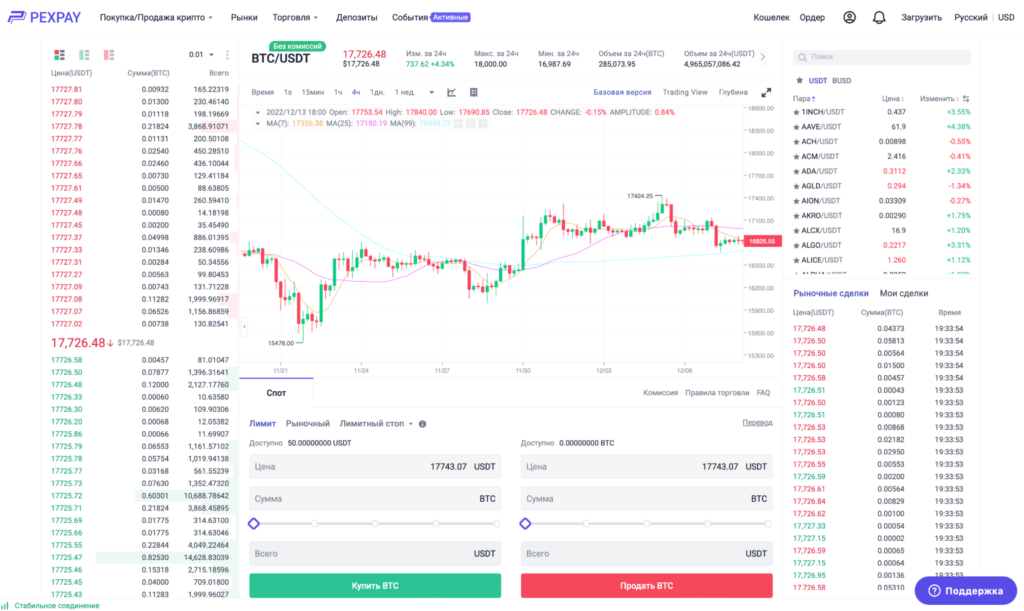
Traders on Pexpay have access to three order types:
- market — an order that is executed immediately at the price of the nearest limit order;
- limit — an order that is added to the order book and is executed when another user buys or sells the asset at the specified price;
- stop — an order that is executed or added to the order book when the asset’s price reaches the specified level.


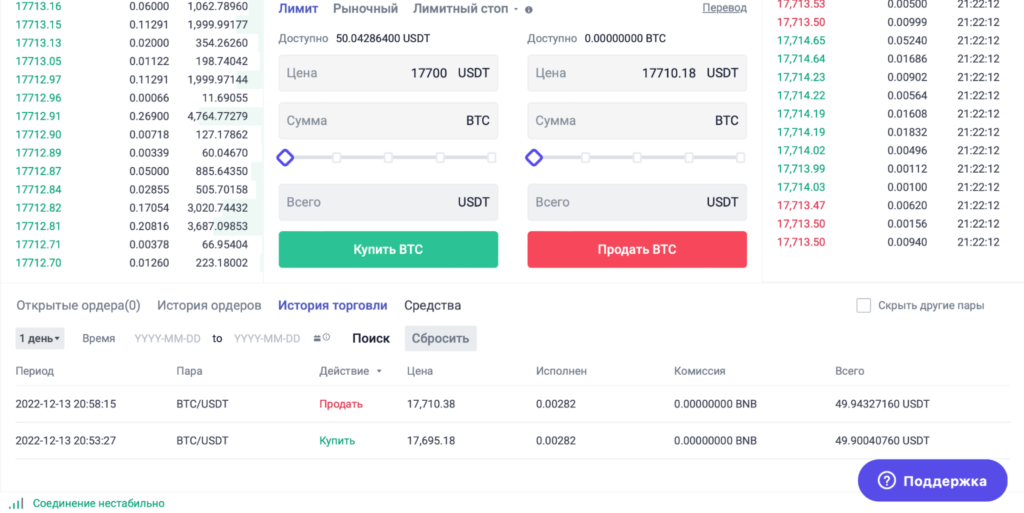
We bought Bitcoin at $17,695 for 50 USDT, and then sold it at $17,710. The price difference was 0.08% — we earned 0.04 USDT.
Futures Trading
Futures contracts — a derivative instrument that allows earning on rising and falling prices of an asset.
In this case, traders do not exchange tokens; they enter into contracts to close the position with a reverse operation — they commit to sell or buy back futures.
They realise profit or loss from the difference between opening and closing prices. For example, a trader would profit if they sold BTCUSDT at $18,000 and bought back at $16,000.
Futures trading can use leverage — a tool that allows you to trade with more capital than you hold in your account. However there is a risk of liquidation — forced closure of a position if losses exceed the value of the collateral.
For example, with 25x leverage a trader would receive 200% of the deposited margin if the asset price rises by 8%. Liquidation would occur with a 4% drop in quotes.
The page futures trading on PexPay contains:
- left — contract menu and price chart;
- center — order book and trade history of other traders;
- right — order creation menu, leverage size and margin mode.


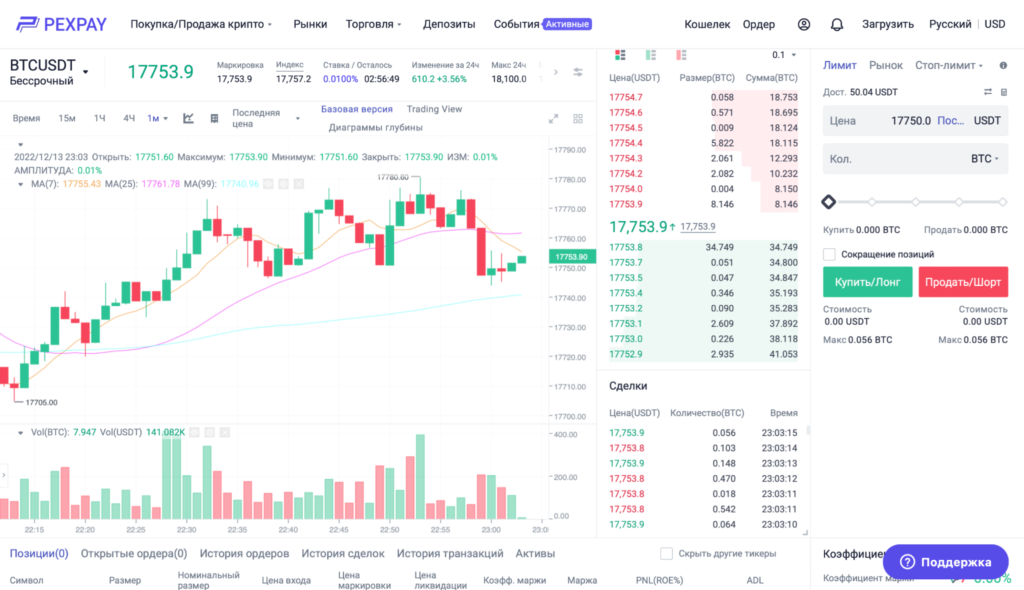
We bought 10 LINKUSDT contracts at $6.52 with 20x leverage: for a position worth $65.2 we posted a margin of $3.26.
To close the trade when the price rises, we placed a limit order to sell the same number of contracts at $6.685.


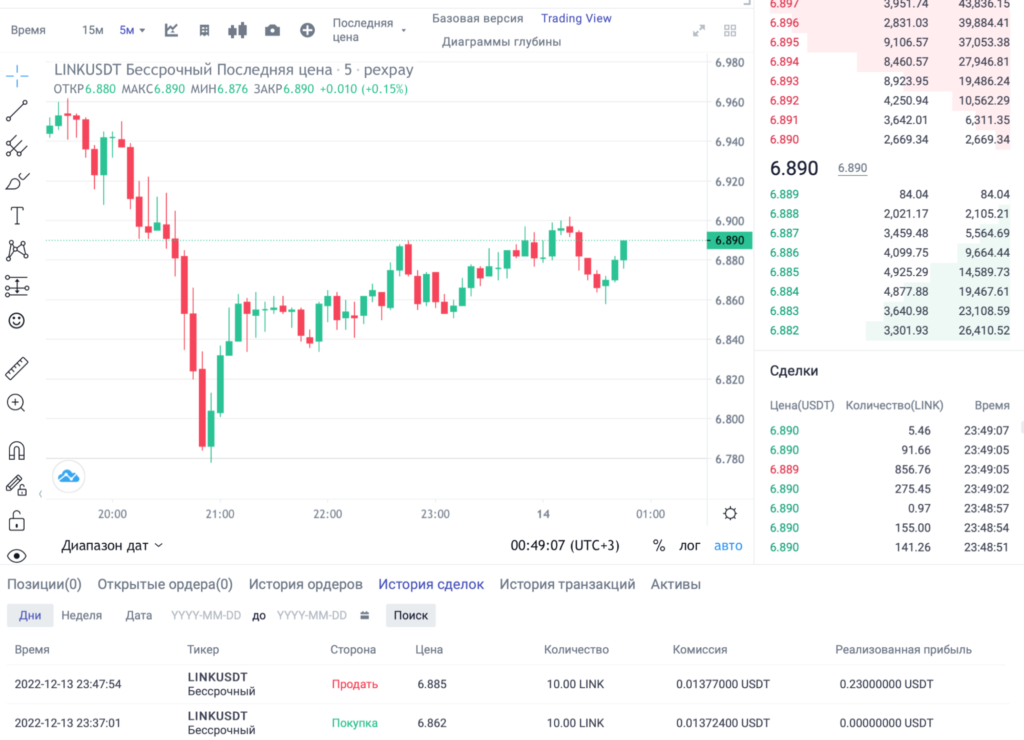
Within a few minutes the LINK/USDT price reached the limit order — we earned 0.23 USDT.
Withdrawing to a Bank Card
Pexpay users can convert cryptocurrencies to fiat only via P2P deals. To do this you need to attach a card: go to your account, click the “Add payment method” button and enter the details in the pop-up window.
We exchanged Tether for hryvnias: we went to the Sell crypto, chose a buyer and created an order for 53.51 USDT.
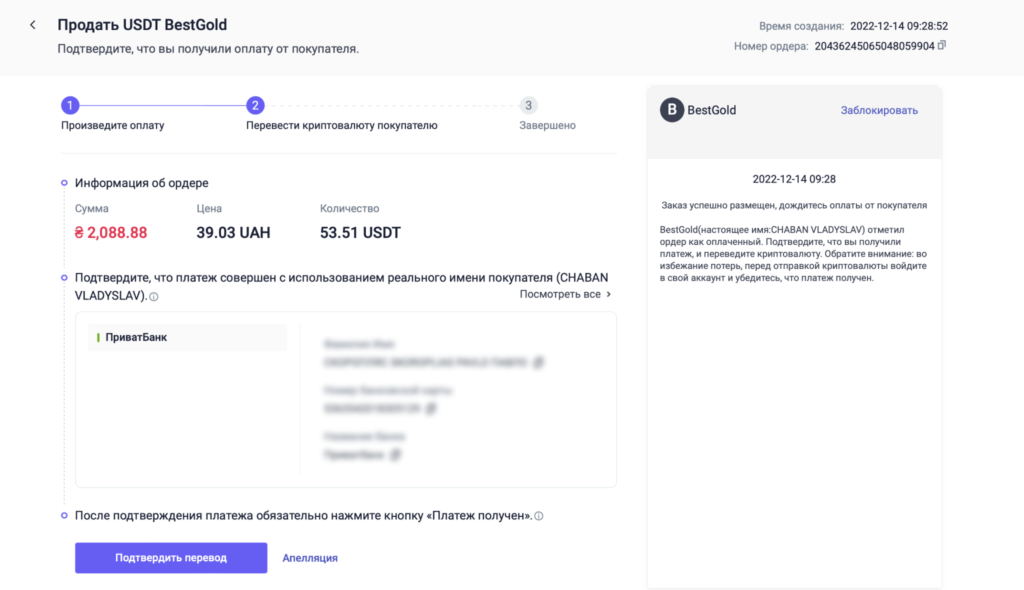
After that we waited for the funds to arrive on the card and confirmed the transfer of tokens to the buyer’s address. The procedure took no more than 10 minutes.
Pexpay for Professional Traders
P2P traders work with cards from the major banks of Eastern Europe: SberBank, Tinkoff, monobank, PrivatBank and others. The minimum exchange amount is $3.
The platform charges no fees for conversions and P2P trades. Fees for makers and takers on the spot market are:
- BTC/USDT — 0% / 0%;
- pairs with BUSD — 0% / 0.075%;
- other pairs with USDT — 0.075% / 0.075%.
For futures trading Pexpay charges 0.02% of the trade value.
The platform offers a 25% discount on spot and 10% on futures when paying fees in BNB.
Conclusions
Pexpay — a crypto exchange with a basic toolkit that is suitable for learning trading and for professional trading.
Newcomers can trade on the P2P market, convert tokens and open deposits in a few clicks.
Professionals gain Binance liquidity and fees, without being distracted by a dozen products for whales and long‑term investors.
Read ForkLog’s bitcoin news on our Telegram — cryptocurrency news, prices and analysis.