



Phemex started in 2019 as a derivatives exchange. Six years later, it trades 600+ crypto assets, tokenised stocks of Apple and Tesla, gold and silver futures, and serves over 10 million users.
The platform combines a low-latency architecture — including a matching engine capable of processing up to 300,000 transactions per second — with a product stack spanning derivatives, spot trading, automated trading bots, and yield products offering up to 15% APY, with maker fees starting at 0.01% on derivatives.
According to SimilarWeb data for January 2026, Russia is a leading source of traffic to Phemex. This review examines the platform’s product architecture, cross-asset expansion strategy, security track record — including its response to an $85 million incident — and its positioning within the broader shift toward tokenisation, 24/7 markets, and infrastructure convergence between traditional finance and crypto.
Who’s Behind Phemex
Phemex launched on November 25, 2019. Since 2023, the exchange has been led by CEO Federico Variola, who previously oversaw business development and strategic expansion at the company. Under Variola, Phemex pivoted from a pure derivatives venue to a multi-asset platform: TradFi futures, tokenised stocks, and AI tools for trading — all layered on the same infrastructure.
As of November 2025, Phemex has 10 million registered users — 66% more than a year earlier. Most of the traffic comes from Eastern Europe, Latin America, and Southeast Asia.
From a regulatory standpoint, Phemex maintains an MSB registration with FinCEN and holds a VASP license in Lithuania, supporting international operations. At the same time, the platform continues to expand its product and infrastructure capabilities.
Infrastructure and Performance
The matching engine processes up to 300,000 transactions per second (TPS), responds to orders in under a millisecond, and executes them within 5–10 ms. The exchange reports 99.999% uptime in 2025 — less than five minutes of downtime over 12 months.
In 2026, Phemex upgraded its futures trading engine. Throughput increased from about 25,000 to 40,000 transactions per second — a 60% jump. Funding rate settlement time dropped from roughly 10 seconds to 500 milliseconds. Batch operations, including mass order cancellations, were also accelerated.
The team also redesigned the architecture. High-risk operations were separated from the core matching flow. A multi-node trigger system replaced the previous single point of failure. As a result, CPU load fell by half and memory usage declined by about one third.
For traders, this matters during periods of high volatility. When sharp market moves cause smaller exchanges to slow down or freeze, Phemex retains enough performance headroom to continue processing and executing orders.
Phemex also introduced Retail Price Improvement (RPI) — a special order type for retail traders. RPI orders match only against other active trader orders, not algorithmic or API-driven flow. The exchange claims this increases liquidity depth within 1% of the mid-price by up to 50% and keeps spreads within a single tick. For a retail user placing a larger order, that can mean less slippage.
On February 19, 2026, Phemex announced its AI-Native Revolution — a push to embed machine learning into risk management, product development, and the trading engine itself.
Phemex Among Competitors
According to CoinGecko data for February 2026, Phemex’s daily spot volume is approximately $425 million, with derivatives volume at roughly $1.57 billion and open interest at $2.97 billion. CoinMarketCap reports a higher spot volume of $543 million. The discrepancy is due to differences in methodology.
The exchange ranks 15th–20th among centralised platforms by spot volume. According to DeFiLlama, reserves are estimated at approximately $360 million.
| Metric | Binance | Bybit | OKX | Phemex |
|---|---|---|---|---|
| Spot maker/taker | 0.10% / 0.10% | 0.10% / 0.10% | 0.08% / 0.10% | 0.10% / 0.10% |
| Futures maker/taker | 0.02% / 0.05% | 0.02% / 0.055% | 0.02% / 0.05% | 0.01% / 0.06% |
| Spot coins | 442 | 475 | 293 | 600+ |
| Max leverage | 125x | 125x | 100x | 100x |
| Pre-market futures | Yes | Yes | Yes | Yes |
| Copy trading | Yes | Yes | Yes | Yes |
| Proof-of-Reserves | Yes (Merkle) | Yes (Merkle) | Yes (zk-STARK) | Yes (Merkle) |
| Users | 300M | 60M | 50M | 10M |
Phemex offers the lowest futures maker fee among major exchanges — 0.01% versus the standard 0.02% at Binance, Bybit, and OKX. The taker fee, however, is above average at 0.06%.
In terms of features, Phemex matches the largest platforms: pre-market futures, copy trading, and full Proof-of-Reserves verified through a Merkle tree. The exchange lists 600 spot coins — more than Binance, Bybit, or OKX — but trails competitors on maximum leverage (100x versus 125x).
Phemex Trading Products: Derivatives, TradFi, and On-Chain
Perpetual futures — contracts with no expiration date — form the core of Phemex’s ecosystem. The exchange offers several types of derivatives:
- USDT-M — USDT/USDC-margined;
- COIN-M — crypto-margined (BTC, ETH);
- TradFi — perpetual contracts on stocks and metals (launched February 2026);
- Pre-Market — trading tokens before their spot listing;
- On-chain derivatives — futures on meme coins with up to 3x leverage.
Maximum leverage reaches 100x on major crypto pairs and TradFi instruments, up to 50x on altcoins, and 5x for spot margin trading. Both isolated and cross-margin modes are supported, along with a multi-asset mode where liquid staking tokens serve as collateral.
TradFi Futures on Phemex
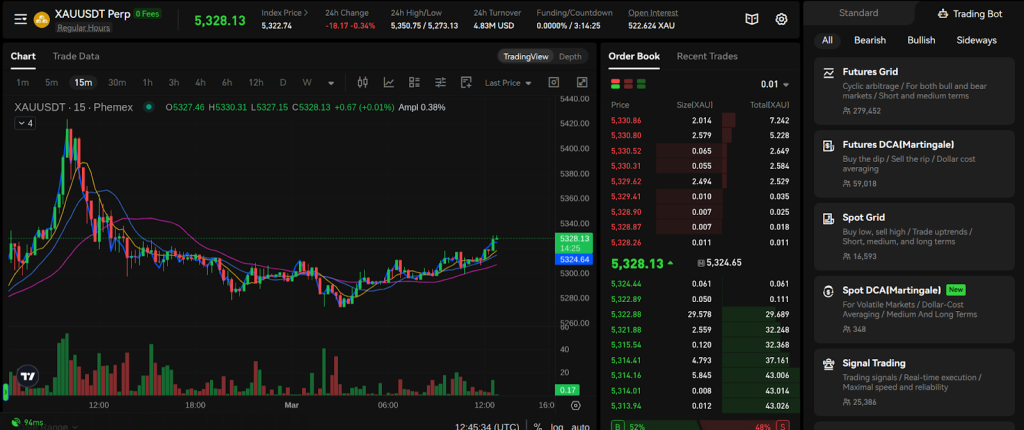
On February 6, 2026, Phemex launched perpetual contracts on stocks and precious metals settled in USDT. To mark the launch, a three-month zero-fee period is in effect, along with a $100,000 prize pool. According to exchange data, TradFi futures trading volume exceeded $100 million within the first 24 hours.
To lower the entry barrier, Phemex offers a first-trade protection mechanism: if the initial TradFi position closes at a loss, the platform compensates with trading vouchers.
Seven instruments were available at launch: Tesla (TSLA), Nvidia (NVDA), Apple (AAPL), Meta (META), Intel (INTC), gold (XAU), and silver (XAG). Plans include contracts on commodities, currency pairs, and indices, as well as copy trading support for TradFi futures.
On February 20, 2026, Phemex announced full integration of tokenised stocks from Ondo Finance. The exchange’s on-chain platform now lists 14 instruments, including ETFs tracking the Nasdaq 100 (QQQon) and SPDR S&P 500 (SPYon). The integration extends the exchange’s RWA offering beyond futures — Ondo’s tokenised stocks operate directly on-chain.
Trading runs 24/7. The mechanics mirror crypto futures: the same order types, funding every eight hours, and leverage up to 100x.


On-Chain Trading
Phemex’s on-chain platform lets users trade tokens directly on Solana, Base, and BNB Chain. No external wallet is needed — users deposit USDT, and the exchange handles all blockchain interactions. The trading fee is 1%.
To help navigate high-volatility on-chain assets, the platform uses real-time AI screening. Algorithms analyse on-chain data — volume spikes, large wallet patterns, liquidity shifts — and flag suspicious contracts to filter out fraudulent tokens.


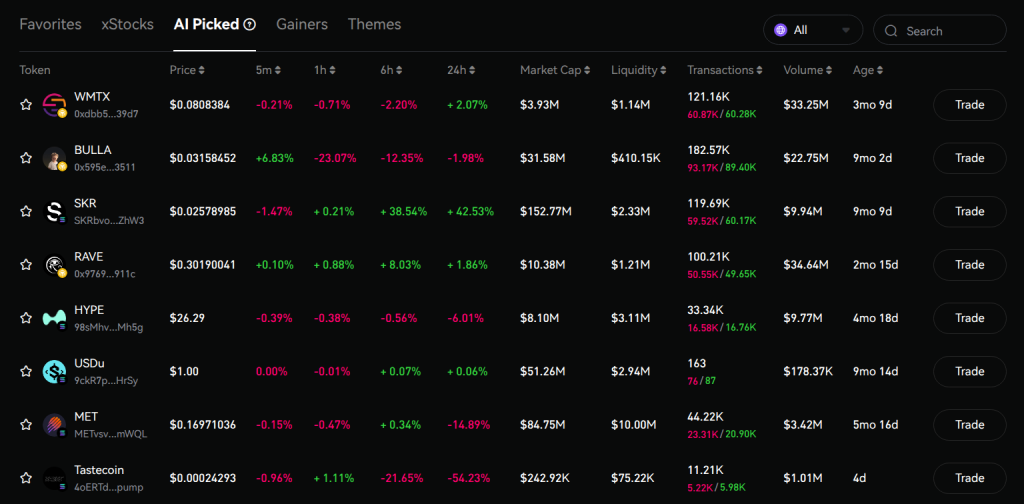
Beyond spot trading, the platform offers derivatives with up to 3x leverage and access to 200+ tokenised stocks through xStocks. This format combines centralised infrastructure with on-chain markets — traders deal in meme coins and volatile assets without setting up wallets or paying gas fees.
Phemex Fees and VIP Program
Base spot fees are industry-standard at 0.1%/0.1% (maker/taker). Futures fees run at 0.01%/0.06%. The Phemex Token (PT) grants a 20% discount on spot trading and a 10% discount on futures trading.
The VIP program includes six levels (VIP1 through Star VIP).


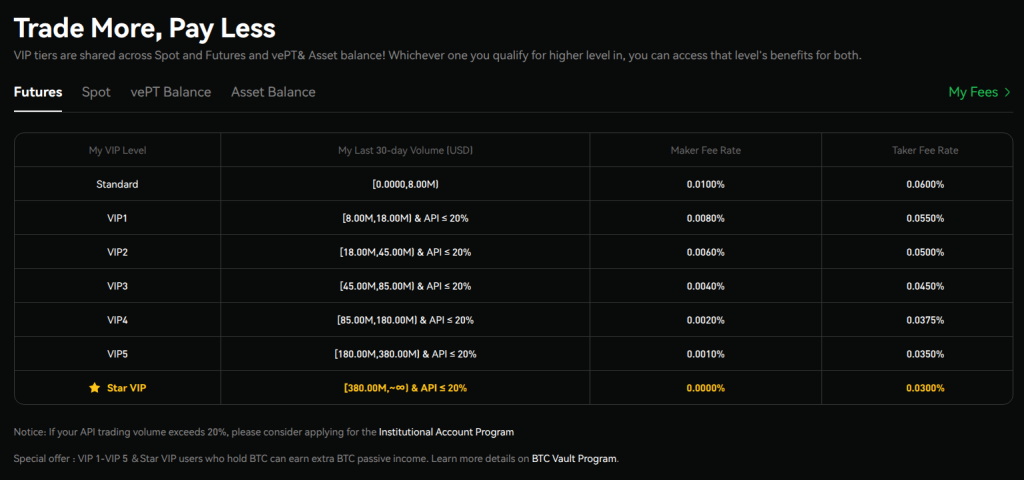
Phemex offers a more transparent and favourable fee structure for high-volume traders. For example, 0% maker fees on futures become available at $380 million monthly volume, while Binance requires $25 billion for comparable terms,” Phemex states.
VIP tiers are recalculated daily based on a 30-day rolling window. Qualification is based on four criteria: vePT balance, total asset balance, 30-day spot volume, or 30-day futures volume.
Phemex also offers a market-maker incentive program that provides up to 0.005% in maker fee rebates.
Crypto deposits and transfers between Phemex users are free. Withdrawals carry network fees (ETH — 0.005 ETH, USDT via TRC-20 — 1 USDT).
Phemex Earn: Flexible Savings, Staking, and BTC Vault
The Phemex Earn platform combines several passive income products. All are accessible within a single account — no external wallets or DeFi protocols required.
Flexible savings operate with no lock-up and daily interest accrual. USDT yields 5% APY on up to 20,000 USDT and 2% above the limit; USDC yields 10% APY on up to 500 USDC and 2% above the limit.
Phemex provides integrated one-click on-chain staking through its On-chain Earn module. Users can access proof-of-stake rewards directly within the exchange without requiring external wallets or manual interaction with DeFi protocols. Supported staking pools, such as ETH, streamline on-chain yield generation inside a centralised trading environment.
BTC Vault is a product for VIP users. Yield is generated from futures taker fees and paid weekly in BTC. No lock-up is required — funds remain available for trading simultaneously. This means a trader earns BTC Vault yield while keeping open positions with the same capital.
Launchpool lets users stake crypto to earn new tokens with hourly payouts. The lock-up period runs from 5 to 14 days.
Trading Bots and Copy Trading
Phemex provides a native automated trading infrastructure that includes six built-in trading bots operating directly within the exchange environment — without subscriptions or external integrations. Users pay only standard trading fees — no subscriptions. Bots run on Phemex’s own servers rather than through third-party services. This removes common risks such as leaked keys, unstable connections, and bugs in external automation tools.
In February 2026, the exchange introduced its AI Trading Bot as part of the broader AI-Native initiative. Unlike rule-based automation, the AI bot uses machine learning to adjust strategy parameters in real time — analysing market conditions, volatility patterns, and order flow data to optimise entry, exit, and position sizing. It runs within the exchange’s risk engine, so there is no round-trip to an external server.
Available strategies:
- Spot Grid and Futures Grid — grid trading for sideways markets. The bot places a grid of buy and sell orders, profiting from each price swing within a set range;
- Spot DCA (Martingale) and Futures DCA — position averaging on price drops. This lowers the average entry price and allows profit-taking on the first bounce;
- Signal Trading — strategy execution via TradingView webhooks;
- Funding Rate Arbitrage — a market-neutral strategy. Extracts yield from funding rate differentials between pairs or markets.
Alongside algorithmic automation, the platform’s copy-trading ecosystem allows users to allocate capital to up to 20 master traders simultaneously.
According to company disclosures, the network includes more than 17,000 traders and over 80,000 copiers. Risk is managed through an isolated sub-account («firewall») structure that segments each copied strategy, ensuring that losses from one trader do not affect other allocations — even when opposing positions are opened on the same asset.
Phemex Security: The $85M Hack and New Protection Standards
On January 23, 2025, Lazarus Group hackers compromised Phemex’s hot wallets. Estimates of losses ranged from $69 million to $85 million.
The exchange immediately suspended withdrawals, published Proof-of-Reserves, and confirmed the integrity of its cold wallets. Withdrawals resumed within days, and all user losses were compensated from the company’s reserves.
Notably, a month later, Bybit suffered a far larger hack — the Lazarus Group stole $1.5 billion in assets.
After the incident, Phemex overhauled its asset storage system. Custodial partner Fireblocks provides storage through MPC (Multi-Party Computation) technology. The private key is split into fragments stored across distributed secure environments. Completing a transaction requires confirmation from multiple independent nodes. An additional layer of protection comes from AWS Nitro Enclaves — isolated compute blocks inaccessible to the operating system and administrators.
The wallet system has three tiers:
- Cold wallets (>70% of assets) — fully offline. Protection: multi-signature and physical confirmation.
- Warm wallets (~22% of assets) — hybrid access mode. Protection: MPC key fragmentation, AWS Nitro Enclaves.
- Hot wallets (<8% of assets) — online access for instant withdrawals. Protection: transaction limits.
Proof-of-Reserves is published monthly and verified using a Merkle tree. Each user can log in to their account, copy their hashed identifier, and independently verify their funds on the blockchain.
According to snapshot data from February 1, 2026, reserve ratios for key assets exceed 100%:
- BTC. Liabilities — 1,468 BTC, reserves — 2,014 BTC (collateral ratio — 137%);
- ETH. Liabilities — 7,231 ETH, reserves — 10,781 ETH (149%);
- USDT/USDC. Liabilities — $170.2 million, reserves — $193.5 million (113.7%);
- SOL. Liabilities — 41,608 SOL, reserves — 61,315 SOL (147%);
- XRP. Liabilities — 7.43 million XRP, reserves — 10.43 million XRP (140%).
Reserves exceeding liabilities create a buffer for extreme market scenarios.
Unlike Binance, which has a SAFU fund, Phemex does not disclose details about a dedicated compensation fund. The exchange states that, in the event of incidents, it compensates losses from its own reserves, as occurred after the January 2025 hack.
Additional measures include: 2FA via Google Authenticator, anti-phishing codes, address whitelisting for withdrawals, a 24-hour freeze on passkey setup, software and hardware authentication, and an AI-based fraud detection system.
Verification on Phemex
To access trading and withdrawals, Phemex users must complete KYC verification. Without it, only educational materials on Phemex Academy are available — trading and crypto withdrawals are restricted.
Identity verification is conducted by Jumio. The process takes 2–5 minutes and involves uploading a photo ID and a selfie check. Accepted documents include a passport, ID card, or driver’s license. Upon verification, the daily withdrawal limit is 2 million USDT.
Verification can be completed via the mobile app or website. The web version offers two methods: scanning a QR code on a smartphone to continue, or completing the process via webcam in the Chrome browser.
Users from Belarus, Russia, and Ukraine face restrictions on fiat operations: fiat deposits and withdrawals through the partner Legend Trading are unavailable.
Phemex offers a specialised institutional program for companies, hedge funds, and professional market makers who require high trading volumes and extended account management. This includes Fireblocks integration, multi-wallet architecture, and dedicated support.
“For rapid market entry, Phemex provides one of the shortest KYB procedures in the industry. When all required documents are fully provided, business verification typically completes within 24 hours,” exchange representatives note.
Bonuses, Education, and the PT Token Ecosystem
Rewards Hub offers up to $15,000 in trading vouchers for completing tasks: passing KYC, making a first deposit of 50 USDT or more, and executing a first trade. Vouchers cannot be withdrawn directly, but trading profits from them can. The referral program provides up to 60% of the trading fees for referred users.
Phemex Academy hosts 450+ articles on crypto, technical analysis, DeFi, and Web3. The exchange supports an educational initiative called Student Foundation and offers a full demo trading mode.
Phemex Token (PT) is a utility token with a fixed maximum supply of 1 billion units. It provides fee discounts, launchpad access, and vePT staking. The token features a deflationary burn mechanism tied to platform revenue.
Advantages and Disadvantages of Phemex
Advantages:
- 0.01% futures maker fee — one of the lowest among major exchanges;
- six types of trading bots at no cost;
- 24/7 TradFi futures on stocks and metals, Ondo Finance tokenised stock integration;
- one-click on-chain staking;
- 300,000 TPS engine with 99.999% uptime;
- “Firewall” for risk isolation in copy trading;
- hybrid CeFi + on-chain model: spot, derivatives, and DeFi staking through one account;
- Proof-of-Reserves with 113–149% collateral ratios on key assets.
Disadvantages:
- 15th–20th by volume — liquidity is several times lower than market leaders;
- above-average futures taker fee (0.06%);
- maximum leverage of 100x — lower than Binance and Bybit (125x) or MEXC (500x).
Phemex’s strategy centres on transforming from a derivatives platform into a multi-asset trading hub that unites crypto, DeFi, and traditional finance. The launch of TradFi futures with round-the-clock access and zero launch fees is a direct challenge to Bitget and other exchanges developing similar products.
The Ondo Finance integration expands access to tokenised assets, and the AI-Native Revolution initiative signals a bet on AI as a foundational element of the exchange’s infrastructure.
For CIS-based traders, the platform holds practical appeal: Russia is the top country by platform traffic, and the product suite covers core needs — from spot and leveraged futures to staking and stock trading via USDT.
FAQ
What is Phemex?
Phemex is a cryptocurrency exchange launched in 2019. The platform offers spot trading (600+ assets), perpetual futures, TradFi contracts on stocks and metals, trading bots, passive income products, and copy trading. According to the company, 10 million traders use the exchange.
Is Phemex safe?
The exchange implements a multi-layered architecture that incorporates Fireblocks’ MPC technology and a three-tier wallet system. It stores over 90% of assets in cold and «warm» wallets to minimise risk while maintaining liquidity.
Each month, the exchange publishes Merkle tree–based Proof-of-Reserves reports, enabling users to independently verify the backing of assets.
What are the fees on Phemex?
Spot fees are 0.1%/0.1% (maker/taker). Futures fees are 0.01%/0.06%. The 0.01% maker fee is the lowest among major exchanges. The PT token provides a 20% discount on spot and 10% on futures. At the highest VIP levels, the maker fee drops to 0%.
What trading bots are available on Phemex?
Phemex offers six bot types for free: Spot Grid, Futures Grid, Spot DCA (Martingale), Futures DCA, Signal Trading, and Funding Rate Arbitrage. Since December 2025, bot vouchers have been available, and the platform has covered losses. Unlike external services, Phemex bots run on the exchange’s infrastructure without the risk of API key leaks.
How do Earn products work on Phemex?
Phemex Earn includes flexible savings (up to 10% APY on USDC), on-chain staking, BTC Vault for VIP users (yield from taker fees, paid in BTC), and Launchpool (staking to earn new tokens).
Is KYC required on Phemex?
Yes, verification is required to access the platform’s core features. It is conducted through Jumio and takes 2–5 minutes.
Can you trade stocks on Phemex?
Since February 2026, Phemex has offered TradFi futures — perpetual contracts on Tesla, Nvidia, Apple, Meta, and Intel stocks, as well as gold and silver. Trading runs 24/7 with USDT settlement and up to 100x leverage. On February 20, 2026, the exchange integrated tokenised stocks from Ondo Finance.
In which countries does Phemex operate?
Phemex is available in most countries worldwide. The platform does not serve citizens or residents of the United States and certain other jurisdictions — the full list of restrictions is specified in Section 1.26 of the Terms of Use.
Does Phemex have fund insurance?
Phemex does not disclose details about a dedicated compensation fund. Unlike Binance (SAFU), there is no separate insurance reserve. The exchange states that it compensates user losses from its own reserves — as it did after the January 2025 hack. The Proof-of-Reserves snapshot from February 1, 2026, shows that reserves for key assets exceed liabilities by 13–49%.